

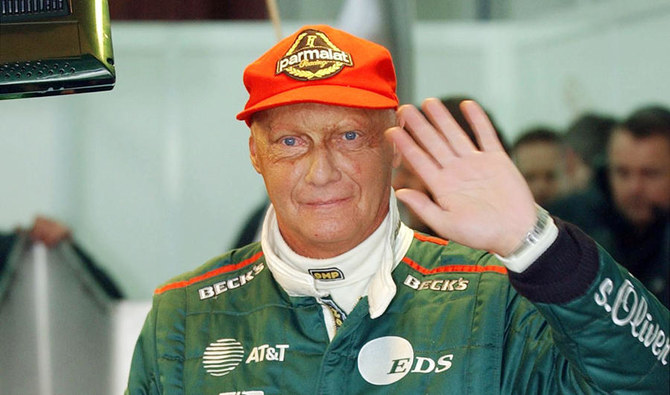
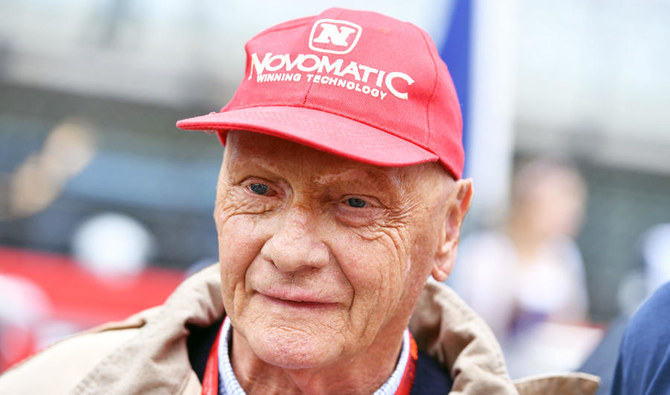

BERLIN: Three-time Formula One world champion Niki Lauda, who won two of his titles after a horrific crash that left him with serious burns and went on to become a prominent figure in the aviation industry, has died. He was 70.
The Austria Press Agency reported that Lauda’s family said in a statement he “passed away peacefully” on Monday. Walter Klepetko, a doctor who performed a lung transplant on Lauda last year, said Tuesday: “Niki Lauda has died. I have to confirm that.”
Lauda won the F1 drivers’ championship in 1975 and 1977 with Ferrari and again in 1984 with McLaren.
In 1976, he was badly burned when he crashed during the German Grand Prix but made an astonishingly fast return to racing just six weeks later.
Lauda remained closely involved with the Formula One circuit after retiring as a driver in 1985, and in recent years served as the non-executive chairman of the Mercedes team.
Born on Feb. 22, 1949 into a wealthy Vienna industrial family, Nikolaus Andreas Lauda was expected to follow his father’s footsteps into the paper-manufacturing industry, but instead concentrated his business talents and determination on his dreams of becoming a racing driver.
Lauda financed his early career with the help of a string of loans, working his way through the ranks of Formula 3 and Formula 2. He made his Formula 1 debut for the March team at the 1971 Austrian Grand Prix and picked up his first points in 1973 with a fifth-place finish for BRM in Belgium.
Lauda joined Ferrari in 1974, winning a Grand Prix for the first time that year in Spain and his first drivers’ title with five victories the following season.
Facing tough competition from McLaren’s James Hunt, he appeared on course to defend his title in 1976 when he crashed at the Nuerburgring during the German Grand Prix. Several drivers stopped to help pull him from the burning car, but the accident would scar him for life. The baseball cap Lauda almost always wore in public became a personal trademark.
“The main damage, I think to myself, was lung damage from inhaling all the flames and fumes while I was sitting in the car for about 50 seconds,” he recalled nearly a decade later. “It was something like 800 degrees.”
Lauda fell into a coma for a time. He said that “for three or four days it was touch and go.”
“Then my lungs recovered and I got my skin grafts done, then basically there was nothing left,” he added. “I was really lucky in a way that I didn’t do any (other) damage to myself. So the real question was then will I be able to drive again, because certainly it was not easy to come back after a race like that.”
Lauda made his comeback just six weeks after the crash, finishing fourth at Monza after overcoming his initial fears.
He recalled “shaking with fear” as he changed into second gear on the first day of practice and thinking, “I can’t drive.”
The next day, Lauda said he “started very slowly trying to get all the feelings back, especially the confidence that I’m capable of driving these cars again.” The result, he said, boosted his confidence and after four or five races “I had basically overcome the problem of having an accident and everything went back to normal.”
He won his second championship in 1977 before switching to Brabham and then retiring in 1979 to concentrate on setting up his airline, Lauda Air, declaring that he “didn’t want to drive around in circles any more.”
Lauda came out of retirement in 1982 after a big-money offer from McLaren, reportedly about $3 million a year.
He finished fifth his first year back and 10th in 1983, but came back to win five races and edge out teammate Alain Prost for his third title in 1984. He retired for good the following year, saying he needed more time to devote to his airline business.
Initially a charter airline, Lauda Air expanded in the 1980s to offer flights to Asia and Australia. In May 1991, a Lauda Air Boeing 767 crashed in Thailand after one of its engine thrust reversers accidentally deployed during a climb, killing all 213 passengers and 10 crew.
Lauda occasionally took the controls of the airline’s jets himself over the years. In 1997, longtime rival Austrian Airlines took a minority stake and in 2000, with the company making losses, he resigned as board chairman after an external audit criticized a lack of internal financial control over business conducted in foreign currency. Austrian Airlines later took full control.
Lauda founded a new airline, Niki, in 2003. Germany’s Air Berlin took a minority stake and later full control of that airline, which Lauda bought back in early 2018 after it fell victim to its parent’s financial woes.
He partnered with budget carrier Ryanair on Niki’s successor, LaudaMotion.
On the Formula One circuit, Lauda later formed a close bond with Mercedes driver Lewis Hamilton, who joined the team in 2013. He often backed Hamilton in public and provided advice and counsel to the British driver.
Lauda also intervened as a Mercedes mediator when Hamilton and his former Mercedes teammate Nico Rosberg feuded, argued and traded barbs as they fought for the title between 2014-16
Lauda twice underwent kidney transplants, receiving an organ donated by his brother in 1997 and, when that stopped functioning well, a kidney donated by his girlfriend in 2005.
In August 2018, he underwent a lung transplant that the Vienna General Hospital said was made necessary by a “serious lung illness.” It didn’t give details.
Lauda is survived by his second wife, Birgit, and their twin children Max and Mia. He had two adult sons, Lukas and Mathias, from his first marriage.


