

Ramadan in Sudan: Iftar with the ‘flavor of revolution’

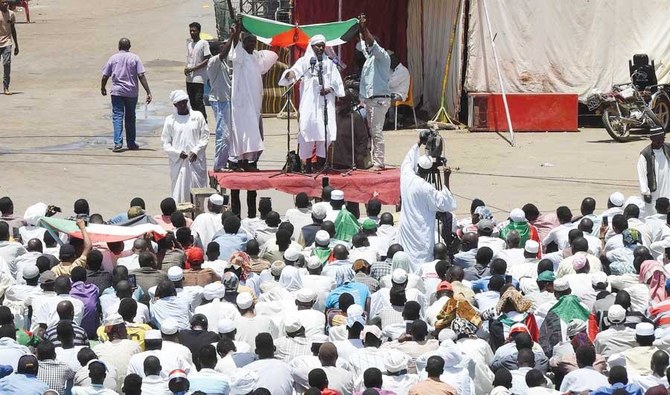
Sudanese protesters attend the Friday prayers near the military headquarters in Khartoum during an ongoing sit-in demanding a civilian-led government transition. (AFP)
Updated 19 May 2019
Follow

Ramadan in Sudan: Iftar with the ‘flavor of revolution’

  • For some this holy month might be the first, without Bashir’s regime, for many years

KHARTOUM: Over the past 30 years, the Sudanese people have lived under the repressive regime of Omar Al-Bashir. But, since the surge of protests that began in the city of Atbara on Dec. 19, in what was to become the start of the Sudanese revolution, citizens hoped that this Ramadan might be the first for many years, and for some, of their entire lives, without the president.

Now, that dream has been realized.
Under Bashir’s rule, poverty stalked the country, but despite the increase in destitution, the values of solidarity and compassion remained strong throughout Sudanese society. Now, as the revolution enters its next phase, those traits endure.
The sit-in in front of the General Command of the Sudanese Armed Forces represents the largest manifestation yet of solidarity and compassion among the general public, who have made this latest protest a symbol of their desire to form a civil government, and turn the country toward the path of democracy and freedom.
Thousands of Sudanese have marched to the rallies, with families arriving hand-in-hand, including their young children in tow, carrying food and drink to prepare for iftar in the courtyard.
The turnout includes hundreds of Sudanese from voluntary organizations providing Ramadan meals to the fasting protesters, and even the soldiers guarding the building, painting a colorful picture of the true spirit of the holy month.
The most prominent charity leader in Sudan, Fares Al-Nour, who was arrested before the overthrow of the Bashir regime, says two centers have been established within the sit-in to supply protesters and soldiers alike for iftar.
Alaa Eddin Sulaiman, an activist, told Arab News that this year’s Ramadan came with the “flavor of the revolution” and that the Sudanese people were expressing joy that the holy month had arrived with Bashir and his regime forced to go.
“We are preparing for a new era, in which the winds of democracy, justice, freedom and supremacy of the law will prevail,” he said.


Turkiye to forge on with tight economic policy, some fine-tuning, VP Yilmaz says

Updated 2 sec ago
Follow

Turkiye to forge on with tight economic policy, some fine-tuning, VP Yilmaz says

ISTANBUL: Turkiye is committed to carrying on its tight economic policies ​in order to cool inflation, and though it may fine-tune the program it will not change course, Vice President Cevdet Yilmaz said in comments embargoed to Friday.
“There is no plan to pause our program,” Yilmaz said at a briefing with reporters in Istanbul on Thursday. “All programs are dynamic, and adjustments can always be made.”
Yilmaz, who plays a key role overseeing economic policy at the presidency, said any such adjustments would aim to support production, investment and ‌exports while moderating consumption.
Turkiye ‌has pursued tight monetary and fiscal policies ‌for more ⁠than ​two years ‌in order to reduce price pressure, leading to high financing and borrowing costs that have weighed on businesses and households. Inflation has eased slowly but steadily over the last year but remains elevated at 31 percent annually.
Last month, Is Bank CEO Hakan Aran warned that focusing solely on one target — inflation — could create side effects, suggesting a “pause and restart” might be healthy once the program achieves certain targets.
Yılmaz said the ⁠government expects improvements in inflation in the first quarter, which should reflect to market expectations for year-end ‌inflation around 23 percent. The government projects inflation to dip ‍as far as 16 percent by year end, ‍within a 13-19 percent range, and falling to 9 percent in 2027. The central ‍bank forecasts inflation between 13-19 percent by end-2026.
Yilmaz noted inflation fell by nearly 45 points despite pressure from elevated food prices, hit by agricultural frost and drought.
The agricultural sector is expected to support growth and help ease price rises this year, which could ​help achieve official inflation targets, he said.
Yilmaz said the government wants to avoid a rapid drop in inflation that could hurt economic ⁠growth, jobs and social stability.
Turkiye’s economic program was established in 2023 after years of unorthodox easy money that aimed to stoke growth but that sent inflation soaring and the lira plunging. The program aims to dislodge high inflation expectations while boosting production and exports, in order to address long-standing current account deficits.
The central bank, having raised interest rates as high as 50 percent in 2024, eased policy through most of last year, bringing the key rate down to 38 percent.
Asked whether lower rates could trigger an exit from the lira currency, Yilmaz said: “What matters is real interest rates. Lowering rates as inflation falls does not affect real rates, so we do ‌not expect such an impact.”
He added that the government will strengthen mechanisms that selectively support companies while improving overall financial conditions.