

Sudan protesters insist on civilian head for new governing body in new talks

1 / 2
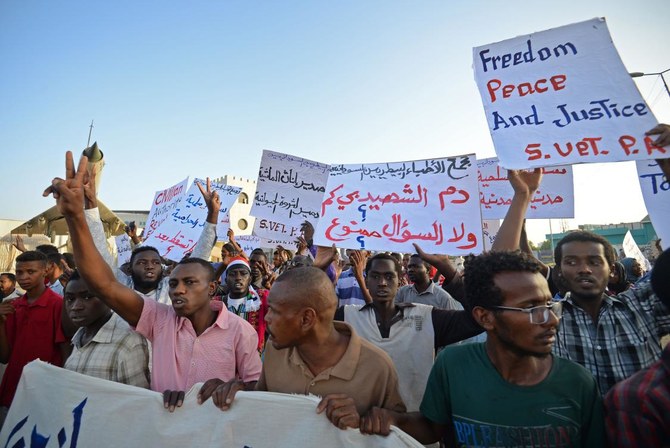
Sudanese protesters chant slogans and wave placards during a demonstration in Khartoum on May 14, 2019. (AFP)
2 / 2
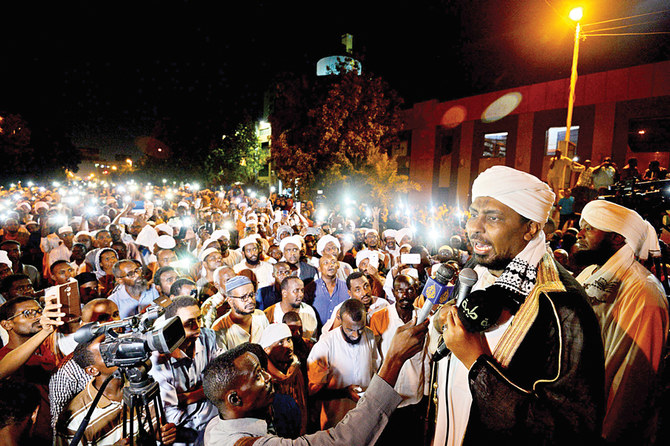
Sudanese cleric Mohamed Ali Jazuli speaks as his supporters rally in front of the Presidential Palace in downtown Khartoum on Saturday. (AFP)
Updated 20 May 2019
Follow

Sudan protesters insist on civilian head for new governing body in new talks

  • Talks over a transfer of power by the generals have repeatedly stalled, resulting in international pressure to return to the table
  • The generals have allowed protesters to hold onto their sit-in outside Khartoum’s army headquarters

KHARTOUM: Sudanese protest leaders said on Sunday they will insist a civilian runs a planned new governing body in new talks with army rulers, as extremists warned against excluding sharia from the political roadmap.

The Alliance for Freedom and Change is determined that the country’s new ruling body be “led by a civilian as its chairman and with a limited military representation,” it said in a statement.

The protesters’ umbrella group said talks would resume with the military council — which has ruled Sudan since President Omar Al-Bashir was deposed on April 11 — at 9 p.m. on Sunday.

Talks over a transfer of power by the generals have repeatedly stalled, resulting in international pressure to return to the table after the military rulers suspended negotiations earlier this week. The generals insist the new body be military-led but the protest leaders demand a majority civilian body.

The deputy head of the military council, Gen. Mohammed Hamdan Dagalo, better known as Hemedti, meanwhile said late Saturday that security forces have arrested those behind an attack on the protesters last week that killed at least five people, including an army officer. Both the military and the protesters had blamed the attack on Bashir loyalists.

“The assailants who opened fire (on protesters) have been caught. Their confessions will be broadcast on TV,” said Dagalo, who heads the paramilitary Rapid Support Forces. He hailed the Forces for the Declaration of Freedom and Change, which represents the protesters, for their role in Bashir’s military overthrow on April 11.

“We want the democracy they are talking about. We want a real democracy, fair and free elections. Whoever the Sudanese choose will rule,” he said.

On Sunday, the protest movement raised the ante by insisting that the ruling body should be headed by a civilian.

The existing military council is headed by Gen. Abdel Fattah Al-Burhan.

In April, Saudi Arabia and the UAE announced 3 billion dollars (€2.7 billion) in financial aid for Sudan. The UAE said on April 28 it was depositing $250 million in Sudan’s central bank.

The Gulf states pledged to inject $500 million into Sudan’s central bank and $2.5 billion to help provide food, medicine and petroleum products, the official Saudi Press Agency (SPA) said last month.

It was Sudan’s worsening economic crisis that triggered nationwide protests against Bashir.

Before talks were suspended between the generals and protest leaders they had agreed on several key issues, including a three-year transition period and the creation of a 300-member parliament, with two thirds of lawmakers to come from the protesters’ umbrella group.

The previous round of talks was marred by violence after five protesters and an army major were shot dead near the ongoing sit-in outside the military headquarters in central Khartoum, where thousands have camped out for weeks.

Initially, the protesters gathered to demand Bashir resign -- but they have stayed put, to pressure the generals into stepping aside.

The protesters had also erected roadblocks on some avenues in Khartoum to put further pressure on the generals during negotiations, but the miliary rulers suspended the last round of talks and demanded the barriers be removed.

Protesters duly took the roadblocks down in recent days -- but they said they will put them back up, if the army fails to transfer power to a civilian administration.

The generals have allowed protesters to maintain their sit-in outside army headquarters.

Islamic movements rallied outside the presidential palace on Saturday night, to reject any civilian administration that excludes sharia as its guiding principle.

Hundreds took part in the rally, the first organised by Islamist groups since Bashir’s ouster.

“The main reason for the mobilisation is that the alliance (the main protesters’ umbrella group) is ignoring the application of sharia in its deal,” said Al-Tayieb Mustafa, who heads a coalition of about 20 Islamic groups.

“This is irresponsible and if that deal is done, it is going to open the door of hell for Sudan,” he told AFP.

Bashir came to power in an Islamist-backed coup in 1989 and Sudanese legislation has since been underpinned by Islamic law.

At Saturday’s rally, hardline cleric Mohamed Ali Jazuli had a warning for the military council.

“If you consider handing over power to a certain faction, then we will consider it a coup”, he vowed as supporters chanted “Allahu Akbar” (God is Greatest).

The protest leaders have so far remained silent on whether sharia has a place in Sudan’s future, arguing that their main concern is installing a civilian administration.


Syrian army pushes into Aleppo district after Kurdish groups reject withdrawal

Updated 6 sec ago
Follow

Syrian army pushes into Aleppo district after Kurdish groups reject withdrawal

  • Two Syrian security officials told Reuters the ceasefire efforts had failed and that the army would seize the neighborhood by force

ALEPPO, Syria: The Syrian army said it would push into the last Kurdish-held district of Aleppo ​city on Friday after Kurdish groups there rejected a government demand for their fighters to withdraw under a ceasefire deal.
The violence in Aleppo has brought into focus one of the main faultlines in Syria as the country tries to rebuild after a devastating war, with Kurdish forces resisting efforts by President Ahmed Al-Sharaa’s Islamist-led government to bring their fighters under centralized authority.
At least nine civilians have been killed and more than 140,000 have fled their homes in Aleppo, where Kurdish forces are trying to cling on to several neighborhoods they have run since the early days of the war, which began in 2011.
ِA ceasefire was announced by the defense ministry overnight, demanding the withdrawal of Kurdish forces to the Kurdish-held northeast. That would effectively end Kurdish control over the pockets of Aleppo that Kurdish forces have held.

CEASEFIRE ‘FAILED,’ SECURITY OFFICIALS SAY
But in a statement, Kurdish councils that run Aleppo’s Sheikh Maksoud and Ashrafiyah districts ‌said calls to leave ‌were “a call to surrender” and that Kurdish forces would instead “defend their neighborhoods,” accusing government forces ‌of intensive ⁠shelling.
Hours ​later, the ‌Syrian army said that the deadline for Kurdish fighters to withdraw had expired, and that it would begin a military operation to clear the last Kurdish-held neighborhood of Sheikh Maksoud.
Two Syrian security officials told Reuters the ceasefire efforts had failed and that the army would seize the neighborhood by force.
The Syrian defense ministry had earlier carried out strikes on parts of Sheikh Maksoud that it said were being used by the Kurdish-led Syrian Democratic Forces (SDF) to launch attacks on the “people of Aleppo.” It said on Friday that SDF strikes had killed three army soldiers.
Kurdish security forces in Aleppo said some of the strikes hit a hospital, calling it a war crime. The defense ministry disputed that, saying the structure was a large arms depot and that it had been destroyed in the resumption of strikes on Friday.
It ⁠posted an aerial video that it said showed the location after the strikes, and said secondary explosions were visible, proving it was a weapons cache.
Reuters could not immediately verify the claim.
The SDF is ‌a powerful Kurdish-led security force that controls northeastern Syria. It says it withdrew its fighters from ‍Aleppo last year, leaving Kurdish neighborhoods in the hands of the Kurdish ‍Asayish police.
Under an agreement with Damascus last March the SDF was due to integrate with the defense ministry by the end of 2025, ‍but there has been little progress.

FRANCE, US SEEK DE-ESCALATION
France’s foreign ministry said it was working with the United States to de-escalate.
A ministry statement said President Emmanuel Macron had urged Sharaa on Thursday “to exercise restraint and reiterated France’s commitment to a united Syria where all segments of Syrian society are represented and protected.”
A Western diplomat told Reuters that mediation efforts were focused on calming the situation and producing a deal that would see Kurdish forces leave Aleppo and provide security guarantees for Kurds who remained.
The diplomat ​said US envoy Tom Barrack was en route to Damascus. A spokesperson for Barrack declined to comment. Washington has been closely involved in efforts to promote integration between the SDF — which has long enjoyed US military support — and Damascus, with which the ⁠United States has developed close ties under President Donald Trump.
The ceasefire declared by the government overnight said Kurdish forces should withdraw by 9 a.m. (0600 GMT) on Friday, but no one withdrew overnight, Syrian security sources said.
Barrack had welcomed what he called a “temporary ceasefire” and said Washington was working intensively to extend it beyond the 9 a.m. deadline. “We are hopeful this weekend will bring a more enduring calm and deeper dialogue,” he wrote on X.

TURKISH WARNING
Turkiye views the SDF as a terrorist organization linked to the outlawed Kurdistan Workers’ Party and has warned of military action if it does not honor the integration agreement.
Turkish Foreign Minister Hakan Fidan, speaking on Thursday, expressed hope that the situation in Aleppo would be normalized “through the withdrawal of SDF elements.”
Though Sharaa, a former Al-Qaeda commander who belongs to the Sunni Muslim majority, has repeatedly vowed to protect minorities, bouts of violence in which government-aligned fighters have killed hundreds of Alawites and Druze have spread alarm in minority communities over the last year.
The Kurdish councils in Aleppo said Damascus could not be trusted “with our security and our neighborhoods,” and that attacks on the areas aimed to bring about displacement.
Sharaa, in a phone call with Iraqi Kurdish leader Masoud Barzani on Friday, affirmed that the Kurds were “a fundamental part ‌of the Syrian national fabric,” the Syrian presidency said.
Neither the government nor the Kurdish forces have announced a toll of casualties among their fighters from the recent clashes.