BAGHDAD: Iraq has contingency plans for any stoppage of Iranian gas imports for its power grid but hopes no such disruption will take place, Oil Minister Thamer Ghadhban said on Thursday.
He also said a meeting of OPEC’s ministerial monitoring committee in Saudi Arabia this weekend would assess member states’ commitment to a deal reducing oil production and that oil prices and markets were now stable.
“It’s still too early to predict what will be decided,” Ghadhban told a news conference when asked whether the Organization of the Petroleum Exporting Countries and its oil-producer allies could extend the output cut or boost supplies.
The gathering on Sunday in Jeddah may issue a recommendation ahead of OPEC’s policymaking meeting with its allies next month in Vienna.
Turkey has asked to buy more Iraqi crude, Ghadhban added, speaking in Baghdad a day after Iraqi Prime Minister Adel Abdul Mahdi traveled to Turkey to meet President Tayyip Erdogan.
The United States is ramping up sanctions pressure on Iraq’s neighbor and ally Iran, especially over oil exports.
“Turkey has asked to increase its crude oil imports from Iraq and we have pledged to consider the Turkish request positively,” Ghadhban said.
Iraq relies heavily on gas from Iran for its electricity supply, which is stretched during hot summer months.
A lack of electricity was one complaint by protesters in demonstrations that descended into violence in Iraq’s oil hub of Basra last year.
Asked how Iraq would react if Iranian gas imports were halted, Ghadhban said: “We hope there will be no halt, but we have taken precautionary measures for such a situation.”
The United States is urging Baghdad to sign energy deals with US companies, including a share for General Electric of a $14 billion power scheme that Washington says would help wean Iraq off Iranian energy.
Ghadhban said international oil companies were operating as normal. He added that oilfields in the south and north of the country were safe and secure amid increased tensions between Washington and Tehran.
The United States evacuated non-essential staff from its diplomatic missions in Iraq over unspecified threats from Iran on Wednesday.
Sources close to foreign oil companies denied reports they were also evacuating employees on Wednesday.
The Kerbala refinery in southern Iraq will start operating in 2022 with a production capacity of 150,000 barrels per day (bpd), Ghadhban said.
Iraq plans to build a refinery with a capacity of 150,000 bpd near the northern city of Mosul to refine heavy crude from the nearby Nejma and Qayyara oilfields, the minister said.
He was speaking on the sidelines of a signing ceremony for a $400 million investment contract with Iraq’s Al-Barham Group Co.
Under the deal, facilities will be built near the Kirkuk refinery to produce 12,000 bpd of high-octane gasoline and 160 tons of liquefied petroleum gas per day.

Iraq has ‘contingency plans’ for its power grid in case Iran gas imports halted
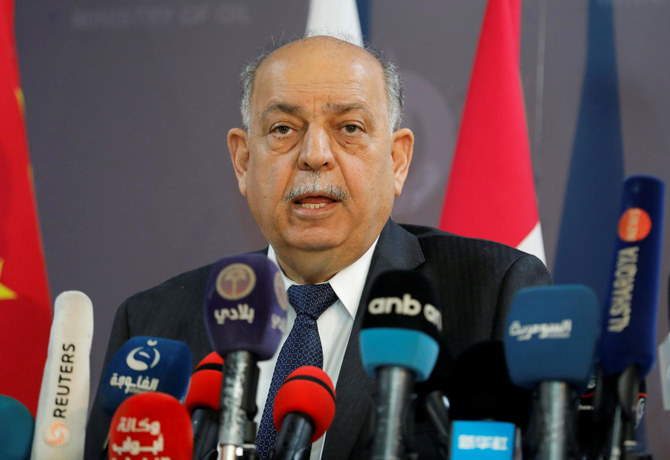
- A lack of electricity was one complaint by protesters in demonstrations that descended into violence in Iraq’s oil hub of Basra last year
Saudi consumer inflation eases to 1.8% in January: GASTAT
RIYADH: Saudi Arabia’s inflation softened to 1.8 percent in January, signaling contained price pressures even as housing rents remained the main driver of consumer costs, official data showed.
According to the General Authority for Statistics, average prices for housing, water, electricity, gas and other fuels rose 4.2 percent in January, reflecting a 5.2 percent increase in actual residential rents.
Saudi Arabia’s inflation trajectory broadly aligns with projections by the International Monetary Fund, which said in October the Kingdom is expected to maintain an annual inflation rate of about 2 percent in 2026.
In its latest report, GASTAT stated: “The Consumer Price Index in Saudi Arabia recorded an annual increase of 1.8 percent in January 2026, compared to the same month of the previous year.”
It added: “This increase was mainly driven by a rise in housing, water, electricity, gas, and other fuel prices by 4.2 percent, transport prices by 1.5 percent and restaurant and accommodation services prices by 1 percent.”
According to the report, expenses for personal care, social protection and miscellaneous goods and services increased 7.9 percent year on year in January, while insurance and financial services costs rose 3.3 percent.
Prices for recreation, sport and culture increased 2.3 percent, driven by a 3.7 percent rise in package holiday expenses. Education service prices rose 1.6 percent, reflecting higher secondary education costs.
Food and beverage prices increased 0.2 percent year on year.
Conversely, prices for furnishings, household equipment and routine household maintenance fell 0.3 percent in January, while healthcare expenses declined 0.1 percent over the same period.
On a month-on-month basis, Saudi Arabia’s CPI rose 0.2 percent in January from December.
Housing, water, electricity, gas and other fuels increased 0.5 percent month on month, again driven by higher residential rents. Transport prices rose 0.2 percent, while restaurant and accommodation services gained 1 percent.
Food and beverage prices fell 0.6 percent during the month, and information and communication costs slipped 0.1 percent. Education, healthcare, furnishings and tobacco prices were largely unchanged.
Wholesale Price Index
In a separate report, GASTAT said Saudi Arabia’s Wholesale Price Index rose 2.9 percent in January compared with the same month in 2025.
The increase was attributed to higher prices for other transportable goods — excluding metal products, machinery and equipment — which climbed 4.9 percent, as well as agricultural and fishery products, which rose 4.2 percent.
Metal products, machinery and equipment prices increased 1.2 percent year on year in January, while food products, beverages, tobacco and textiles rose 0.3 percent. Ores and mineral prices declined 0.1 percent.
Compared with December, the Kingdom’s WPI increased 1.5 percent, driven by a 3.4 percent rise in other transportable goods excluding metal products, machinery and equipment.
On a month-on-month basis, agricultural and fishery product prices increased 0.5 percent, while food products, beverages, tobacco and textiles posted a modest 0.2 percent gain.
Average prices
In another report, GASTAT highlighted notable changes in average prices of goods and services across Saudi Arabia in January.
Local watermelon recorded the largest month-on-month increase at 7.5 percent, followed by local black eggplants at 6.5 percent, local okra at 6.3 percent and Indian pomegranates at 6.1 percent.
Conversely, several items posted sharp price declines.
Abu Sorra Egyptian oranges recorded the steepest fall at 28.2 percent, followed by Pakistani mandarins at 21.3 percent and green beans at 12.3 percent.


