

Thousands of Palestinians demonstrate to mark ‘Nakba’

1 / 5
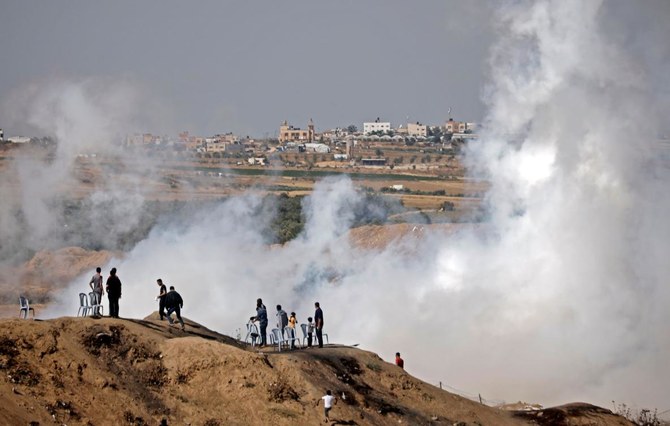
Israeli forces send tear gas on Palestinian men observing clashes along the Israeli fence during clashes with Israeli forces following a protest marking the 71st anniversary of Nakba in El-Burej in the central Gaza Strip on May 15, 2019. (AFP)
2 / 5
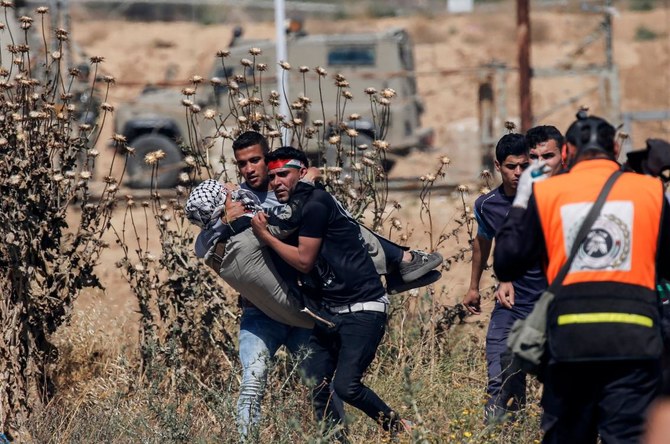
A wounded Palestinian woman is carried away from the border fence during a protest with Israeli forces east of Khan Yunis in the southern Gaza Strip on May 15, 2019, during a protest marking the 71st anniversary of Nakba. (AFP)
3 / 5
Palestinian demonstrators run for cover from tear gas canisters fired by Israeli forces during a protest marking the 71st anniversary of the 'Nakba' near the Israel-Gaza border fence, east of Gaza City May 15, 2019. (Reuters)
4 / 5
A Palestinian man rides a camel during clashes with Israeli forces following a protest marking the 71st anniversary of Nakba in El-Burej in the central Gaza Strip on May 15, 2019. (AFP)
5 / 5
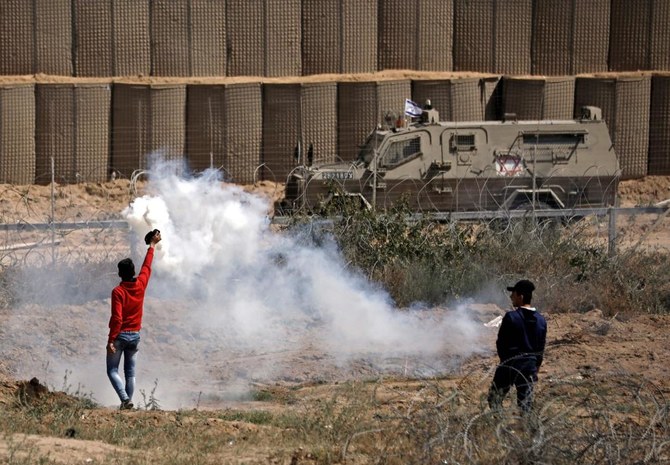
Palestinian protesters throw back Israeli tear gas canisters during clashes with Israeli forces following a protest marking the 71st anniversary of Nakba in El-Burej in the central Gaza Strip on May 15, 2019. (AFP)
Updated 15 May 2019
Follow

Thousands of Palestinians demonstrate to mark ‘Nakba’

  • In the West Bank city of Ramallah, protesters held up giant paper keys to symbolize their will to return to the lands and homes they were expelled from or were forced to abandon, now located inside Israel
  • More than 700,000 Palestinians fled or were expelled from their land during the 1948 war surrounding the creation of Israel

GAZA CITY: Palestinians protested Wednesday for the annual commemoration of what they call the Nakba, or catastrophe, when hundreds of thousands were expelled or fled during the 1948 war surrounding the creation of Israel.
Thousands gathered at various locations along the volatile border fence between Israel and the Gaza Strip, while crowds also demonstrated in the occupied West Bank.
Protests and clashes in Gaza a year earlier, which coincided with the controversial move of the US embassy to Israel to Jerusalem, had seen more than 60 Palestinians killed by Israeli fire but Wednesday’s were far smaller.
The clashes on Wednesday erupted along parts of the border fence, with the health ministry in Hamas-run Gaza reporting 65 people injured, including 16 with gunshot wounds.
Protesters largely avoided approaching the fence, an AFP journalist said.
The AFP journalist on the border saw a number of kites being floated across the border and a fire breaking out inside Israeli territory.

Palestinians in Gaza have regularly used kites with firebombs attached to them to set fires on the Israeli side of the fence.
Israel’s military said around 10,000 “rioters and demonstrators” were along the Gaza fence.
“The rioters are setting tires on fire and hurling rocks,” it said in a statement.
“A number of explosive devices have been hurled within the Gaza Strip as well, and a number of attempts have been made to approach the security fence.”
It said “troops are responding with riot dispersal means.”
In the West Bank city of Ramallah, protesters held up giant paper keys to symbolize their will to return to the lands and homes they were expelled from or were forced to abandon, now located inside Israel.
Palestinians commemorate the Nakba every year.

Opinion

This section contains relevant reference points, placed in (Opinion field)

More than 700,000 Palestinians fled or were expelled from their land during the 1948 war surrounding the creation of Israel.
This year’s protests came two weeks after a deadly flare-up between Gaza militants and Israel which threatened to spill into a new war.
After two days a truce was reached under which Israel is meant to ease its blockade of the strip in exchange for calm, according to Hamas officials. Israel has not commented on the truce.
Bassem Naim, a senior Hamas figure, told AFP at a protest site east of Gaza City the “truce understandings played a role in controlling the demonstrations” on Wednesday.
Separately, there have also been regular protests and clashes along the Gaza border for more than a year.
At least 293 Palestinians have been killed by Israeli fire in Gaza since the protests began in March 2018.
The majority died during the often-violent weekly protests, though others were killed in Israeli air strikes or by tank fire in response to violence from Gaza.
Six Israelis have been killed in Gaza-related violence over the same time period.
Violence peaked on May 14, 2018 when 62 Palestinians were killed by Israeli fire as tens of thousands approached the border, with many seeking to breach the fence.

Fresh clashes kill six in Iran cost-of-living protests

Updated 4 sec ago
Follow

Fresh clashes kill six in Iran cost-of-living protests

  • The protests began on Sunday in Tehran, where shopkeepers went on strike over high prices and economic stagnation
  • Earlier Thursday, state television reported that a member of Iran’s security forces was killed overnight during protests in the western city of Kouhdasht

TEHRAN: Protesters and security forces clashed in several Iranian cities on Thursday, with six reported killed, the first deaths since the cost-of-living demonstrations broke out.
The protests began on Sunday in Tehran, where shopkeepers went on strike over high prices and economic stagnation, and have since spread to other parts of the country.
On Thursday, Iran’s Fars news agency reported two people killed in clashes between security forces and protesters in the city of Lordegan, in the province of Chaharmahal and Bakhtiari, and three in Azna, in neighboring Lorestan province.
“Some protesters began throwing stones at the city’s administrative buildings, including the provincial governor’s office, the mosque, the Martyrs’ Foundation, the town hall and banks,” Fars said of Lordegan, adding that police responded with tear gas.
Fars reported that the buildings were “severely damaged” and that police arrested several people described as “ringleaders.”
In Azna, Fars said “rioters took advantage of a protest gathering... to attack a police commissariat.”
During previous protest movements, state media has labelled demonstrators “rioters.”
Earlier Thursday, state television reported that a member of Iran’s security forces was killed overnight during protests in the western city of Kouhdasht.
“A 21-year-old member of the Basij from the city of Kouhdasht was killed last night by rioters while defending public order,” the channel said, citing Said Pourali, the deputy governor of Lorestan Province.
The Basij are a volunteer paramilitary force linked to Iran’s Revolutionary Guards, the ideological branch of the Islamic republic’s army.
Pourali said that “during the demonstrations in Kouhdasht, 13 police officers and Basij members were injured by stone throwing.”
In the western city of Hamedan, protesters torched a motorbike in what the Tasnim news agency described as an unsuccessful attempt to burn down a mosque.
The same agency reported on Thursday that 30 people in a district of Tehran had been arrested the night before for alleged public order offenses in a “coordinated operation by the security and intelligence services.”

- ‘End up in hell’ -

The demonstrations are smaller than the last major outbreak of unrest in 2022, triggered by the death in custody of Mahsa Amini, who was arrested for allegedly violating Iran’s strict dress code for women.
Her death sparked a nationwide wave of anger that left several hundred people dead, including dozens of members of the security forces.
The latest protests began in the capital and spread after students from at least 10 universities joined in on Tuesday.
Iranian President Masoud Pezeshkian has sought to calm tensions, acknowledging protesters’ “legitimate demands,” and he urged the government Thursday to take action to improve the economic situation.
“From an Islamic perspective... if we do not resolve the issue of people’s livelihoods, we will end up in Hell,” Pezeshkian said at an event broadcast on state television.
Authorities, however, have also promised to take a “firm” stance, and have warned against exploiting the situation to sow chaos.
Local media coverage of the demonstrations has varied, with some outlets focusing on economic difficulties, and others on incidents caused by “troublemakers.”
Iran is in the middle of an extended weekend, with the authorities declaring Wednesday a bank holiday at the last minute, citing the need to save energy during the cold weather.
They made no official link to the protests.
The weekend in Iran begins on Thursday, and Saturday is a long-standing national holiday.
Iran’s prosecutor general said on Wednesday that peaceful economic protests were legitimate, but any attempt to create insecurity would be met with a “decisive response.”
“Any attempt to turn economic protests into a tool of insecurity, destruction of public property, or implementation of externally designed scenarios will inevitably be met with a legal, proportionate and decisive response.”

- Viral video -

Earlier this week, a video showing a person sitting in the middle of a Tehran street facing down motorcycle police went viral on social media, with some seeing it as a “Tiananmen moment” — a reference to the famous image of a Chinese protester defying a column of tanks during 1989 anti-government protests in Beijing.
On Thursday, state television alleged the footage had been staged to “create a symbol” and aired another video purportedly shot from another angle by a police officer’s camera.
Sitting cross-legged, the protester remains impassive, head bowed, before covering his head with his jacket as behind him a crowd flees clouds of tear gas.
On Wednesday evening, Tasnim reported the arrest of seven people it described as being affiliated with “groups hostile to the Islamic Republic based in the United States and Europe.”
It said they had been “tasked with turning the demonstrations into violence.” Tasnim did not say when they were arrested.
The national currency, the rial, has lost more than a third of its value against the US dollar over the past year, while double-digit hyperinflation has been undermining Iranians’ purchasing power for years.
The inflation rate in December was 52 percent year-on-year, according to the Statistical Center of Iran, an official body.