DUBAI: Four oil tankers anchored in the Mideast were damaged by what Gulf officials described as sabotage, though satellite images obtained by The Associated Press on Tuesday showed no major visible damage to the vessels.
Details of the alleged sabotage to two Saudi, one Norwegian and one Emirati oil tanker on Sunday remained unclear, and Gulf officials have declined to say who they suspected was responsible. But it demonstrated the raised risks for shippers in a region vital to global energy supplies as tensions are increasing between the US and Iran over its unraveling nuclear deal with world powers.
The US has warned sailors of the potential for attacks on commercial sea traffic, and regional allies of the United Arab Emirates condemned the sabotage as the tankers were off the coast of the UAE port city of Fujairah.
A US official in Washington, without offering any evidence, told the AP that an American military team’s initial assessment indicated Iran or Iranian allies used explosives to blow holes in the ships. The official, who was not authorized to discuss the investigation, agreed to reveal the findings only if not quoted by name. The US Navy’s 5th Fleet, which patrols the Mideast and operates from a base in Fujairah, has repeatedly declined to comment.
The US already had warned ships that “Iran or its proxies” could be targeting maritime traffic in the region. America is deploying an aircraft carrier and B-52 bombers to the Arabian Gulf to counter alleged, still-unspecified threats from Tehran.

Satellite images show no major damage to ‘sabotaged’ ships
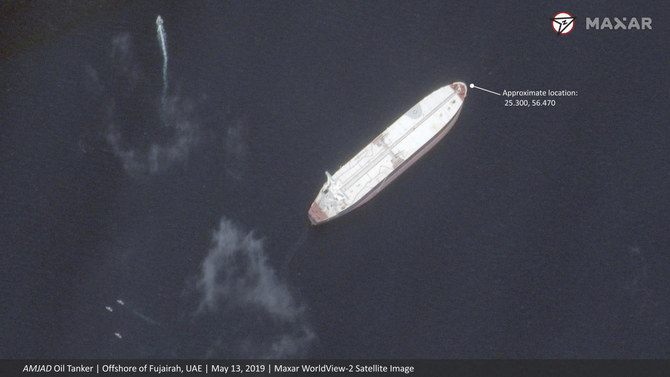
- Satellite images showed no major visible damage to the vessels
- The US has warned sailors of the potential for attacks on commercial sea traffic
Trump taps Tony Blair, US military head for Gaza
- Blair is a controversial choice in the Middle East because of his role in the 2003 invasion of Iraq, and Trump himself said last year that he wanted to make sure he was an “acceptable choice to everybody”
- The plan’s second phase is now underway, though clouded by allegations of aid shortages and violence
WASHINGTON: US President Donald Trump on Friday gave a key role in post-war Gaza to former British prime minister Tony Blair and appointed a US officer to lead a nascent security force.
Trump named members of a board to help supervise Gaza that was dominated by Americans, as he promotes a controversial vision of economic development in a territory that lies in rubble after two-plus years of relentless Israeli bombardment.
The step came after a Palestinian committee of technocrats meant to govern Gaza held its first meeting in Cairo which was attended by Jared Kushner, Trump’s son-in-law who plays a key role on the Middle East.
Trump has already declared himself the chair of a “Board of Peace” and on Friday announced its full membership that will include Blair as well as senior Americans — Kushner, Secretary of State Marco Rubio and Steve Witkoff, Trump’s business partner turned globe-trotting negotiator.
Blair is a controversial figure in the Middle East because of his role in the 2003 invasion of Iraq. Trump himself said last year that he wanted to make sure Blair was an “acceptable choice to everybody.”
Blair spent years focused on the Israeli-Palestinian issue as representative of the “Middle East Quartet” — the United Nations, European Union, United States and Russia — after leaving Downing Street in 2007.
The White House said the Board of Peace will take on issues such as “governance capacity-building, regional relations, reconstruction, investment attraction, large-scale funding and capital mobilization.”
Trump, a real-estate developer, has previously mused about turning devastated Gaza into a Riviera-style area of resorts, although he has backed away from calls to forcibly displace the population.
The other members of the board are World Bank President Ajay Banga, an Indian-born American businessman; billionaire US financier Marc Rowan; and Robert Gabriel, a loyal Trump aide who serves on the National Security Council.
Israel strikes
Israel’s military said Friday it had again hit the Gaza Strip in response to a “blatant violation” of the ceasefire declared in October.
The strikes come despite Washington announcing that the Gaza plan had gone on to a second phrase — from implementing the ceasefire to disarming Hamas, whose October, 2023 attack on Israel prompted the massive Israeli offensive.
Trump on Friday named US Major General Jasper Jeffers to head the International Stabilization Force, which will be tasked with providing security in Gaza and training a new police force to succeed Hamas.
Jeffers, from special operations in US Central Command, in late 2024 was put in charge of monitoring a ceasefire between Lebanon and Israel, which has continued periodic strikes aimed at Hezbollah militants.
The United States has been searching the world for countries to contribute to the force, with Indonesia an early volunteer.
But diplomats expect challenges in seeing countries send troops so long as Hamas does not agree to disarm fully.


