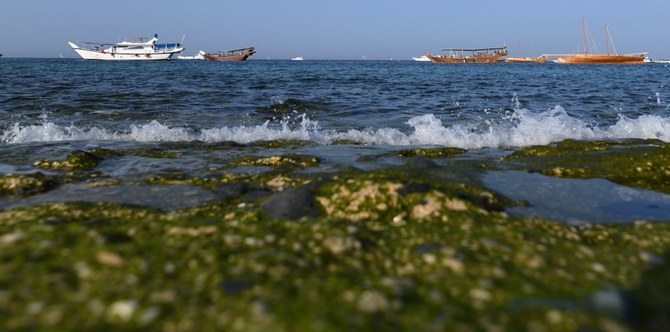

DUBAI: Four commercial vessels were targeted by "acts of sabotage" near the territorial waters of the United Arab Emirates on Sunday morning, the UAE foreign ministry said in a statement amid rising tensions between neighboring Iran and the US.
The statement added the vessels, that were targeted near Fujairah and at a distance of 115 kilometers from Iran, were “civilian trading vessels of various nationalities”, and that the UAE was investigating the incident with local and international bodies.
Rumors about ships inside the port being sabotaged were unfounded, the ministry added.
The port of Fujairah continues to operate as normal and there were no victims of the sabotage incident.
The ministry added that targeting merchant ships and threatening the lives of crew members is a “dangerous development,” and that the government considers the acts of sabotage to be a threat to the safety and security of the UAE.
The country called on the international community to prevent any party from compromising maritime safety and security.
The ministry statement was tweeted by the official news agency WAM.
Lebanon’s pro-Iran satellite channel Al-Mayadeen falsely reported that a series of explosions had struck Fujairah’s port, and the reports were repeated by state media in Iran.
Heshmatollah Falahatpisheh, head of the Iranian Parliament’s national security committee, said the “explosions” showed that the security of Gulf states was “like glass.”
The sabotage incident follows a US Maritime Administration warning last week that Iran could target commercial sea traffic. “Since early May, there is an increased possibility that Iran and/or its regional proxies could take action against US and partner interests, including oil production infrastructure, after recently threatening to close the Strait of Hormuz,” the organization said.
“Iran or its proxies could respond by targeting commercial vessels, including oil tankers, or US military vessels in the Red Sea, Bab El Mandeb or the Arabian Gulf.”
Bahrain condemned the acts of sabotage, saying it was a "criminal act" that threatened maritime traffic in the region. The kingdom said it stood with the UAE.
The US deployed the Abraham Lincoln aircraft carrier strike group and B-52 bombers to the region on May 4 in response to what it said was an “escalated threat” from Iran.
A senior Islamic Revolutionary Guard Corps commander issued a veiled threat on Sunday to the US military presence in the Gulf.
“An aircraft carrier that has at least 40 to 50 planes on it and 6,000 forces gathered within it was a serious threat for us in the past but now it is a target and the threats have switched to opportunities,” said Amirali Hajjizadeh, head of the Guards’ aerospace division. “If they make a move we will hit them in the head.”
Earlier on Sunday, the UAE emirate of Fujairah denied media reports that claimed a series of explosions had rocked its port on Sunday.
Claims from a number of news outlets, which were then shared on social media, said there had been explosions on Sunday morning and that fires had broken out on some of the docked oil tankers in the port.
Fujairah government’s media office tweeted a statement on Sunday denying there had been any explosions and that operations were continuing as normal.
It also called on media organizations to be “accurate” in their reporting and to only publish information once it was “confirmed by official sources.”
The harbor master of Fujairah port, who had been on shift at the time, also confirmed that there was no truth to the reports.