Iranian commander threatens to hit America ‘in the head’ if it makes military move

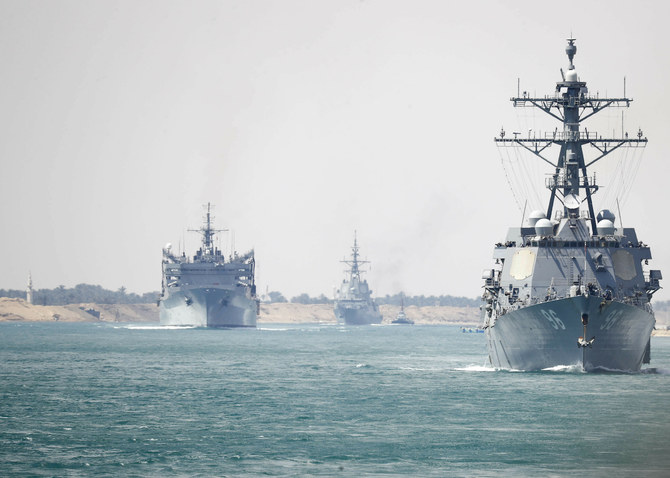
The Abraham Lincoln Carrier Strike Group transits the Suez Canal in Egypt on May 9, 2019. (US Navy/AP)
Updated 16 May 2019
Follow

Iranian commander threatens to hit America ‘in the head’ if it makes military move

  • The US military has sent forces to the Middle East to counter what the Trump administration says are “clear indications” of threats from Iran to US forces there
  • An Israeli cabinet minister warned of possible direct or proxy Iranian attacks on Israel should the stand-off between Tehran and Washington escalate

LONDON: A commander of Iran’s Revolutionary Guard threatened Sunday to hit America “in the head” if it made a military move, the Iranian Students' News Agency (ISNA) reported.

Amirali Hajizadeh, the head of the Guard's aerospace division, also said that America’s military presence in the Gulf used to be a serious threat but now it’s an opportunity. 

"An aircraft carrier that has at least 40 to 50 planes on it and 6000 forces gathered within it was a serious threat for us in the past but now...the threats have switched to opportunities," Hajizadeh said.  

The US military has sent forces, including an aircraft carrier and B-52 bombers, to the Middle East to counter what the Trump administration says are “clear indications” of threats from Iran to US forces there.
The USS Abraham Lincoln is replacing another carrier rotated out of the Gulf last month.

Earlier on Sunday, an Israeli cabinet minister warned of possible direct or proxy Iranian attacks on Israel should the stand-off between Tehran and Washington escalate.
Israeli Prime Minister Benjamin Netanyahu’s government, which supports Trump’s hard tack against its arch-foe, has largely been reticent about the spiralling tensions.
Parting with the silence, Israeli Energy Minister Yuval Steinitz said that, in the Gulf, “things are heating up.”
“If there’s some sort of conflagration between Iran and the United States, between Iran and its neighbors, I’m not ruling out that they will activate Hezbollah and Islamic Jihad from Gaza, or even that they will try to fire missiles from Iran at the State of Israel,” Steinitz, a member of Netanyahu’s security cabinet, told Israel’s Ynet TV.
Hezbollah and Islamic Jihad are Iranian-sponsored guerrilla groups on Israel’s borders, the former active in Syria as well as Lebanon and the latter in the Palestinian territories.
The Israeli military declined to comment when asked if it was making any preparations for possible threats linked to the Iran-US standoff.
Israel has traded blows with Iranian forces in Syria, as well as with Hezbollah in Lebanon and Palestinian militants. But it has not fought an open war with Iran, a country on the other side of the Middle East.

(With Reuters)


Lebanon ex-central bank chief's corruption case being sent to top court, officials say

Updated 10 sec ago
Follow

Lebanon ex-central bank chief's corruption case being sent to top court, officials say

BEIRUT: The corruption case of Lebanon's former central bank governor, who is widely blamed for the country’s economic meltdown, has been transferred to the country's highest court, judicial officials told The Associated Press on Tuesday.
Riad Salameh was released on $14 million bail in September after a year in prison while awaiting trial in Lebanon on corruption charges, including embezzlement and illicit enrichment.
The trial of Salameh, 75, and his two legal associates, Marwan Khoury and Michel Toueini, will now be heard at the Court of Cassation, according to a copy of the notice obtained by the AP. Salameh and the others will be issued with arrest warrants if they don't show up for trial at the court.
No trial date has been set yet. Salameh denies the charges. The court’s final ruling can't be appealed, according to the four officials who spoke on condition of anonymity, because they weren't authorized to speak with the media.
In September 2024, he was charged with the embezzlement of $42 million, with the court later adding charges of illicit enrichment over an apartment rented in France, supposedly to be a substitute office for the central bank if needed. Officials have said that Salameh had rented from his former romantic partner for about $500,000 annually.
He was once celebrated for steering Lebanon’s economic recovery, after a 15-year civil war, upon starting his long tenure in 1993 and keeping the fragile economy afloat during long spells of political gridlock and turmoil.
But in 2023, he left his post after three decades with several European countries investigating allegations of financial crimes. Meanwhile, much of the Lebanese blame his policies for sparking a fiscal crisis in late 2019 where depositors lost their savings, and the value of the local currency collapsed.
On top of the inquiry in Lebanon, he is being investigated by a handful of European countries over various corruption charges. In August 2023, the United States, United Kingdom and Canada imposed sanctions on Salameh.
Salameh has repeatedly denied allegations of corruption, embezzlement and illicit enrichment. He insists that his wealth comes from inherited properties, investments and his previous job as an investment banker at Merrill Lynch.
Lebanon’s current central bank governor, Karim Souaid, announced last week that he's filing legal complaints against a former central bank governor and former banking official who diverted funds from the bank to what he said were four shell companies in the Cayman Islands. He didn't name either individual.
But Souaid said that Lebanon's central bank would become a plaintiff in the country's investigation into Forry Associates. The U.S. Treasury, upon sanctioning Salameh and his associates, described Forry Associates as “a shell company owned by Raja (Salameh’s brother) in the British Virgin Islands” used to divert about $330 million in transactions related to the central bank.
Several European countries, among them France, Germany, and Luxembourg, have been investigating the matter, freezing bank accounts and assets related to Salameh and his associates, with little to no cooperation from the central bank and Lebanese authorities.
Souaid said that he will travel later this month to Paris to exchange “highly sensitive” information as France continues its inquiries.