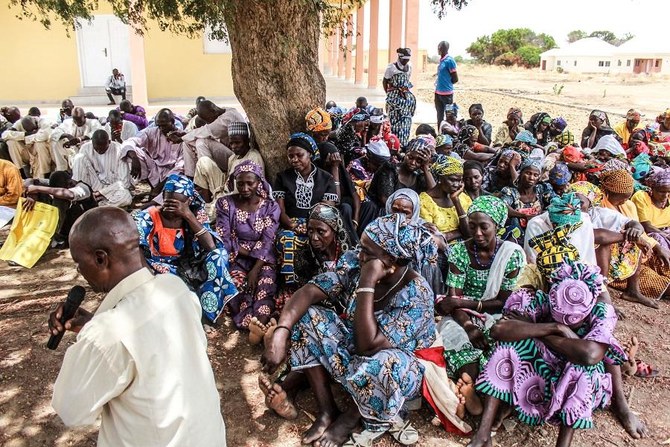
Anti-Boko Haram militia frees 900 children in Nigeria

It was not clear how many children remain in its ranks. (File/AFP)
Updated 10 May 2019
Follow

Anti-Boko Haram militia frees 900 children in Nigeria

  • The 894 children, including 106 girls, had been in the ranks of the government-backed Civilian Joint Task Force, a local militia that supports Boko Haram
  • The children freed on Friday bring the total released since then to 1,727 children, UNICEF said

MAIDURUGI, Nigeria: Nearly 900 children held by a pro-government militia force fighting Boko Haram insurgents in northeastern Nigeria were freed on Friday, the UN said.
The 894 children, including 106 girls, had been in the ranks of the government-backed Civilian Joint Task Force (CJTF), a local militia which supports regular soldiers battling the extremist insurgents.
At a ceremony in the northeastern town of Maiduguri, they were released as part of the CJTF’s “commitment to end and prevent the recruitment and use of children,” the UN children’s agency (UNICEF) said.
“Children of north-east Nigeria have borne the brunt of this conflict,” said UNICEF chief in Nigeria Mohamed Fall.
“They have been used by armed groups in combatant and non-combatant roles and witnessed death, killing and violence.”
The CJTF is a militia formed in 2013 to protect communities from attack, but it has also recruited hundreds of children.
In 2017, the militia signed a promise to stop recruiting child soldiers and release the ones they hold.
The children freed on Friday bring the total released since then to 1,727 children, UNICEF said.
It was not clear how many children remain in its ranks, but the UN welcomed the news on Friday.
“Any commitment for children that is matched with action is a step in the right direction for the protection of children’s rights, and must be recognized and encouraged,” Fall said.
The freed children will be enrolled into a reintegration program with education and training to help them return to civilian life.
Boko Haram’s decade-long uprising to establish a hard-line group in Nigeria’s northeast has spilled into neighboring Niger, Chad and Cameroon.
The militants have also recruited thousands of children to fight in their ranks.
“We will continue until there is no child left in the ranks of all armed groups in Nigeria,” Fall said, noting that children “have been abducted, maimed, raped and killed.”


Military intervention in Iran ‘not the preferred option’: French minister

People cross a street in downtown Tehran, Iran, Sunday, Jan. 25, 2026. (AP)
Updated 6 sec ago
Follow

Military intervention in Iran ‘not the preferred option’: French minister

  • The president’s son blamed foreign interference for the protests’ violent turn, but said “the security and law enforcement forces may have made mistakes that no one intends to defend and that must be addressed”

PARIS: Military intervention in Iran, where authorities launched a deadly crackdown on protesters that killed thousands, is not France’s preferred option, its armed forces minister said on Sunday.

“I think we must support the Iranian people in any way we can,” Alice Rufo said on the political broadcast “Le Grand Jury.”

But “a military intervention is not the preferred option” for France, she said, adding it was “up to the Iranian people to rid themselves of this regime.”

Rufo lamented how hard it was to “document the crimes the Iranian regime has carried out against its population” due to an internet shutdown.

“The fate of the Iranian people belongs to Iranians, and it is not for us to choose their leaders,” said Rufo.

The son of Iran’s president, who is also a government adviser, has called for internet connectivity to be restored, warning that the more than two-week blackout there would exacerbate anti-government sentiment.

Yousef Pezeshkian, whose father, Masoud, was elected president in 2024, said, “Keeping the internet shut will create dissatisfaction and widen the gap between the people and the government.”

“This means those who were not and are not dissatisfied will be added to the list of the dissatisfied,” he wrote in a Telegram post that was later picked up by the IRNA news agency.

Such a risk, he said, was greater than that of a return to protests if connectivity were restored.

The younger Pezeshkian, a media adviser to the presidency, said he did not know when internet access would be restored.

He pointed to concerns about the “release of videos and images related to last week’s ‘protests that turned violent’” as a reason the internet remained cut off, but criticized the logic.

Quoting a Persian proverb, he posted “‘He whose account is clean has nothing to fear from scrutiny.’”

The president’s son blamed foreign interference for the protests’ violent turn, but said “the security and law enforcement forces may have made mistakes that no one intends to defend and that must
be addressed.”

He went on to say that “the release of films is something we will have to face sooner or later. Shutting down the internet won’t solve anything; it will just postpone the issue.”