US tribe says South Dakota governor not welcome on reservation for stand on oil pipeline

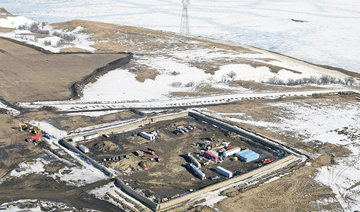
In this Nov. 20, 2016 file photo, law enforcement and protesters clash near the site of the Dakota Access pipeline in Cannon Ball, North Dakota. (Morton County Sheriff's Department via AP, File)
Updated 03 May 2019
Follow

US tribe says South Dakota governor not welcome on reservation for stand on oil pipeline

  • South Dakota’s Gov. Kristi Noem led efforts to pass a state law targeting demonstrations against the Dakota Access oil pipeline
  • Those demonstrations resulted in 761 arrests over six months and cost the state $38 million

WASHINGTON: A Native American tribe has told South Dakota’s Republican Gov. Kristi Noem she’s not welcome on one of largest reservations in the country after she led efforts to pass a state law targeting demonstrations such as those in neighboring North Dakota that plagued the Dakota Access oil pipeline.
“I am hereby notifying you that you are not welcome to visit our homelands,” Oglala Sioux President Julian Bear Runner said in a letter to Noem following a 17-0 Tribal Council vote on Wednesday approving the action. He told Noem that if she ignores the directive “we will have no choice but to banish you” from the the Pine Ridge reservation.
Banishment is a formal tribal process in which a person can be barred permanently from the reservation. Violations can result in fines or even jail time, but Bear Runner spokesman Chase Iron Eyes said the tribe’s goal is to show its unhappiness with Noem and that “no one wants to go through the steps to actually banish a sitting governor.”
“The notion of banishment has not been considered by the Tribal Council,” he said. ““The president just wanted to make the letter as clear as possible as to what the options might be.”
Noem traveled to the reservation in late March after she activated National Guard soldiers to help with the tribe’s flood response — a trip Iron Eyes said was welcomed by the tribe. However, he said she has made at least one and possibly two trips since without notifying the tribal government, presumably to speak with reservation residents about the laws.
A statement issued by Noem’s spokeswoman Thursday said “It’s unfortunate that the governor was welcomed by Oglala Sioux’s leadership when resources were needed during the storms, but communication has been cut off when she has tried to directly interact with members of the Pine Ridge community.
“The governor will continue working to engage with tribal members, stay in contact with tribal leadership, and maintain her efforts to build relationships with the tribes,” spokeswoman Kristin Wileman said.
Legislation that Noem and GOP leaders pushed through in a matter of days in March allows officials to pursue money from demonstrators who engage in “riot boosting,” or encouraging violence during a riot.
Activists and American Indian tribes plan on-the-ground protests against the Keystone XL pipeline if it’s built, similar to protests against the Dakota Access pipeline in North Dakota in 2016 and 2017. Those demonstrations , in which American Indians played a key role, resulted in 761 arrests over six months and cost the state $38 million.
Noem has said the South Dakota law is meant to address problems caused by “out-of-state rioters funded by out-of-state interests.” The American Civil Liberties Union and tribes contend the law stifles free speech, and the ACLU is suing Noem, Attorney General Jason Ravnsborg and a county sheriff in federal court on behalf of activists.
The Oglala Sioux is not a party to the suit but says in a statement, “the Governor has been asked not to set foot upon a swath of land the size of Delaware and Rhode Island combined.”
TransCanada Corp.’s planned Keystone XL pipeline would move Canadian crude through Montana and South Dakota to Nebraska, where it would connect with lines to Gulf Coast refineries. The $8 billion project has the backing of President Donald Trump but is being fought in the courts by opponents.


Japan prepares to restart world’s biggest nuclear plant, 15 years after Fukushima

Updated 7 sec ago
Follow

Japan prepares to restart world’s biggest nuclear plant, 15 years after Fukushima

NIIGATA: Japan took the final step to allow the world’s largest nuclear power plant to ​resume operations with a regional vote on Monday, a watershed moment in the country’s return to nuclear energy nearly 15 years after the Fukushima disaster. Kashiwazaki-Kariwa, located about 220 km (136 miles) northwest of Tokyo, was among 54 reactors shut after the 2011 earthquake and tsunami crippled the Fukushima Daiichi plant in the worst nuclear disaster since Chernobyl.
Since then, Japan has restarted 14 of the 33 that remain operable, as it tries to wean itself off imported fossil fuels. Kashiwazaki-Kariwa will be the first operated by Tokyo Electric Power Co. (TEPCO), which ran the doomed Fukushima plant. On Monday, Niigata prefecture’s assembly passed a vote of confidence on Niigata Governor Hideyo Hanazumi, who backed the restart last month, effectively allowing for the plant to begin operations again.
“This is a milestone, but this is not the end,” Hanazumi told reporters after the vote. “There is no end in terms of ensuring the safety of Niigata residents.”
While lawmakers voted in support of Hanazumi, the assembly session, the ‌last for the year, ‌exposed the community’s divisions over the restart, despite new jobs and potentially lower electricity bills.
“This is nothing ‌other ⁠than ​a political settlement ‌that does not take into account the will of the Niigata residents,” an assembly member opposed to the restart told fellow lawmakers as the vote was about to begin.
Outside, around 300 protesters stood in the cold holding banners reading ‘No Nukes’, ‘We oppose the restart of Kashiwazaki-Kariwa’ and ‘Support Fukushima’. “I am truly angry from the bottom of my heart,” Kenichiro Ishiyama, a 77-year-old protester from Niigata city, told Reuters after the vote. “If something was to happen at the plant, we would be the ones to suffer the consequences.”
TEPCO is considering reactivating the first of seven reactors at the plant on January 20, public broadcaster NHK reported.
Kashiwazaki-Kariwa’s total capacity is 8.2 GW, enough to power a few million homes. The pending restart would bring one 1.36 GW unit online next year and start another one with the same capacity around 2030.
“We remain firmly committed to never ⁠repeating such an accident and ensuring Niigata residents never experience anything similar,” said TEPCO spokesperson Masakatsu Takata. Takata declined to comment on timing. TEPCO shares closed up 2 percent in afternoon trade in Tokyo, higher than the wider ‌Nikkei index, which was up 1.8 percent.

RELUCTANT RESIDENTS WARY OF RESTART
TEPCO earlier this year pledged to ‍inject 100 billion yen ($641 million) into the prefecture over the next ‍10 years as it sought to win the support of Niigata residents.
But a survey published by the prefecture in October found 60 percent of residents did ‍not think conditions for the restart had been met. Nearly 70 percent were worried about TEPCO operating the plant.
Ayako Oga, 52, settled in Niigata after fleeing the area around the Fukushima plant in 2011 with 160,000 other evacuees. Her old home was inside the 20 km irradiated exclusion zone.
The farmer and anti-nuclear activist has joined the Niigata protests.
“We know firsthand the risk of a nuclear accident and cannot dismiss it,” said Oga, adding that she still struggles with post-traumatic stress-like symptoms from what happened at Fukushima.
Even Niigata Governor Hanazumi ​hopes that Japan will eventually be able to reduce its reliance on nuclear power. “I want to see an era where we don’t have to rely on energy sources that cause anxiety,” he said last month.

STRENGTHENING ENERGY SECURITY
The Monday vote was seen as the ⁠final hurdle before TEPCO restarts the first reactor, which alone could boost electricity supply to the Tokyo area by 2 percent, Japan’s trade ministry has estimated. Prime Minister Sanae Takaichi, who took office two months ago, has backed nuclear restarts to strengthen energy security and to counter the cost of imported fossil fuels, which account for 60 percent to 70 percent of Japan’s electricity generation.
Japan spent 10.7 trillion yen ($68 billion) last year on imported liquefied natural gas and coal, a tenth of its total import costs.
Despite its shrinking population, Japan expects energy demand to rise over the coming decade due to a boom in power-hungry AI data centers. To meet those needs, and its decarbonization commitments, it has set a target of doubling the share of nuclear power in its electricity mix to 20 percent by 2040.
Joshua Ngu, vice chairman for Asia Pacific at consultancy Wood Mackenzie, said public acceptance of the restart of Kashiwazaki-Kariwa would represent “a critical milestone” toward reaching those goals. In July, Kansai Electric Power, Japan’s top nuclear power operator, said it would begin conducting surveys for a reactor in western Japan, the first new unit since the Fukushima disaster.
But for Oga, who was in the crowd outside the assembly on Monday chanting ‘Never forget Fukushima’s lessons!’, the nuclear revival is a terrifying reminder of the potential risks. “At the time (2011), I never thought that TEPCO would operate a nuclear power ‌plant again,” she said.
“As a victim of the Fukushima nuclear accident, I wish that no one, whether in Japan or anywhere in the world, ever again suffers the damage of a nuclear accident.”