

May 2 marks eight years since Osama bin Laden was killed at Abbottabad compound

Ongoing construction work on April 26, 2019 near the compound where Osama bin Laden lived for five years in Pakistan until he was killed by US Navy Seals on May 02, 2011. (AN photo)
Updated 02 May 2019
Follow

May 2 marks eight years since Osama bin Laden was killed at Abbottabad compound

  • US Navy Seals found and killed the world’s most wanted militant leader after a ten-year worldwide hunt
  • After the operation was completed, Pakistan demolished the structure on February 26, 2012

ABBOTTABAD: Thursday marked eight years since Al-Qaeda leader Osama bin Laden was killed in a firefight with US forces in Pakistan, ending a nearly 10-year worldwide hunt for the mastermind of the September 11 attacks.


A long street, photographed on April 26, 2018, runs between the compound in which Al Qaeda leader Osama bin Laden lived until May 2, 2011 and the home of neighbour Muhammad Zain. (AN Photo)


The three-story house in a vast compound was located in the garrison town of Abbottabad, just 1,300 meters southwest of the Pakistan Military Academy. Bin Laden was reported to have lived in a section of the house for at least five years, having no Internet or phone connection, and evading capture by completely hiding away from the public.


Cows and other cattle graze on April 26, 2019, inside the compound where Al-Qaeda leader Osama bin Laden lived in Pakistan’s garrison city of Abbottabad for nearly half a decade before being killed in a US Navy Seals' raid on May 2, 2011. (AN photo)

After the September 11 attacks in 2001, the US searched for bin Laden for nearly 10 years, finally finding him by tracking his courier Abu Ahmed Al-Kuwaiti to the compound. During a raid on May 2, 2011, 24 US Navy Seals arrived by helicopter, breached a wall using explosives, and entered the compound in search of the militant leaders.


On April 26, 2019, children play cricket on a cemented pitch in a compound where Al-Qaeda chief Osama bin Laden lived in Abbottabad for five years and was killed by US Navy Seals on May 02, 2011. (AN photo)

After the operation was completed and bin Laden was killed, Pakistan demolished the structure on February 26, 2012, erasing a symbol of humiliation for Pakistan’s military that said the country’s sovereignty had been violated by an assault that unleashed one of the most difficult periods in US-Pakistan ties.


Zain Muhammad [right] sits with Muhammad Aziz on April 26, 2019. Both live in the surroundings of the compound in which Al-Qaeda leader Osama Bin Laden hid for five years in Pakistan until he was killed in a US Navy Seals raid on May 2, 2011. (AN photo)

Residents had complained for months of problems due to security measures since the killing of bin Laden, with many saying it was better to remove the building and let people live their lives.
During the demolition, security forces cordoned off the compound and restricted nearby residents’ movements. Life in the rest of the military town continued as normal, with children playing cricket and flying kites, and couples strolling or shopping.


The remains of the Pakistani home of Al-Qaeda chief Osama bin Laden, the place where he was killed after the biggest manhunt in history, as pictured on April 26, 2019. The Pakistan government demolished the structure in February 2012. (AN photo)

Pakistan closed off NATO supply routes to troops in Afghanistan following the raid. A Pakistani doctor, Shakeel Afridi, who helped the United States verify bin Laden’s location in Abbottabad is in a military prison facing possible treason charges for working for the US Central Intelligence Agency.


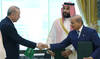
Pakistan president meets UAE counterpart, explores trade, investment opportunities

Updated 5 sec ago
Follow

Pakistan president meets UAE counterpart, explores trade, investment opportunities

  • Asif Ali Zardari is in UAE on four-day visit to strengthen bilateral ties, review bilateral cooperation
  • Both sides discuss regional, international developments, reaffirm commitment to promote peace

ISLAMABAD: President Asif Ali Zardari met his UAE counterpart Sheikh Mohammed bin Zayed Al-Nahyan in Abu Dhabi on Tuesday during which both sides explored new opportunities in trade, investment, energy and other sectors, Zardari's office said. 

Zardari arrived in Abu Dhabi on Monday evening with a high-level delegation on a four-day official visit to the UAE to review trade, economic and security cooperation. 

"The leaders discussed ways to further deepen the longstanding and brotherly relations between Pakistan and the UAE," a statement from Zardari's office said about his meeting with the UAE president. 

"They reviewed the full spectrum of bilateral cooperation and explored new opportunities in trade, investment, energy, infrastructure, technology, and people-to-people exchanges, highlighting the significant potential for expanding economic and strategic partnership.

Zardari highlighted the significance of Al-Nayhan's visit to Pakistan last month, the statement said, expressing appreciation for the UAE's continued support for strengthening bilateral ties.

It said both sides also exchanged views on a range of regional and international developments, reaffirming their commitment to promoting peace, stability and sustainable development.

The meeting was also attended by Pakistan's First Lady Aseefa Bhutto-Zardari, the Pakistani president's son Bilawal Bhutto-Zardari, who is also the chairman of the Pakistan Peoples Party, Interior Minister Mohsin Naqvi and Pakistan's ambassador to the UAE. 

ZARDARI MEETS AD PORTS CEO

Zardari earlier met AD Ports Group CEO Captain Mohamed Juma Al-Shamisi to discuss the group's investment initiatives in Karachi. 

"Both sides agreed that the expansion and modernization of port infrastructure would strengthen trade flows and support Pakistan’s broader economic development and country’s seaborne trade," the President's Secretariat said in a statement.

It added that Zardari described the AD Ports Group's long-term investment and expanding role in Pakistan's maritime and logistics sector as a key pillar of Pakistan–UAE economic cooperation.

Pakistan and the UAE maintain close political and economic relations, with Abu Dhabi playing a pivotal role in supporting Islamabad during periods of financial stress through deposits, oil facilities and investment commitments. 

The UAE is Pakistan's third-largest trading partner, after China and the United States, and a key destination for Pakistani exports, particularly food, textiles and construction services.

The Gulf state is also home to more than 1.5 million Pakistani expatriates, one of the largest overseas Pakistani communities in the world, who contribute billions of dollars annually in remittances, a crucial source of foreign exchange for Pakistan’s economy.

Beyond trade and labor ties, Pakistan and the UAE have steadily expanded defense and security cooperation over the years, including military training, joint exercises and collaboration in counter-terrorism and regional security matters.