

Japan’s Emperor Naruhito takes throne day after his father abdicates

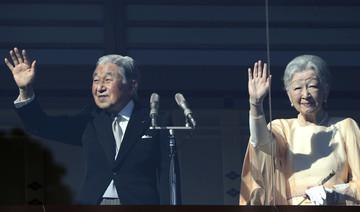
From a car window on his way to palace, Naruhito smiled and waved at the people on the sidewalk who cheered him. (AP)
Updated 01 May 2019
Follow

Japan’s Emperor Naruhito takes throne day after his father abdicates

  • Naruhito has promised to emulate his father in seeking peace and staying close to people

TOKYO: Japan's new Emperor Naruhito will perform his first ritual Wednesday hours after succeeding his father on the Chrysanthemum Throne.
Naruhito will receive the Imperial regalia of sword and jewel as proof of succession at the ceremony and later will make his first address.
His wife, Empress Masako, a Harvard-educated former diplomat, and their daughter Princess Aiko, are barred from the first ceremony, where only adult male royals can participate.
Prime Minister Shinzo Abe's Cabinet earlier Wednesday approved the male-only ritual as an official duty under Japan's Constitution. The sword and jewel succession ceremony has been criticized as being out of step.
Akihito, 85, now holds the title of emperor emeritus after becoming Japan's first emperor to abdicate in 200 years.
Japan is in a festive mood celebrating an imperial succession that occurred by retirement rather than by death. Many people stood outside the palace Tuesday to reminisce about Akihito's era, others joined midnight events when the transition occurred, and more came to celebrate the beginning of Naruhito's reign.
From a car window on his way to palace, Naruhito smiled and waved at the people on the sidewalk who cheered him. He and his family still live at the crown prince's Togu palace until they switch places with his parents.
He is the nation's 126th emperor, according to a palace count historians say could include mythical figures until around the 5th century.
The emperor under Japan's constitution is a symbol without political power. Naruhito is free of influence from Japan's imperial worship that was fanned by the wartime militarist government that had deified the emperor as a living god until his grandfather renounced that status after Japan's 1945 war defeat.
Naruhito has promised to emulate his father in seeking peace and staying close to people. Palace watchers say he might focus on global issues, including disaster prevention, water conservation and climate change, which could appeal to younger Japanese.

He will also face uncertainties in the Imperial household. Only his younger brother, Prince Akishino, 53, and Akishino's 12-year-old son, Prince Hisahito, can currently succeed him. The Imperial House Law confines the succession to male heirs, leaving Naruhito's daughter, Aiko, now 17, out of the running.
Naruhito's wife Masako is a Harvard-educated former diplomat who may prove an adept partner in his overseas travels and activities. But much will depend on her health, since she has been recovering from what the palace describes as stress-induced depression for about 15 years.
Naruhito, the first Japanese emperor to have studied abroad, is considered a new breed of royal, his outlook forged by the tradition-defying choices of his mother, Empress Michiko, and Akihito, who broke with ancient imperial traditions.
Naruhito is also the first monarch raised by his own parents, as Akihito and Michiko, who was born a commoner, chose to take care of their children instead of leaving them in the hands of palace staff. They also supported his choice to attend Oxford University, where he researched the history of the Thames River transportation systems.
In an annual news conference marking his Feb. 23 birthday, Naruhito said he was open to taking up a new role that "suits the times." But he said his father's work will be his guidepost.

Geoeconomic confrontation tops global risks in 2026: WEF report

Updated 20 min 53 sec ago
Follow

Geoeconomic confrontation tops global risks in 2026: WEF report

  • Also armed conflict, extreme climate, public polarization, AI
  • None ‘a foregone conclusion,’ says WEF’s MD Saadia Zahidi

DUBAI: Geoeconomic confrontation has emerged as the top global risk this year, followed by state-based armed conflict, according to a new World Economic Forum report.

The Global Risks Report 2026, released on Wednesday, found that both risks climbed eight places year-on-year, underscoring a sharp deterioration in the global outlook amid increased international competition.

The top five risks are geoeconomic confrontation (18 percent of respondents), state-based armed conflict (14 percent), extreme weather events (8 percent), societal polarization (7 percent) and misinformation and disinformation (7 percent).

The WEF’s Managing Director Saadia Zahidi said the report “offers an early warning system as the age of competition compounds global risks — from geoeconomic confrontation to unchecked technology to rising debt — and changes our collective capacity to address them.

“But none of these risks are a foregone conclusion.”

The report assesses risks across three timeframes: immediate (2026); short-to-medium term (next two years); and long term (next 10 years).

Economic risks show the largest overall increase in the two-year outlook, with both economic downturn and inflation jumping eight positions.

Misinformation and disinformation rank fifth this year but rise to second place in the two-year outlook and fourth over the 10-year horizon.

The report suggests this reflects growing anxiety around the rapid adoption of artificial intelligence, with adverse outcomes linked to AI surging from 30th place in the two-year timeframe to fifth in the 10-year outlook.

Uncertainty dominates the global risk outlook, according to the report.

Surveyed leaders and experts view both the short- and long-term outlook negatively, with 50 percent expecting a turbulent or stormy global environment over the next two years, rising to 57 percent over the next decade.

A further 40 percent and 32 percent, respectively, describe the outlook as unsettled across the two- and 10-year timeframes, while just 1 percent anticipate a calm global outlook in either period.

Environmental risks ease slightly in the short-term rankings. Extreme weather fell from second to fourth place and pollution from sixth to ninth. Meanwhile, critical changes to Earth systems and biodiversity loss dropped seven and five positions, respectively.

However, over the next decade, environmental threats re-emerge as the most severe, with extreme weather, biodiversity loss, and critical changes to Earth systems topping the global risk rankings.

Looking ahead over the next decade, around 75 percent of respondents anticipate a turbulent or stormy environmental outlook, making it the most pessimistic assessment across all risk categories.

Zahidi said that “the challenges highlighted in the report underscore both the scale of the potential perils we face and our shared responsibility to shape what comes next.”

Despite the gloomy outlook, Zahidi signaled a positive shift in global cooperation.

 “It is also clear that new forms of global cooperation are already unfolding even amid competition, and the global economy is demonstrating resilience in the face of uncertainty.”

Now in its 21st year, the Global Risks Report highlights a core message: global risks cannot be managed without cooperation.

As competition intensifies, rebuilding trust and new forms of collaboration will be critical, with the report stressing that today’s decisions will shape future outcomes.

The report was released ahead of WEF’s annual meeting, which will be held in Davos from Jan. 19 to 23.