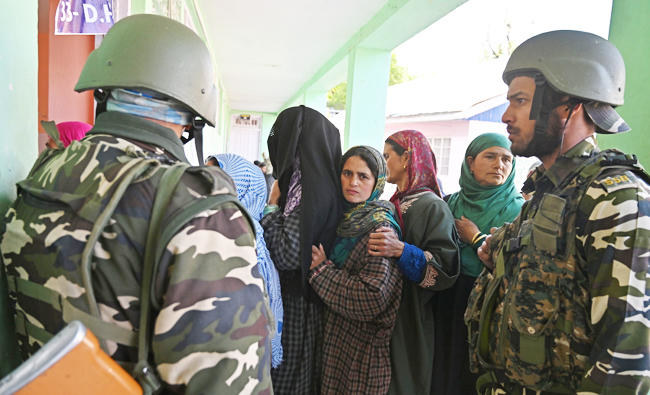
NEW DELHI: The fourth phase of India’s staggered national election Monday was marred by multiple clashes that injured at least seven people and led to security forces firing warning shots outside one polling station.
A junior minister in Prime Minister Narendra Modi’s Hindu nationalist party, Babul Supriyo, said his car was attacked by supporters of a rival party outside a polling station in West Bengal’s Asansol district as they tried to stop him from entering.
In West Bengal’s Dubrajpur area, security forces fired warning shots in the air at a group of voters who turned violent when stopped from carrying mobile phones into polling stations, the Press Trust of India news agency said.
Clashes between rival groups elsewhere in the state injured seven people, the agency reported. They included a woman who was hit by a crude bomb that exploded outside a polling station, police said.
The Election Commission said police filed a case of trespass against Supriyo, the minister, for forcing his way into a polling station without authorities’ permission.
Modi’s Bharatiya Janata Party is facing a major test as it looks to govern for another five years after winning a clear majority in the 2014 election. The party suffered a setback in December when the opposition Congress party wrested power from it in three key state elections — Rajasthan, Madhya Pradesh and Chhattisgarh.
Rajasthan and Madhya Pradesh were among the nine states voting on Monday.
The remaining three phases of the election will be completed by May 19, and vote counting will begin May 23.
Even before Monday, more than half of India’s 543 parliamentary constituencies had already voted in the election, which began April 11. With 900 million of India’s 1.3 billion people registered to vote, the election is the world’s largest democratic exercise.
On Monday, 64% of 128 million eligible voters cast ballots on electronic voting machines, the Election Commission said.
In the first three phases, voter turnout was around 66.4%, the same as in 2014, when Modi’s party came into power. This may not be good news for the BJP, which launched a campaign two years ago seeking to increase voter turnout in the 2019 election.
“The BJP hasn’t been able to enthuse people and overcome the voters’ apathy,” said Nilanjan Mukhopadhyay, a political analyst who has written a biography of Modi.
Modi said in campaign speeches last week that his government was not facing an anti-incumbency bias “as people know that the BJP-led government is working honestly for the development of the country.” He also said all past governments in India had faced such biases in national and state elections.
Under the leadership of political dynasty scion Rahul Gandhi, the Congress party, which had ruled the country for more than half a century after 1947 independence, has struggled to coalesce India’s many opposition parties into a coherent force that could go head-to-head with the BJP.
The opposition says the BJP’s emphasis on Hindu nationalism has aggravated religious tensions and violence against Muslims and other minorities in constitutionally secular India. Hindus comprise 80% of India’s population. There is a large Muslim minority, with smaller minorities of Sikhs, Christians and others.
Surveys show Modi’s BJP is projected to come out first again, though with a smaller mandate.


![]()

Latest round of India’s national election marred by violence
Latest round of India’s national election marred by violence
- The opposition says the BJP’s emphasis on Hindu nationalism has aggravated religious tensions and violence against Muslims and other minorities in constitutionally secular India


Latest updates





© 2026 SAUDI RESEARCH & PUBLISHING COMPANY, All Rights Reserved And subject to Terms of Use Agreement.