ISLAMABAD: United States Special Representative for Afghanistan Zalmay Khalilzad on Tuesday appreciated Pakistan’s pledge to help fast-track the intra-Afghan dialogue as he concluded his two-day visit to the country.
Another high-profile American diplomat, Alice G. Wells, also traveled to Pakistan at the same time. However, her meetings focused on a much broader spectrum of issues between the two countries, though she also discussed the overall regional security situation, “including the joint efforts [by the US and Pakistan] to advance the Afghan peace process.”
In a statement released by the US Embassy on Tuesday, Khalilzad “requested and received support” from Pakistan to help “accelerate intra-Afghan dialogue and negotiations” that is viewed as vital to Washington’s exit strategy from Afghanistan.
The statement also claimed that he convinced Pakistani officials to use their influence to help bring down violence in the war-torn country, adding that the administration in Islamabad also expressed its willingness to take other “concrete steps necessary for a comprehensive settlement” in Afghanistan.
Lauding Prime Minister Imran Khan’s recent remarks in support of the peace process, the US special envoy said that Afghan peace held particular significance for the region since it could facilitate regional economic integration. He also noted that such integration would also advance PM Khan’s vision for a development-centric transformation of his country.
Both US diplomats arrived in Islamabad on Monday and held combined and separate meetings with several senior Pakistani officials, including the military top brass.
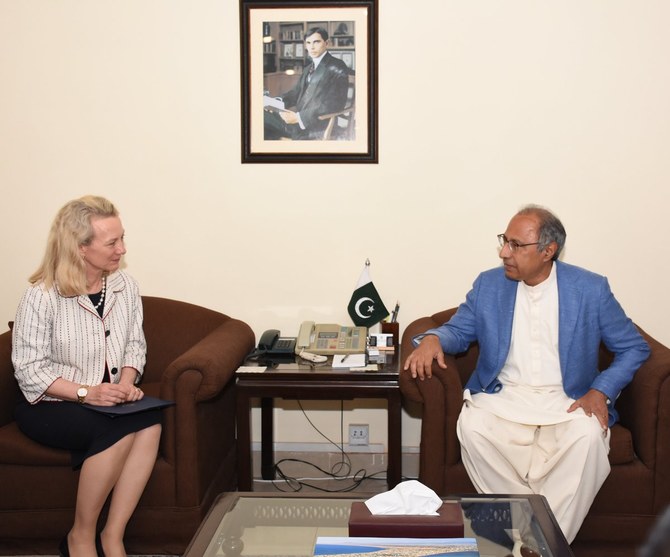
Ambassador Wells met Prime Minister’s Adviser on Finance Abdul Hafeez Shaikh, Foreign Secretary Sohail Mahmood, Additional Secretary Interior Tariq Sardar, and Chairman of the Joint Chiefs of Staff Committee General Zubair Mahmood Hayat.
Her discussions centered on “opportunities to strengthen economic ties between the United States and Pakistan” and sought to identify “areas for growth in bilateral relationship,” the press handout added.
Following a meeting between the two US officials and Pakistan’s interagency delegation, headed by Additional Secretary Americas Aftab Khokhar, on Monday, the foreign office said the talks were a “part of regular consultations on the Afghan peace process, Pakistan-US bilateral relationship and regional security situation.”
The two sides agreed that all Afghan stakeholders as well as regional players had an important role to play in order to bring an end to the prolonged conflict, read the statement.
Pakistan also stressed the need to create a conducive environment in Afghanistan for “early and dignified return of Afghan refugees to their homeland.”
The two sides further reviewed the state of engagement and cooperation between Pakistan and the United States on a range of bilateral issues including political, economic and consular matters, according to the statement.
The US is seeking a safe exit from Afghanistan on the basis of an agreement among all stakeholders to end the 17-year-long Afghan conflict. However, the collapse of a meeting, which was scheduled to take place between representatives of the US, Taliban, and a large group of Afghan politicians in Qatar earlier this month – and the Taliban announcing their annual spring offensive – highlights the fact that political players in Afghanistan are far from reaching a consensus on the matter.
Pakistan’s Foreign Office Spokesman Dr. Muhammad Faisal told Arab News that while the dialogue between the US and the Taliban continues to be in place, the issues will not get resolved “until the US opens a wider dialogue,” citing strategic talks on Afghanistan – which involved the international community – as an example.


![]()
![]()

US Special envoy receives Pakistan’s support to expedite stalled intra-Afghan dialogue

US Special envoy receives Pakistan’s support to expedite stalled intra-Afghan dialogue
- Says dialogue and negotiations is vital to Washington’s withdrawal from Afghanistan
- Both sides discussed opportunities to strengthen economic ties
Latest updates




© 2026 SAUDI RESEARCH & PUBLISHING COMPANY, All Rights Reserved And subject to Terms of Use Agreement.