

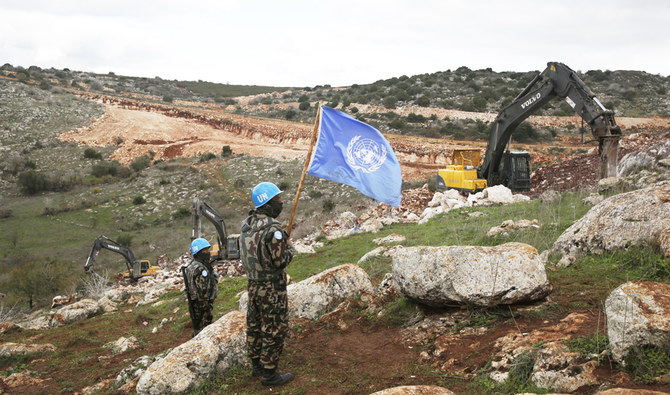
UN force says third tunnel crossed Lebanon-Israel border

The Israeli army said the tunnel from the Lebanese town of Ramyeh — just 800 meters from the border — reached a few dozen meters into Israel. (AP)
Updated 25 April 2019
Follow

UN force says third tunnel crossed Lebanon-Israel border

  • UNIFIL’s independent assessment confirms that this tunnel crosses the blue line, UN says

BEIRUT: A UN peacekeeping force in Lebanon on Thursday said a tunnel discovered earlier this year by Israel had crossed the Lebanese-Israeli border, in the third such breach of a cease-fire resolution.

Israel in January accused Lebanese movement Hezbollah of having dug what it described as the deepest, “longest and most detailed” tunnel it had discovered.

The Israeli army said the tunnel from the Lebanese town of Ramyeh — just 800 meters from the border — reached a few dozen meters into Israel, and descended to 55 meters underground.

UN Interim Force In Lebanon (UNIFIL) on Thursday said the tunnel was the third to have crossed the “blue line,” a demarcation line drawn by the UN to mark Israel’s withdrawal from southern Lebanon in 2000.

“UNIFIL’s independent assessment confirms that this tunnel crosses the blue line in violation of resolution 1701,” which ended the 2006 war between Israel and Hezbollah, it said.

“UNIFIL has informed the Lebanese authorities about the violation and has requested urgent follow-up actions,” the UN force said in a statement.

Lebanon and Israel are still technically at war. Israel is currently building a wall along the 130 km frontier to block Hezbollah attempts to infiltrate.

Since early December, Israel has said it discovered six tunnels, destroying them either with explosives or by filling them with a cement-like material.

Five have been confirmed to exist by UNIFIL.

“Of these, three tunnels have been found to be crossing the blue line,” the peacekeeping force said.

Israel alleges Hezbollah had planned to use the tunnels to kidnap or kill its civilians or soldiers, and to seize Israeli territory in the event of any hostilities.

On Jan. 26, Hezbollah leader Hassan Nasrallah said it had taken Israel “years” to discover some of the tunnels, but did not specify who had constructed them.

Hezbollah is the only side not to have disarmed after Lebanon’s 1975-1990 civil war.

In recent years, Israel has repeatedly carried out airstrikes against what it says are Hezbollah weapons convoys in war-torn Syria next door, where the group is backing regime forces.

The US has designated Hezbollah a “terrorist” group since 1997, while the EU blacklisted its military arm in 2013.

But it also functions as a political party, with posts in the current Cabinet.

The US on Monday offered a $10 million reward for information that would disrupt the group’s finances.


Iran temporarily closes airspace to most flights

Updated 2 min 57 sec ago
Follow

Iran temporarily closes airspace to most flights

WASHINGTON: Iran temporarily closed its airspace to all flights except international ones to and from Iran with official ​permission at 5:15 p.m. ET  on Wednesday, according to a notice posted on the Federal Aviation Administration’s website.

The prohibition is set to last for more than two hours until 7:30 p.m. ET, or 0030 GMT, but could be extended, the notice said. The United States was withdrawing some personnel from bases in the Middle East, a US official said on Wednesday, after a senior Iranian official said ‌Tehran had warned ‌neighbors it would hit American bases if ‌Washington ⁠strikes.

Missile ​and drone ‌barrages in a growing number of conflict zones represent a high risk to airline traffic. India’s largest airline, IndiGo said some of its international flights would be impacted by Iran’s sudden airspace closure. A flight by Russia’s Aeroflot bound for Tehran returned to Moscow after the closure, according to tracking data from Flightradar24.

Earlier on Wednesday, Germany issued a new directive cautioning the ⁠country’s airlines from entering Iranian airspace, shortly after Lufthansa rejigged its flight operations across the Middle ‌East amid escalating tensions in the ‍region.

The United States already prohibits ‍all US commercial flights from overflying Iran and there are no ‍direct flights between the countries. Airline operators like flydubai and Turkish Airlines have canceled multiple flights to Iran in the past week. “Several airlines have already reduced or suspended services, and most carriers are avoiding Iranian airspace,” said Safe Airspace, a ​website run by OPSGROUP, a membership-based organization that shares flight risk information.

“The situation may signal further security or military activity, ⁠including the risk of missile launches or heightened air defense, increasing the risk of misidentification of civil traffic.” Lufthansa said on Wednesday that it would bypass Iranian and Iraqi airspace until further notice while it would only operate day flights to Tel Aviv and Amman from Wednesday until Monday next week so that crew would not have to stay overnight.

Some flights could also be canceled as a result of these actions, it added in a statement. Italian carrier ITA Airways, in which Lufthansa Group is now a major shareholder, said that it would similarly suspend night flights ‌to Tel Aviv until Tuesday next week.