

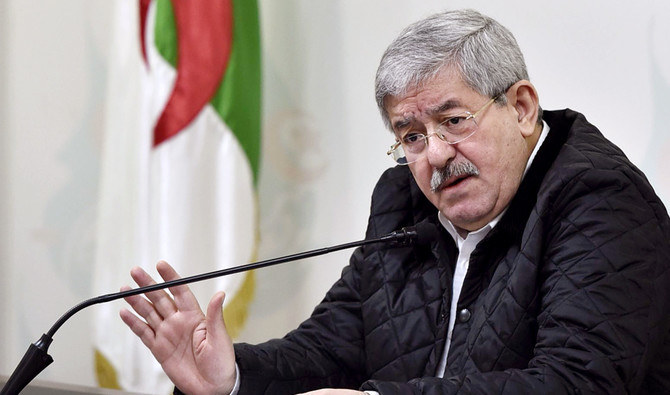
Algeria court summons former PM Ouyahia and former finance minister Louka

An Algerian court has summoned former Prime Minister Ahmed Ouyahia after a probe into wasting of public money. (AFP/File Photo)
Updated 21 April 2019
Follow

Algeria court summons former PM Ouyahia and former finance minister Louka

  • Pair are being investigated over "dissipation of public money"
  • Two were associates of former President Abdelaziz Bouteflika

ALGIERS: An Algerian court summoned former Prime Minister Ahmed Ouyahia and current Finance Minister Mohamed Loukal on Saturday, two associates of former President Abdelaziz Bouteflika, in a probe looking into the wasting of public money.
The pair are being investigated over "dissipation of public money" and "illegal privilege," state TV said.
No more details were immediately available.
The move comes after army chief, Lieutenant General Gaid Salah, said last week he expected to see members of the ruling elite in the major oil and natural gas-producing country prosecuted for corruption.
Bouteflika stepped down after 20 years in power two weeks ago, bowing to pressure from the army and weeks of demonstrations mainly by young people seeking change in the country.
But the protests, which began on Feb. 22 and have been largely peaceful, have continued as many want the removal of an elite that has governed Algeria since independence from France in 1962 and the prosecution of people they see as corrupt.
Ouyahia served several times as prime minister under Bouteflika and is also head of the RND party, the coalition partner of Bouteflika's ruling FLN party.
Loukal was central bank governor under the former president.
Bouteflika has been replaced by Abdelkader Bensalah, head of the upper house of parliament, as interim president for 90 days until a presidential election on July 4.
Hundreds of thousands protested on Friday to demand the resignation of Bensalah and other top officials.
Bensalah appointed Ammar Haiwani as acting central bank governor, state TV earlier said. The position had been vacant since Loukal was made finance minister by Bouteflika before he had resigned.

(With Agencies)


Why Lebanese are enduring another wave of war and displacement

A displaced woman living in a school’s classroom after fleeing Israeli airstrikes in Beirut’s southern suburbs, prepares iftar.
Updated 7 sec ago
Follow

Why Lebanese are enduring another wave of war and displacement

  • More than 1 million displaced as Israeli strikes hit Beirut’s southern suburbs, southern Lebanon and the Bekaa
  • Government opens schools, universities and sports centers to house growing numbers of displaced

BEIRUT: Haitham Al-Mousawi has spent two decades documenting Lebanon’s wars through his camera lens, capturing scenes of destruction, grief and displacement. Yet, he says nothing prepared him for what he witnessed in the past week.

“What I photographed over the past few days is worse than everything I’ve documented in years combined,” the photojournalist told Arab News.

Families fled their homes in panic, often with no time to gather belongings. “People came straight out of their beds onto the streets, still in their pajamas,” he said. “One man was screaming that he had left his father behind because the old man was on an oxygen machine and could not be moved.

“Women ran carrying children in one arm and blankets in the other. Children were crying, chasing after parents who themselves didn’t know where they were fleeing to.”

The pre-dawn hours of Monday turned into a nightmare for many Lebanese as the fragile calm along the border collapsed. Hezbollah fired six Katyusha rockets into Israeli territory — the first such attack since the November 2024 ceasefire. Israel responded with devastating airstrikes that tore into Beirut’s southern suburbs and swept across large parts of southern Lebanon and the Bekaa Valley.

Naim Qassem, Hezbollah’s secretary-general, defended the attack as retaliation for what he described as “15 months of Israeli ceasefire violations” since the November 2024 agreement.

However, for many residents of Beirut’s southern suburbs, the renewed escalation meant another sudden flight from home.

Nora Hamza, 35, did not hesitate when the evacuation warnings spread. She, her husband, their three daughters, both sets of parents, her sister and her sister’s family hurried into two cars with only a few blankets, a loaf of bread and their identity documents before leaving their home.

They drove to the same two small rooms where they had sheltered during the 2024 war. “We crammed ourselves into those two rooms believing the nightmare was behind us,” she told Arab News.

“We had convinced ourselves we were safe, that it would not happen again. It seems we miscalculated — that there are those who want to impose war on us by force.

“Displacement is hard. It is a feeling only those who live it can understand.”

Tens of thousands of the displaced sought refuge with relatives in Beirut or returned to homes in Chouf, the mountain villages, and northern regions that had sheltered them during the previous conflict. But tens of thousands more found themselves with nowhere to go.

Hotels filled within hours. Furnished apartments were snapped up by those who could afford them — particularly families from the southern city of Tyre. Those without options spread blankets on pavements and public squares in central Beirut, along the seafront corniche, braving the bitter cold. Cars, vans, and trucks turned into makeshift shelters, where families waited through the night.

On the first day alone, more than 95,000 Lebanese left their homes. As Israeli evacuation warnings continued to cascade, targeting villages south and north of the Litani River and Beirut’s southern suburbs, the total number of displaced crossed the 1 million mark.

Scenes of people sleeping out in the open along the coastal road and in public spaces in Beirut, relying on makeshift means as displacement rises, prompted Prime Minister Nawaf Salam last Friday to warn of an “imminent humanitarian catastrophe.”

Israel’s evacuation warnings extended to the densely populated Palestinian refugee camps in Beirut’s southern suburbs and on the capital’s outskirts, reviving memories of the uprooting that has marked their lives for decades.

Within hours, the narrow alleys of Burj Al-Barajneh and Shatila camps filled with confusion and fear as Palestinian families rushed to gather what they could and flee, with no clear destination in sight.

Steve Cutts, CEO of UK-based Medical Aid for Palestinians, said that Israel’s military campaign in Lebanon “is the unmistakable extension of the Israeli military playbook used in Gaza” in forms of “collective punishment, forced displacement and the deliberate terrorising of civilian populations, including already traumatised Palestinian communities.”

He urged the international community to pressure Israel to lift the displacement orders and enforce a ceasefire in Lebanon, warning that inaction would have severe humanitarian consequences and allow violations of international law to continue unchecked.

At first glance, it appeared that people had been left to fend for themselves. For its part, the government said that “overcrowding was complicating relief efforts.”

Haneen Sayed, Lebanon’s social affairs minister, said that the government had made all public schools and universities across various regions available as shelters.

“After Beirut and Mount Lebanon became overwhelmed by displaced people, we urged families seeking shelter to head to the North, Akkar and parts of the Bekaa, where there is still greater capacity,” she told Arab News.

Sayed added that additional centers were being prepared in Beirut’s administrative area, including the Camille Chamoun Sports City Stadium, the Charles Helou bus terminal and the Olympic swimming pool in Dbayeh.

She estimated that the state may have to handle about 500,000 displaced people. So far, she said, Lebanese authorities have been able to meet the needs of about 70 percent of the displaced.

“Work is ongoing to secure shelter and basic services and, if possible, reach everyone. State institutions are on high alert, and we need national solidarity. We are facing daunting challenges,” she said.

Human Rights Watch described the forced displacement as a “war crime” and warned that the risks are increasing. It urged governments worldwide to condemn the actions publicly and press Israel to halt its military’s implementation of the forced-displacement order in Beirut’s southern suburbs.

Volker Turk, the UN high commissioner for human rights, said Israel’s large-scale evacuation orders in southern Lebanon and Beirut’s southern suburbs “raise serious concerns under international law, and in particular when it comes to issues around forced transfer.

“These blanket, massive displacement orders, we are talking here about hundreds and thousands of people,” he said.

Imran Riza, the UN humanitarian coordinator in Lebanon, said, the situation in Lebanon was “unprecedented,” both in terms of the scale of warnings and evacuation orders and the panic they triggered across the country.

Israeli warnings also extended to hospitals in Beirut’s southern suburbs. The Lebanese Red Cross said its teams evacuated patients from Bahman Hospital, Al-Rasoul Al-Aazam Hospital and Al-Sahel Teaching Hospital.

Melhem Khalaf, an independent MP, said the danger of the ongoing displacement is that “it is systematic.”

He told Arab News: “It started from the frontline border villages before turning into a mass displacement from deep within the south, reaching the southern suburbs of Beirut and the Bekaa region.”

While the number of displaced people is large, he criticized the state’s response as “weak.”

Khalaf said that “disasters are unfolding with no single authority to address them,” adding: “Reaching all displaced persons is not possible, and leaving matters to governors who lack the necessary capabilities only worsens the situation, while all international institutions remain entirely absent.”

Marie Daou, a lawyer who represents Farah Al-Ataa association, spoke of the state’s lack of organizational capabilities.

“No one knows who is in charge of the shelters, and there is no hotline directing people to gathering points before spreading out in shelters,” she said.

Reports say Farah Al-Ataa has taken in 943 displaced persons at its center in Karantina, Beirut.

“Is it enough to open shelters without providing hot water services for example?” asked Marc Tarabay, Farah Al-Ataa’s president.

He described the situation as a national humanitarian disaster, with no plan in place to address it.

“In Lebanon, there is tremendous volunteer engagement, yet the state fails to benefit from it,” he said.

Al-Mousawi, the photojournalist, was struck by the anger among many displaced residents toward those they hold responsible for forcing them from their homes.

“Some refuse to have their photographs taken, vowing revenge on those who pushed them into the streets,” he said.

“They are angry at the state, and at the same time they cannot justify what Hezbollah has done. People have had enough.”

Unlike previous rounds of conflict, the overall mood among the displaced does not reflect support for Hezbollah. Many say they are shocked by the state’s inability to assist them, with frustration and exhaustion increasingly shaping the public mood.

Local communities are receiving the displaced people with caution. Any displaced person must now fill out a form at the municipality with personal details and details about their families in order to have their request to rent an apartment approved or rejected.

Claudine, 55, says people fear that the displaced may be affiliated with Hezbollah and are being pursued by Israel.

“What good would it do me if my apartment were destroyed because of them?” she told Arab News, speaking at the Furn Al-Shubbak neighborhood.

Beirut has witnessed several incidents in which verbal disputes between displaced residents and host communities escalated into larger confrontations.

One such incident occurred in the Hamra district, where an argument between two displaced young men and local youths quickly escalated, with the displaced men opening fire.

A patrol from the Lebanese Army’s intelligence directorate arrived at the scene and arrested the two men as part of efforts to curb the spread of weapons among some displaced people.

Two days earlier, Salam warned in a statement against attacking or exploiting displaced persons “as they are victims of policies they did not create.”

Salam described the latest events as “a difficult moment our country is going through.”
