

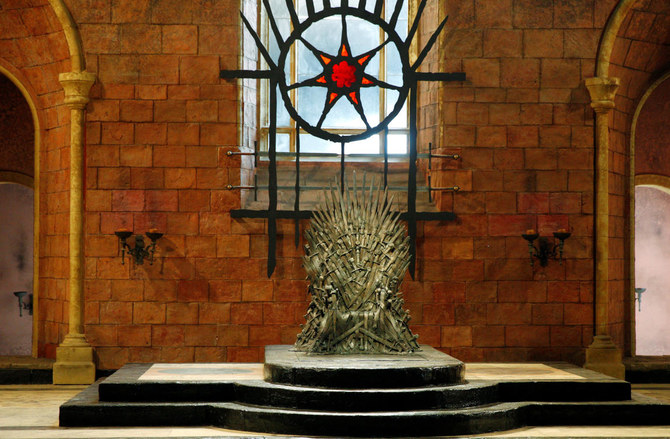
Tourists follow ‘Game of Thrones’ trail in Northern Ireland

The Iron Throne is seen on the set of the television series Game of Thrones in the Titanic Quarter of Belfast, Northern Ireland. (File/Reuters)
Updated 20 April 2019
Follow

Tourists follow ‘Game of Thrones’ trail in Northern Ireland

  • Since the series began in 2011, fans have started to flock to the coastal caves and ruined castles of the British province where much of the show was shot
  • Tourism Northern Ireland estimates the magical show drew 120,000 visitors to the province in 2016

BELFAST: Wielding a replica broadsword, Indian tourist Akshay Mannur duels with friends — re-enacting scenes from “Game of Thrones” on the Northern Ireland pilgrimage trail for devotees of the blockbuster fantasy TV show.
Since the blood and guts series began its rise to prominence in 2011, fans have started to flock to the coastal caves and ruined castles of the British province where much of the HBO television production was shot.
“Every new step is like something new, it’s more than my expectations,” 23-year-old student Mannur marvelled.
“It’s a beautiful country — Northern Ireland is just amazing.”

Tourism Northern Ireland estimates the magical show — in its final season — drew 120,000 visitors to the province in 2016, generating £30 million (35 million euros, $39 million).
One in six visitors now comes to Northern Ireland to visit shooting locations, according to their estimates.
Along the largely coastal trail, a short drive outside the capital of Belfast, that popularity is clear to see.
A steady hum of buses and coaches are marshalled in and out of parking lots on strict schedules, and sleepy village shops throng with tourists.
“The last week, I think on Saturday past, we had a bus with 24 nationalities on it,” said tour guide Patrick Rogan at the mouth of the Cushendun Caves, the site of a pivotal plot point in the series.
“We had people from Patagonia, from New Zealand, from Japan, from Russia, from South Korea and Europe, so I think that tells its own story.”
Since 2012 his employer — the “Stones and Thrones” tour — has offered daily outings out of Belfast, manned mainly by guides who have acted as extras on the show.
Today they run at least two full buses a day, he said, competing with at least four other companies offering a similar service.
Other more bespoke tour services offer immersive experiences — axe-throwing, archery, and photo opportunities with a pair of wolves that starred in the epic series.

A popular comparison holds that “Game of Thrones” is to Northern Ireland tourism what “Lord of the Rings” has been to New Zealand.
But Northern Ireland’s very recent bloody past during the so-called ‘Troubles’ — when 3,500 were killed in 30 years of sectarian strife — makes the boom particularly welcome.
“The dark history that was here is coming out,” said Irish actor Liam Cunningham, a stalwart character in the series now feted as the most expensive to ever be filmed for the small screen.
“The place is blooming, and for us to have this show here and be part of that transition is joyful.”

Cunningham was speaking at the opening of a touring exhibition of costume and scenery pieces in Belfast, the same week as the new season of the series premiered.
Ranked displays of dragon skulls, intricately crafted weapons and interactive exhibits are preceded by a gallery of landscape prints, depicting the countryside shooting locations.
A caption on one image reads “Views to die horribly for,” whilst another reads “Sun, sea and savagery,” referring to the show’s reputation for bloodily killing off major characters.
They are testament to the canny local tourist board, making efforts to cement the link between their territory and the series.
“I think our association with such a global success helps to transform the image of Northern Ireland across the globe,” said John McGrillen, chief executive of Tourism Northern Ireland.
“In many ways that gives you PR that you just simply couldn’t buy.”
With the final season of “Game of Thrones” under way, the fever pitch devotion to the series may be about to end.
But with spin-off projects in the pipeline and a studio tour development due to open in Northern Ireland next year, the province still hopes for tourism revenues.
“We think this still has longevity,” said McGrillen.


Russian cyclist finds warm welcome on Saudi Arabia’s roads 

Updated 20 January 2026
Follow

Russian cyclist finds warm welcome on Saudi Arabia’s roads 

  • Anna Rodnishcheva’s ride through Kingdom is defining chapter in solo expedition
  • Rodnishcheva cycled to Aqaba, crossed the border into Saudi Arabia, and has since traveled through Tabuk, AlUla, Madinah, Jeddah, and Taif on her way to Riyadh

MAKKAH: Solo adventurer Anna Rodnishcheva, 27, has undertaken an ambitious journey that spans countries, climates and cultures — on a bicycle. 

Born and raised in Moscow and trained as a biologist before becoming an event photographer, she now finds herself pedaling thousands of kilometers across unfamiliar landscapes in pursuit of discovery, connection, and the simple joy of movement.

In her conversation with Arab News, Rodnishcheva offered a detailed account of her ongoing route in Saudi Arabia, describing how the expedition is her third major cycling adventure.

After previously riding from Moscow to Sochi and later from Vladivostok to Sochi — a route that stretches across the entirety of Russia — she felt compelled to explore foreign lands by bicycle.

She set off from Moscow heading south last June, passing through Russia, Georgia, and Turkiye before flying from Antalya to Amman. She cycled to Aqaba, crossed the border into Saudi Arabia, and has since traveled through Tabuk, AlUla, Madinah, Jeddah, and Taif on her way to Riyadh.

Rodnishcheva explained that physical preparation played only a small role in her planning. She began slowly and allowed her body to adapt naturally over the first month. 

The true challenge, she said, was in the mental and financial preparation. She spent a year and a half planning the journey, even though she originally intended to postpone it for several more years. 

Ultimately, her belief that “life is short” convinced her to start with the resources she already had. Although she sought medical evaluations and additional vaccinations, she was unable to complete them all and decided to continue regardless.

Her journey through Georgia and Turkiye presented unexpected difficulties. Simple tasks such as finding groceries or locating bicycle repair shops became more challenging outside of Russia, where she knew how to navigate on a budget. 

She also encountered language barriers, though the situation improved when a local cyclist joined her in Georgia. The intense midsummer heat added another layer of difficulty, but she had prepared herself for such conditions.

One of the most striking moments of her trip occurred as she crossed from Jordan into Saudi Arabia. She described the experience as surreal and emotionally overwhelming, likening it to the adventures of a literary hero traveling across the Arabian Peninsula. 

Her anxiety eased unexpectedly when she got a flat tire at the border, bringing her back to the present. 

Despite being warned that crossing by bicycle would be prohibited, the process went smoothly, and she was struck by the friendliness of both Jordanian and Saudi officials. She expressed particular surprise at meeting a female Saudi passport officer, an encounter that challenged her previous assumptions about women’s roles in the Kingdom.

Rodnishcheva said the hospitality she had experienced in Saudi Arabia surpassed anything she had encountered on previous journeys. Drivers frequently stop to offer her water, fruit, or sweets, and several families have generously hosted her in their homes or guest flats. 

She emphasized that she feels completely safe traveling across the Kingdom, especially on the open roads between cities, noting the strong and visible security presence.

She has also observed significant differences in weather. While the stretch from the border to Jeddah was hot despite being winter, the climate changed dramatically after climbing Al-Hada in Taif, turning cooler and windier — a climate she compared to Russian summers.

Rodnishcheva documents her travels primarily through Russian-language platforms such as VK and Telegram. Although she maintains YouTube and Instagram accounts, she explained that her schedule left little time for frequent updates.

Offering a message to women around the world who dream of embarking on similar adventures, she said such journeys were “not as scary as they seem before you start,” though they may not suit everyone.

Her closing advice? “Listen to your heart.”