

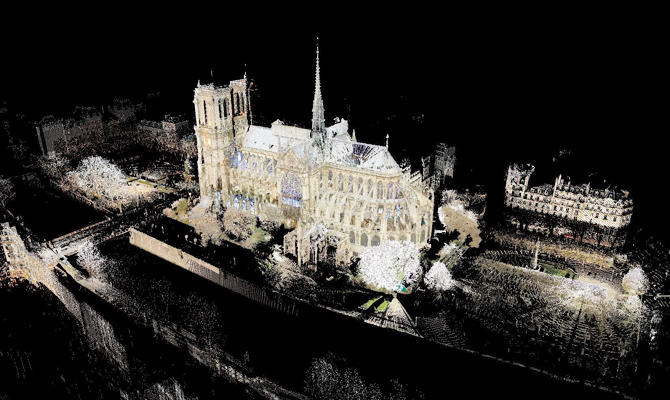
On American hard drives, the most accurate 3-D model of Notre-Dame

1 / 2
Photo obtained April 16, 2019 courtesy of Vassar College in Poughkeepsie, New York shows art historian Andrew Tallon's laser scan of Notre-Dame de Paris. (AFP)
2 / 2
Photo obtained April 16, 2019 courtesy of Vassar College in Poughkeepsie, New York shows art historian Andrew Tallon's longitudinal section laser scan of Notre-Dame de Paris. (AFP)
Updated 17 April 2019
Follow

On American hard drives, the most accurate 3-D model of Notre-Dame

  • The final computer-generated images reconstruct the cathedral down to the smallest detail, including its tiny defects, with a precision of about five millimeters (0.1 inches)

WASHINGTON: At Vassar College in the United States, a university team gathered the week before the devastating fire at Notre-Dame cathedral in Paris to plan an ambitious project: inventorying about a terabyte of 3-D modeling data of the famed Gothic masterpiece.
The precious data — the most accurate in the world — is the work of Andrew Tallon, a Francophile American art professor who loved medieval architecture and was passionate about Gothic cathedral. He died in November.
His technique was nothing new, but his application of the tools was innovative. In 2011 and 2012, funded by a foundation, Tallon used a laser device to accurately measure the interior and exterior of the cathedral, which was ravaged by flames this week.
He placed the device in about 50 places to measure the distance between each wall and pillar, recess, statue or other form — and to record all the imperfections intrinsic to any centuries-old monument.
The result is over a billion points in the “point cloud.” The final computer-generated images reconstruct the cathedral down to the smallest detail, including its tiny defects, with a precision of about five millimeters (0.1 inches).
These images, for example, confirmed how the west side of the cathedral was a “total mess... a train wreck,” Tallon told National Geographic in 2015, pointing to the misalignment of the interior columns.
He wanted to get “into the mind of the builders,” said his former student Lindsay Cook, a Francophile like Tallon who is now a visiting assistant professor of art at Vassar.
“He was interested in using laserscan data to find moments like small ruptures in the construction, places where things were not exactly straight or in plumb, where you could see the hand of an individual architect at work, and in that case the hand of individual masons,” Cook told AFP.

From these measurements were born the images published in a book in 2013 and shown in an exhibition at Notre-Dame in 2014. But the bulk of the data remains untapped in the form of 1s and 0s on some hard drives.
Notre-Dame can probably be reconstructed without this data, but laser modeling brings precision to the photographs and drawings held by architects in France.
This is particularly useful for elements such as roofing and the spire, which were more difficult to measure physically. The 19th-century spire collapsed in the fire, and the roof is largely devastated.
The modeling will help restorers to identically recreate the part of the vault that has collapsed inside.
“If eventually the authorities wish to use this, then of course it would be shared with them,” said Cook.
The data is currently on external hard drives at Vassar, with copies at Columbia University, where academics collaborated with Tallon as part of the “Mapping Gothic” project.
If architects ask for the data, it would have to be delivered in person, as it is too large to be transmitted over the Internet.
If Tallon’s “scholarly work can somehow inform those who will be taking on the daunting task of restoring a cathedral to its former glory, it will be a fitting memorial for a very wonderful scholar who devoted so much to Notre-Dame,” said Vassar dean Jon Chenette.
On other hard drives, historians will also find, if they wish one day, another inheritance from Tallon: laser modeling of the cathedrals of Beauvais, Chartres, Canterbury and even the Basilica of Saint-Denis.


59-kilogram monster fish catches eyes at Nigerian fishing festival

Updated 58 min 52 sec ago
Follow

59-kilogram monster fish catches eyes at Nigerian fishing festival

  • Over the decades, the festival grew into one of Nigeria’s biggest cultural events, drawing international visitors, before insecurity and funding shortages reduced it to an occasional celebration

ARGUNGU: Local fisherman Abubakar Usman’s 59-kilogram monster catch was the major highlight of the UNESCO-listed Argungu fishing festival, which returned after a six-year hiatus because of the insecurity in northwestern Nigeria’s Kebbi state.
Thousands of people, including a handful of women and children, defied the blistering 39-degree heat to take part. Fishermen from Nigeria’s West African neighbors Niger, Chad, and Togo also came to compete.
The fishing festival was first staged in 1934 by the then traditional ruler of Argungu, Mohammed Sama. It was held to mark an end to a century-old history of hostility and distrust between his people and the region’s most powerful ruler, the Sultan of Sokoto, then Hassan Dan-Mu’azu.

FASTFACT

The festival has grown into one of Nigeria’s biggest cultural events, drawing international visitors, before insecurity and funding shortages reduced it to an occasional celebration.

Over the decades, the festival grew into one of Nigeria’s biggest cultural events, drawing international visitors, before insecurity and funding shortages reduced it to an occasional celebration. The last full edition was held six years ago, say organizers.
On Saturday, fishermen floated on brown, round gourds as they hunted for the biggest catch in Matan Fada river, using only their hands and nets in the river’s murky waters.
Thousands of spectators lined the riverbank cheering loudly.
For the Emir of Argungu, Al-Hajji Samaila Mohammed Mera, hosting the festival this year was a victory of some sort.
Parts of Kebbi state have seen sporadic militant attacks in recent years, with analysts blaming the Lakurawa terror group for the deadly violence.
“I came back to have a fuller experience,” said Adeniyi Olugbemii, 56, who is attending the festival a second time from neighboring Sokoto state.
Outside the arena that sits on the edge of the Matan Fada, chants, drumbeats, and cultural displays added to the atmosphere, highlighting the heritage that has turned Argungu into a global tourism draw.
Rukaya Ismaila, 23, said she had traveled from Kogi state, some 850 kilometers away, to attend the festival for the first time.
“The famous Argungu that we’ve been told about since primary school,” she said.
“It is worth all the excitement,” she added, praising the way the competing fishermen helped each other out.
Days of activities preceded the fishing competition, including a motor rally from Nigeria’s capital city, Abuja, a Durbar procession, and a variety of cultural events.
Abubakar Usman’s hefty catch earned him two new saloon cars and 1-million-naira cash prize (about $739).
Hundreds of much smaller catches ended up at a makeshift market set up on the adjoining streets to the arena.
The event was overshadowed by a prominent political campaign for the re-election of President Tinubu and Kebbi Gov. Mohammed Nasir Idris.
Billboards and posters of both men lined the streets leading to the river arena.
Supporters in blue t-shirts emblazoned with their images drummed and danced, drawing crowds of their own, while songs eulogising the visiting president blared through speakers inside the main arena.
Earlier in the day, a false start around midday had forced the already anxious contestants to plunge into the river. They had defied the scorching sun to wait for the arrival of President Bola Tinubu.
The president arrived more than two hours later, after which the contest was restarted.