

Federal cabinet fails to reach consensus on new amnesty scheme for undeclared assets

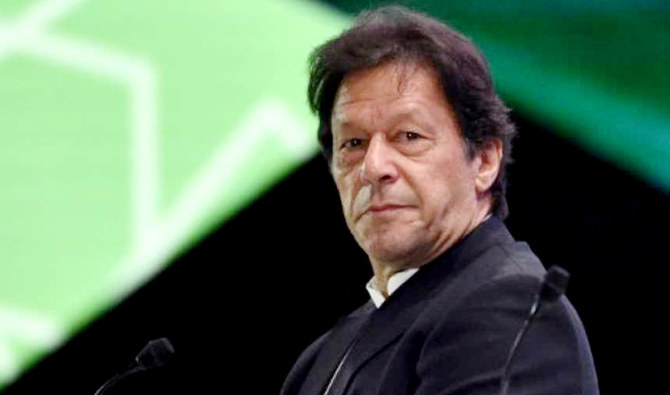
Members of Pakistan’s federal cabinet failed to reach a consensus in a meeting on Tuesday chaired by Prime Minister Imran Khan to approve the government’s new Asset Declaration scheme. (AFP)
Updated 17 April 2019
Follow

Federal cabinet fails to reach consensus on new amnesty scheme for undeclared assets

  • Ministry of Finance says amnesty scheme requires further fine tuning
  • Commerce and Industry representatives urge this to be the last scheme for tax evaders

ISLAMABAD: Members of Pakistan’s federal cabinet failed to reach a consensus in a meeting on Tuesday chaired by Prime Minister Imran Khan to approve the government’s new Asset Declaration scheme for undeclared local and offshore assets aimed to bait tax evaders, announced Information Minister Fawad Chaudhry.

Speaking to reporters at the PM office to publicly apprise discussions held during the cabinet meeting session, Chaudhry said, “members of the cabinet raised several reservations and concerns over the contours of the amnesty scheme which require further discussion to address issues” without elaborating on the raised apprehensions.

Finance Ministry Spokesman Dr. Khaqan Hassan Najeeb told Arab News, “The amnesty scheme is just being fine-tuned to make it more effective and it will be announced in a day or two.” The Prime Minister has postponed passing the draft which will come under discussion in the next committee meeting on Wednesday Chaudhry said.

“The cabinet has very wisely raised questions on the scheme so that any loopholes that can be exploited should be plugged and not result in an embarrassment to the government," said Naeem Siddique, a former member of Islamabad Chamber of Commerce & Industry (ICCI). 

“We are running short of Rs.300 billion in revenue at the moment and if this scheme can fetch Rs.500 billion then it can be successful,” commented Siddique.    

Pakistan is struggling to fix its ailing economy faced with a multitude of financial challenges including a decline in tax collection and international pressure to stop inflow of laundered money in to the realty sector.

On Monday, the Ministry of Finance announced that negotiations with the International Monetary Fund (IMF) for a three-year bailout package excepted between $6 to $8 billion had been successful. The loan potentially could help stabilize the country’s economy and ease pressure on the low foreign exchange reserves.

The government anticipates that the addition of an amnesty scheme will help support closing the widening current account deficit gap through tax revenue attracting non-filers from a population of 208 million people of which a small percentage file tax returns.

In the previous tax amnesty scheme announced last year during the Pakistan Muslim League-Nawaz (PML-N) administration, 82,889 people availed the facility and declared foreign assets worth PKR 1,040 billion and domestic assets up to worth PKR 1,460 billion. The scheme was able to fetch a total of PKR 124 billion tax out of which PKR 47 billion was paid on foreign and PKR 77 billion on domestic assets.

The draft document of the 2019 Asset Declaration Scheme, shared with Arab News by Islamabad’s Regional Tax Office, shows comparisons to the previous one, Unnamed Assets, Undeclared Sales/ Production in Sales Tax / FED, and Undisclosed Expenditure will be covered in the new tax amnesty scheme. 

Also the tax rate on the Unnamed assets would be 10 percent while Foreign Liquid Assets repatriated would be taxed at 5 percent instead of 2 percent, according to the document's omparison chart.

Speaking on Unnamed Assets, Federation of Pakistan Chamber of Commerce Senior Vice President Dr. Mirza Ikhtiar Baig said that a proposal had been sent to the Prime Minister earlier to decrease the rate of penalty and income tax. He argued that the government should provide some relaxation and flexibility in the mode of payment proposing installments over taxation of undeclared assets particularly real estate.

However, “this should be the last scheme and no more,” said Baig advising that the government should introduce incentives for tax payers which in turn would encourage tax evaders to come under the fold of the country’s tax system.


’I will go’: Bengalis in Pakistan hope for family reunions

Updated 6 sec ago
Follow

’I will go’: Bengalis in Pakistan hope for family reunions

  • Direct flights between Pakistan and Bangladesh, one nation until 1971m finally resumed last month after 14-year pause
  • Over a million Bengalis now live in Pakistan, many of whom arrived during 1971 war when Bangladesh seceded

KARACHI: Shah Alam traveled from his home in Bangladesh to Pakistan for a brief visit nearly three decades ago, but flaring hostility between the two countries and financial woes left him stranded in the megacity of Karachi.

Now the 60-year-old, who makes a modest living selling dried seafood, is determined to return to his birthplace, having already missed the deaths of his parents and first wife in Bangladesh.

Direct flights between Pakistan and Bangladesh — one nation until 1971 — finally resumed last month after a 14-year pause, reflecting a warming of once-frosty ties since a Bangladeshi student-led uprising ushered in new leadership in 2024.

Shah Alam has already started planning his trip to be reunited with remaining family.

“I will go,” he told AFP with teary eyes.

“I am facing some financial issues but will certainly go with my son after Eid Al-Adha,” referring to the Muslim holiday expected in late May.

Shah Alam, who married again in Pakistan, still owns agricultural land and his family home in Bangladesh.

“Everything is there. I was stuck here,” he told AFP in Karachi, near the well-known Bengali market where he peddles desiccated fish and prawns to make ends meet for $7 to $9 per day.

“I wanted to go back, but there was no way. The relationship (between Pakistan and Bangladesh) was not good. I had no money as well to go back home.”

“Now, I want to see my elder brother and my married daughter who live in Bangladesh.”

BITTER CIVIL WAR

Bangladesh and Pakistan, which are geographically divided by about 1,500 kilometers (930 miles) of Indian territory, split after a bitter war in 1971.

Hundreds of thousands were killed in the conflict — Bangladeshi estimates say millions — and Pakistan’s military was accused of widespread atrocities.

There are estimated to be over a million ethnic Bengalis now living in Pakistan, many of whom arrived during the war, after which East Pakistan declared independence and became Bangladesh.

The vast majority of Bangladesh’s population of 170 million people identify as belonging to the ethnic and linguistic group, and tens of millions more Bengalis live across South Asia, mostly in neighboring India.

Bengalis have long complained that Pakistan, where they are a small minority, has never accepted them as citizens and that they lack access to education, business opportunities and the property market.

Hussain Ahmed, 20, whose family lives in Machhar Colony, one of Karachi’s largest slum areas where most of the population is comprised of Bengalis, does not have Pakistani nationality or an identity card.

“How can I go (to Bangladesh)? I want to go there,” the fish factory worker told AFP. “Even my father doesn’t have an identity card. How can I get it then?“

Karachi has several Bengali neighborhoods, mainly slums, which residents say have housed Bengalis since before East Pakistan became Bangladesh.

Most Bengalis rarely venture outside their home areas owing to fear of being interrogated by law enforcement agencies to prove their “identities” as Pakistani citizens.

“I am a Pakistani, but I don’t have my identity card,” another 22-year-old Bengali, Ahmed, told AFP.

Ahmed says he has the required documents, but cannot prove that his family was living in what is now Pakistan before 1971.

“They declare me a Bangladeshi, but I am a Pakistani,” he said.

Like many others, Ahmed’s relatives live in Bangladesh, but he and his family have never had the chance to see them as they remain stateless.

“We have our relatives there, but the (Pakistan) government doesn’t recognize us.”

’CORDIAL RELATONSHIP’

Last August, Pakistan’s Foreign Minister Ishaq Dar visited Dhaka and met with Bangladesh’s Chief Adviser Muhammad Yunus in the first Pakistani government visit to Dhaka since 2012, with Islamabad calling it a “significant milestone.”

Yunus vowed to warm strained ties with Islamabad after he took the helm of Bangladesh’s government in a temporary capacity following the 2024 overthrow of former Prime Minister Sheikh Hasina who fled to her long-time ally India — Pakistan’s arch-rival.

The diplomatic thaw is widely expected to continue under Bangladesh’s newly elected Prime Minister Tarique Rahman, who took office this month.

Local politician Muhammad Rafiqul Hussain, who was born in Karachi, told AFP that Bengalis like him live across Pakistan and contribute to the economy like other Pakistanis.

He is one of the seven elected leaders from the Bengali community in Karachi’s municipal government.

“This is our fourth generation in Pakistan,” he said, adding there are more than 106 Bengali neighborhoods in Karachi, Pakistan’s largest city which is known as a multicultural melting pot.

For Hussain, the “cordial relationship” between Pakistan and Bangladesh has made a big difference for Pakistani Bengalis.

“Everyone is happy. It will boost both countries’ economies. It will encourage brotherhood like we had in the past.”

However, community activist and lawyer Hafiz Zainulabdin Shah said Bengalis living in Pakistan have lost some of their identity by adopting local languages.

“Bengalis who live in Karachi mostly speak Urdu,” he said, adding: “We don’t have our own culture now.”

But despite Pakistan-based Bengalis living “with a sense of deprivation,” Shah said “they feel content with the newly developed relationship between the two countries.”

“It should continue forever,” he said.