KHARTOUM: Sudan’s military rulers faced pressure from demonstrators and Western governments to hand power to a new civilian government Monday as activists warned of an attempt to disperse a 10-day-old mass protest outside army headquarters.
Thousands remained camped outside the complex in Khartoum overnight after protest leaders issued demands to the military council set up following the ouster of veteran president Omar Al-Bashir.
The organization that spearheaded the months of protests leading to Bashir’s fall, the Sudanese Professionals Association, called on their supporters to boost the numbers at the complex.
“There is an attempt to disperse the sit-in from the army headquarters area, they are trying to remove the barricades,” the SPA said in a statement, without saying who was responsible.
“We call on our people to come immediately to the sit-in area to protect our revolution.”
Witnesses said several army vehicles had surrounded the area and that troops were seen removing the barricades which demonstrators had put up as a security measure.
Britain’s ambassador to Khartoum, Irfan Siddiq, met the new military council’s deputy and stated his “top request was no violence and no attempt to forcibly break the sit in.”
In the meeting with Mohammad Hamdan Daglo, widely known as Himeidti, Siddik wrote on Twitter that he also backed the SPA’s call for a civilian administration.
The talks came a day after the embassies of Britain, the United States and Norway issued a joint statement saying the “legitimate change” the Sudanese people demanded had not taken place.
“It is time for the transitional military council and all other parties to enter into an inclusive dialogue to effect a transition to civilian rule,” they said.
The SPA has said a transitional government and the armed forces must bring to justice both Bashir and officials from his feared National Intelligence and Security Service (NISS).
The military council on Sunday met with political parties and urged them to agree on an “independent figure” to be prime minister, an AFP correspondent at the meeting said.
“We want to set up a civilian state based on freedom, justice and democracy,” a council member, Lt. Gen. Yasser Al-Ata, told members of several political parties.
A 10-member delegation representing the protesters delivered a list of demands during talks with the council late Saturday, according to a statement by the Alliance for Freedom and Change umbrella group.
But in a press conference, the council’s spokesman did not respond to the protesters’ latest demands.
He did however announce the appointment of a new NISS head after the intelligence agency’s chief Salih Ghosh resigned on Saturday.
The foreign ministry said military council head General Abdel Fattah Al-Burhan was “committed to having a complete civilian government” and urged other nations to back the council in order to achieve “the Sudanese goal of democratic transition.”
In the latest shake-up, Burhan on Monday named Lt. Gen. Hashim Abdelmotalib as the army’s chief of staff.
American actor George Clooney, who has campaigned hard to draw attention to the conflict in Sudan’s Darfur region, over the weekend urged world powers to pressure the military “to turn over full executive power to a civilian-led transitional government.”
“The most potent form of leverage would be to go after the assets laundered by Bashir and his allies through the international financial system,” Clooney wrote in a joint Washington Post column with rights activist John Prendergast.
The military council’s deputy Himeidti is a field commander for the Rapid Support Forces (RSF) counter-insurgency unit, which rights groups have accused of abuses in Darfur.
But at the protest site Monday, witnesses said demonstrators put up a banner with a photograph of Himeidti which read: “We will not forget that you stood with us.”
Burhan has pledged that individuals implicated in killing protesters would face justice and that demonstrators detained under a state of emergency imposed by Bashir during his final weeks in power would be freed.
Bashir ruled Sudan with an iron fist for 30 years before he was deposed last week following mass protests that have rocked the country since December.
Tens of thousands of people have massed non-stop outside the army headquarters since April 6, initially urging the military to back their demand for Bashir’s removal.
But his departure in a coup failed to satisfy the protesters, who have pushed for justice for Bashir-era officials.
The SPA has also called for the confiscation of properties belonging to the ousted president’s National Congress Party and the release of soldiers who sided with their movement.
Late on Sunday, the military council said it has set up a committee to register NCP properties and seize control of them.

Sudan leaders face pressure for transfer to civilian rule as protesters reject attempts to clear camp
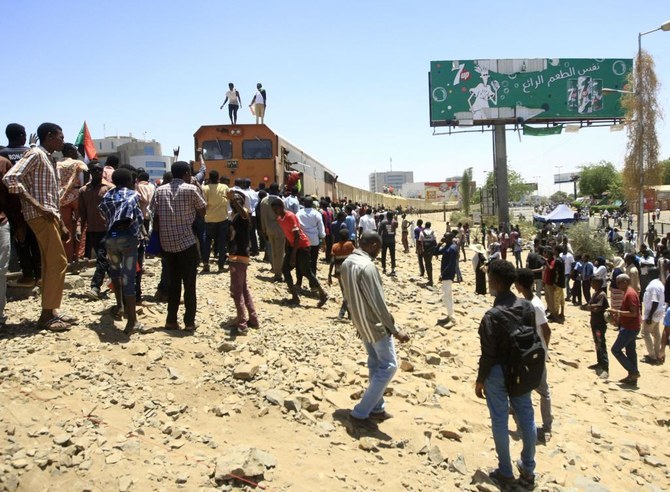
- Thousands remained camped outside the complex in Khartoum overnight after protest leaders
- The organization that spearheaded the months of protests leading to Bashir’s fall
Halt to MSF work will be ‘catastrophic’ for people of Gaza: MSF chief
GENEVA: Israel’s ban on Doctors Without Borders’ humanitarian operation in Gaza spells deeper catastrophe for the Palestinian territory’s people, the head of the medical charity told AFP on Monday.
Israel announced on Sunday that it was terminating all the activities in Gaza and the West Bank by the organization, known by its French acronym MSF, after it failed to provide a list of its Palestinian staff.
MSF slammed the move, which takes effect on March 1, as a “pretext” to obstruct aid.
“This is a decision that was made by the Israeli government to restrict humanitarian assistance into Gaza and the West Bank at the most critical time for Palestinians,” MSF secretary-general Christopher Lockyear warned in an interview with AFP at the charity’s Geneva headquarters.
“We are at a moment where Palestinian people need more humanitarian assistance, not less,” he said. “Ceasing MSF activities is going to be catastrophic for the people of the Gaza Strip and the West Bank.”
MSF has been a key provider of medical and humanitarian aid in Gaza, particularly since war broke out after Hamas’s October 7, 2023 attack on Israel.
The charity says it currently provides at least 20 percent of hospital beds in the territory and operates around 20 health centers.
In 2025 alone, it carried out more than 800,000 medical consultations, treated more than 100,000 trauma cases and assisted more than 10,000 infant deliveries.
It also provided more than 700 million liters of water, Lockyear pointed out.
’Impossible choice’
Israel announced in December that it planned to prevent 37 aid organizations, including MSF, from working in Gaza for failing to submit detailed information about their Palestinian employees. The move drew widespread condemnation from NGOs and the United Nations.
It had alleged that two MSF employees had links with Palestinian militant groups Hamas and Islamic Jihad, which the medical charity vehemently denies.
“If Israel has any evidence of such things, then they should share that evidence,” Lockyear said, insisting that “there’s been no proof given to us.”
He decried “an orchestrated campaign to delegitimize us,” calling on other countries to defend efforts to bring desperately-needed humanitarian aid into Gaza.
“They should be speaking to Israel, pressuring Israel to ensure that there is a reverse of any banning of humanitarian organizations.”
Lockyear said MSF, which counts around 1,100 staff inside Gaza, had been trying to engage with Israeli authorities for nearly a year over the requested lists.
But it had been left with “an impossible choice,” he said.
“We’ve been forced to choose between the safety and security of our staff and being able to reach patients.”
’Can only get worse’
The organization said it decided not to hand over staff names “because Israeli authorities failed to provide the concrete assurances required to guarantee our staff’s safety, protect their personal data, and uphold the independence of our medical operation.”
Lockyear insisted that was a “very rational” decision, pointing out that 15 MSF staff had been killed in Gaza during the war, out of more than 500 humanitarian workers and more than 1,700 medical workers killed in the Strip.
Lockyear highlighted that without independent humanitarian organizations in Gaza, an already “catastrophic” situation “can only get worse.”
“We need to increase massively the humanitarian assistance that’s going into Gaza,” he said, “not restrict it, not block it.”
Israel announced on Sunday that it was terminating all the activities in Gaza and the West Bank by the organization, known by its French acronym MSF, after it failed to provide a list of its Palestinian staff.
MSF slammed the move, which takes effect on March 1, as a “pretext” to obstruct aid.
“This is a decision that was made by the Israeli government to restrict humanitarian assistance into Gaza and the West Bank at the most critical time for Palestinians,” MSF secretary-general Christopher Lockyear warned in an interview with AFP at the charity’s Geneva headquarters.
“We are at a moment where Palestinian people need more humanitarian assistance, not less,” he said. “Ceasing MSF activities is going to be catastrophic for the people of the Gaza Strip and the West Bank.”
MSF has been a key provider of medical and humanitarian aid in Gaza, particularly since war broke out after Hamas’s October 7, 2023 attack on Israel.
The charity says it currently provides at least 20 percent of hospital beds in the territory and operates around 20 health centers.
In 2025 alone, it carried out more than 800,000 medical consultations, treated more than 100,000 trauma cases and assisted more than 10,000 infant deliveries.
It also provided more than 700 million liters of water, Lockyear pointed out.
’Impossible choice’
Israel announced in December that it planned to prevent 37 aid organizations, including MSF, from working in Gaza for failing to submit detailed information about their Palestinian employees. The move drew widespread condemnation from NGOs and the United Nations.
It had alleged that two MSF employees had links with Palestinian militant groups Hamas and Islamic Jihad, which the medical charity vehemently denies.
“If Israel has any evidence of such things, then they should share that evidence,” Lockyear said, insisting that “there’s been no proof given to us.”
He decried “an orchestrated campaign to delegitimize us,” calling on other countries to defend efforts to bring desperately-needed humanitarian aid into Gaza.
“They should be speaking to Israel, pressuring Israel to ensure that there is a reverse of any banning of humanitarian organizations.”
Lockyear said MSF, which counts around 1,100 staff inside Gaza, had been trying to engage with Israeli authorities for nearly a year over the requested lists.
But it had been left with “an impossible choice,” he said.
“We’ve been forced to choose between the safety and security of our staff and being able to reach patients.”
’Can only get worse’
The organization said it decided not to hand over staff names “because Israeli authorities failed to provide the concrete assurances required to guarantee our staff’s safety, protect their personal data, and uphold the independence of our medical operation.”
Lockyear insisted that was a “very rational” decision, pointing out that 15 MSF staff had been killed in Gaza during the war, out of more than 500 humanitarian workers and more than 1,700 medical workers killed in the Strip.
Lockyear highlighted that without independent humanitarian organizations in Gaza, an already “catastrophic” situation “can only get worse.”
“We need to increase massively the humanitarian assistance that’s going into Gaza,” he said, “not restrict it, not block it.”
© 2026 SAUDI RESEARCH & PUBLISHING COMPANY, All Rights Reserved And subject to Terms of Use Agreement.


