Trump reaffirms North Korea sanctions

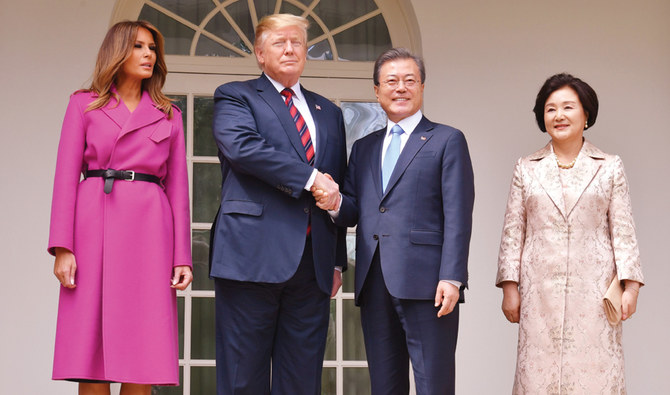
US President Donald Trump and first lady Melania Trump welcome South Korean President Moon Jae-in and his wife Kim Jung-sook to the White House. (AFP)
Updated 12 April 2019
Follow

Trump reaffirms North Korea sanctions

  • President rejects concessions to facilitate inter-Korean economic projects

SEOUL: US President Donald Trump has rejected suggestions that he could allow concessions on North Korean sanctions, during discussions in Washington with South Korean President Moon Jae-in.

At a press conference at the White House, Trump suggested that he would be open to dialogue with Pyongyang on the condition of complete denuclearization.

“I think that sanctions are, right now, at a level that’s a fair level. And I really believe something very significant is going to happen,” he said. “We could always increase them, but I didn’t want to do that at this time.”

There had been suggestions that some sanctions could be eased in order to facilitate cross-border economic projects, but Trump stated: “This isn’t the right time.”

Inter-Korean initiatives, including an industrial park, railway link and tourism opportunities, have been suspended as a result of the North conducting a series of intercontinental ballistic missile and nuclear warhead tests.

Moon expressed hope that a new summit with North Korean leader Kim Jong Un could jump-start the denuclearization process, after the collapse of the Trump-Kim summit in Hanoi in February.

“The important task that I face is to maintain dialogue and also express to the international community that a third US-North Korea Summit will be held in the near future,” Moon told reporters in the Oval Office. “The Republic of Korea is absolutely on the same page when it comes to the complete denuclearization of North Korea.”

Trump remained cautious about a third encounter with Kim, but did not rule it out.

“A third summit could happen. It’s step by step, it’s not a fast process … If it goes fast, it’s not going to be a proper deal.”

There remain doubts over the South’s optimism for progress, however. Moon Keun-shik, an analyst at the Korea Defense and Security Forum, said: “Moon was not able to hear what he had wanted from Trump, but he has cemented his role as the mediator over the nuclear issue.”

Many North Korea experts, though, also queried Moon’s ability to bridge the gap between Trump and Kim.

“Moon and Trump failed to narrow a gap over practical issues, including sanctions on North Korea,” said Chung Se-hyun, a former minister for Korean unification. “If you say there was no deal at the Hanoi Summit, there is also no deal from this Moon-Trump summit.”

Shin Bum-cheol, director of the Center for Security and Unification at the Asan Institute for Policy Studies, said Moon’s pursuit of a “good enough deal” for partial relief of sanctions in exchange for gradual denuclearization was rebuffed by Trump, leaving Seoul little option but to persuade Pyongyang to meet US terms.

“I question if Kim will accept Moon’s proposal to hold a summit, as he has shown his resolution to respond to the current sanctions,” Shin said.

North Korean state media reported Kim had vowed a “serious blow” to those imposing sanctions on his regime prior to the Trump-Moon Summit, during an address to the central committee of the ruling Workers’ Party in Pyongyang on Wednesday.

The remark was construed as a firm stance against economic and trade sanctions imposed by the international community, rather than a threat, as it did not explicitly mention the South, the US, nor threaten military action.


Cuba says attacking speedboat had nearly 13,000 rounds of ammunition

Updated 9 sec ago
Follow

Cuba says attacking speedboat had nearly 13,000 rounds of ammunition

  • Firefight took place at a range of 20 meters, Cuba says
  • Incoming crew originally ‌set out on two vessels but ditched one
HAVANA: A commando of Cuban exiles who intended to infiltrate Cuba on a speedboat was armed with nearly 13,000 rounds of ammunition, 13 rifles and 11 pistols, Cuban officials said on Friday, providing new details about Wednesday’s deadly exchange of gunfire at sea. The government in Havana has said 10 Cuban nationals coming from the United States entered Cuban waters and opened fire on a border guard vessel, leading Cuban forces to return fire killing four and wounding six others, who were taken into custody.
In an attempt to dispel doubts about its account to date, senior Cuban Interior Ministry officers displayed the captured armaments from the studio on a special television program, including bins full of at least some of the 12,846 recovered rounds. They also showed pictures of the vessels, each peppered with bullet holes from ‌the firefight they ‌said took place at a range of 20 meters (66 feet).
The confrontation took place ‌at ⁠a fraught moment ⁠in US-Cuban relations, with US President Donald Trump pressuring the island by imposing a virtual oil blockade after capturing and ousting Venezuelan President Nicolas Maduro, a crucial Cuban ally, on January 3.
Cuba has identified the assailants as Cuban exiles, some of whom had been previously placed on a list of accused terrorists, who came from the United States with the intent to sow chaos and attack military units on the Communist-ruled island.
“The intent of this group is to infiltrate, to promote public disorder. To incite the people to unite. To carry out something violent. Attack military units ⁠in order to incite social unrest and to unite the people in order to ‌steal the revolution. That has been duly proven,” said Col. Victor Alvarez ‌of the Interior Ministry.
Cuba says response ‘proportional’
US politicians have expressed skepticism over Cuba’s version of events. Secretary of State Marco ‌Rubio on Wednesday said his government would independently investigate, adding that it was not a US operation and ‌that no US government personnel were involved.
Cuban officers said the infiltrators set out from Marathon in the Florida Keys on two vessels but ditched one at some point due to technical difficulties. They united on one speedboat, which a US official said was reported stolen in Florida. Cuba said it recovered a drone, radios, knives, a portable power plant, bolt cutters and ‌other materiel. They also found emblems of the November 30th Movement and People’s Self-Defense, anti-communist groups that oppose the Cuban government.
Cuba says a patrol of five ⁠border guard members on ⁠a 9-meter boat spotted the incoming vessel shortly after 7 a.m., with some members of the incoming crew in the water, about one nautical mile off a cay on the Caribbean island’s northern coast, about 100 miles (160 km) from Marathon.
The infiltrators opened fire at a distance of 185 meters, striking the captain of the Cuban vessel in the abdomen, Cuba said. Bleeding heavily, the wounded captain remained at the helm and steered toward the enemy vessel, leading to a firefight at a distance of about 20 meters, the officers said.
Cuba called its response “proportional.”
“It is a defensive model that practically never uses firearms, and the use of firearms is proportional to the type of action being carried out against our force,” said Interior Ministry Col. Ybey Carballo.
The captured Cuban nationals were receiving medical care and face charges including armed aggression, illegal entry into national territory, crimes associated with terrorist acts, and arms trafficking, prosecutor Edward Robert Campbell told the program. He said they face prison terms of up to 10 to 15 years for the lesser offenses and 20 to 30 years — or even the death penalty — for the more serious charges.