

What the Gulf’s Indians want from their election at home

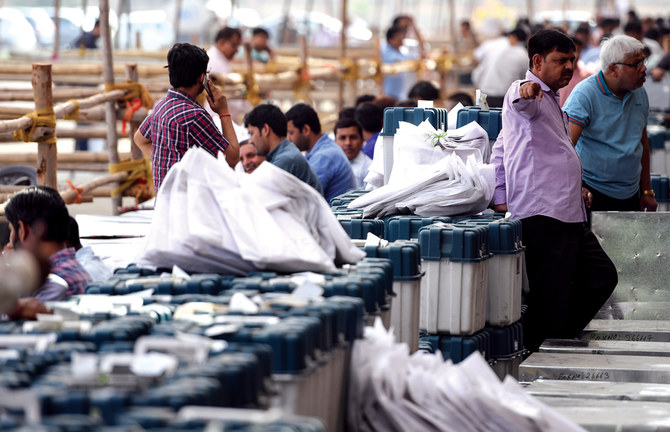
Indian officials prepare election-related material at a distribution centre in Noida in India’s northern state of Uttar Pradesh on Wednesday. (AFP)
Updated 11 April 2019
Follow

What the Gulf’s Indians want from their election at home

  • The election in the world’s largest democracy will begin on April 11, with voting at one million polling stations across India
  • Those who remain in the Gulf region will not be able to vote, but that doesn’t stop them from having opinions about it

DUBAI: For the first time this year, Mukesh Kalvaniya will not be able to vote in India’s general election, which starts on Wednesday. That’s because he moved to the UAE from his hometown in Rajasthan three years ago, joining millions of Indians in the Gulf who cannot cast a ballot outside of their country.

“I am feeling frustrated that my vote would be wasted,” said the 43-year-old mason, who is working on a private construction project in Dubai. “My country is going to have one of the most crucial elections of recent history. I want the right person (to) be elected from my hometown. If I want the right people to rule my country, then I should also vote.”

The election in the world’s largest democracy will begin on April 11, with voting at one million polling stations across India. About 900 million people, almost triple the entire population of the US, are eligible to vote, including as many as 84.3 million youths for the first time.

However, there is no system for about 8.5 million Indians, the largest non-resident Indian (NRI) population in the world, to vote online or designate a proxy vote, as there is for many expats from other countries who work in the Gulf Cooperation Council (GCC).

“We have been reduced to becoming passive watchers. We have no choice but to bear the consequences of the decisions others make,” said Kalvaniya. 

Shankar Ram, a 20-year-old mechanic in Riyadh, is also regretting that he won’t be able to cast his first vote. “I just turned 20 last month. I wanted to go home and cast a vote. But I won’t get holidays in my probation period,” said Ram, who joined his new job three months ago. 

Ram said that he hears a lot of Indians in Riyadh complaining about their country and its system. “If you have a problem, then find a solution. Criticism won’t give you the solution. As an Indian, this is our responsibility to make our country a better place whether we live there or work outside.” 

Like many other overseas Indians, Ram said that he was expecting the government to arrange a way for them to vote, but it didn’t happen. “My vote is important for my country,” he said. “I hope my government also realizes that soon.”


However, many Indians will vote while they are visiting their homes during the election. “I will be in India on vacation when my city goes to the polls,” said Umaid Khan, a cyber-security professional in Dubai. “Instead of getting carried away by the frenzy created by politicians and the media, I will cast my vote based on the qualifications and background of the candidate.”

Khan, who has been based in Dubai for 16 years, believes that the election in India will decide the country’s future. He said that in recent years there has been a disturbing spike in hate crimes in India because of religious extremism. “I want my government to take severe action against intolerance irrespective of the community they belong to,” he said.

Khan said that it was shameful that India has the world’s highest number of malnourished children, despite being one of the world’s largest economies. “Issues such as education, health care, infrastructure, corruption, pollution, ease of doing business, safety and security etc. get submerged when political parties build the narrative based on religions, castes and regional biases.”

According to Surender Singh Kandhari, chairman of Al-Dobowi Group and head of Sikh Gurudwara in Dubai, millions of Indians living in the Gulf want a “clean government” that can address real issues on the ground. “Most non-resident Indians (NRIs) living in the Gulf closely follow what is happening in India. They follow every single action and step taken by the politicians,” he said.

“We need to uplift the weaker sections of the society. We need the per-capita income to go up so that all Indians become prosperous. Each one of them should have shelter, food and good health.”
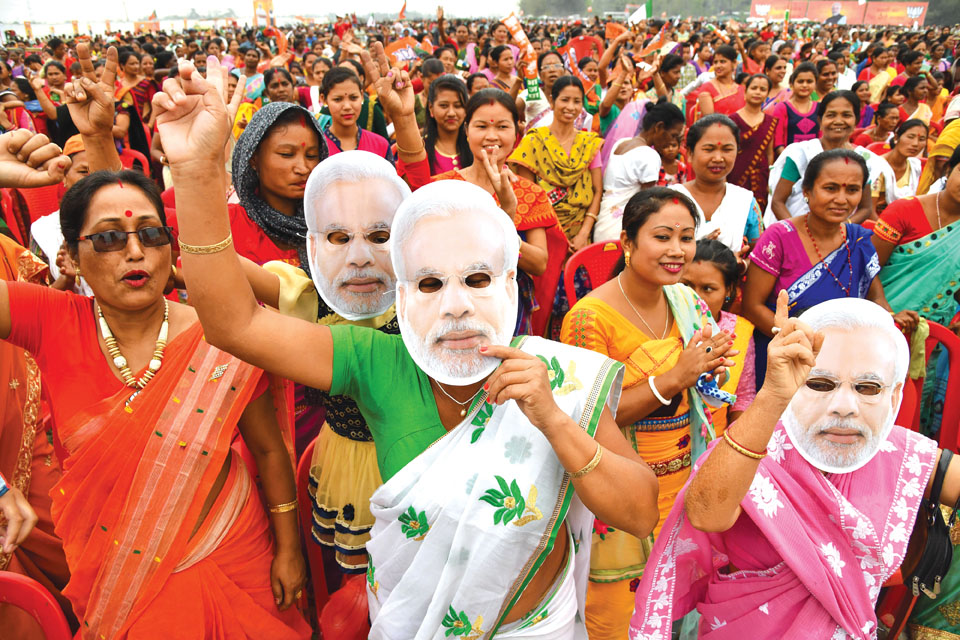


Bharatiya Janata Party (BJP) voters in the lead-up to the election. (AFP)

Kandhari described the present electoral landscape in India as very messy. “The ruling party and the opposition are by hook and crook trying to woo the voters just to be in power. None of them mean anything they say,” he said.

If Kandhari is to be believed, NRIs in the Gulf are not pleased with the situation back home, especially with the country’s politicians. “All of them have skeletons in their cupboards. They really do not mean to do good for the country. The motive itself is very selfish,” he said.

Rizwan Sajan, founder and chairman of the Dubai-based Danube Group, is more hopeful. He said that elections in India are a celebration of the world’s largest democracy. 

According to Sajan, most NRIs are long-term investors, and their investment goals and objectives are directed toward creating a future for their children through education and retirement planning. “Hence, such schemes will definitely boost investment by us in the economy of India,” he said, adding that the government should focus more on the rural economy to provide people outside cities with a better future.

Entrepreneur Rehan Khan, who is based in Dubai, said voters must act smartly to send a message to politicians. “Most politicians come from the most uneducated backgrounds, and they take the public for granted,” he said. “Unfortunately, the whole atmosphere this time is so polarized that people are looking at issues only through the prism of religion.” 

He said politicians should focus less on religion and talk only about development. “Only then the country can move ahead. We may be one of the biggest democracies for sure, but we are not the most mature yet.”


Melania Trump’s documentary premieres at the Kennedy Center ahead of global release

Updated 3 sec ago
Follow

Melania Trump’s documentary premieres at the Kennedy Center ahead of global release

  • The Kennedy Center in Washington hosted a screening for the movie, “Melania,” on Thursday, one day before its release in theaters worldwide
  • Melania Trump says the film offers rare insight into her life in the run-up to the 2025 inauguration
WASHINGTON: Melania Trump is capping her first year back as first lady with the global release of a documentary she produced about the 20 days leading up to husband Donald Trump’s return to the White House.
A private person, Melania Trump remains a bit of a mystery to the public in her husband’s second term. “Melania” premiered Thursday at the Kennedy Center before it is released on Friday in more than 1,500 theaters in the US and around the world.
“I want to show the audience my life, what it takes to be a first lady again and (the) transition from private citizen back to the White House,” Melania Trump told reporters as she and the president moved along a charcoal-colored walkway at the event attended by Cabinet members, members of Congress and conservative commentators.
She said viewers will see how she conducts her businesses and philanthropy, cares for her family and builds her White House team.
“It’s beautiful, it’s emotional, it’s fashionable, it’s cinematic and I’m very proud of it,” she said.
The documentary was produced by AmazonMGM Studios and is said to have cost $40 million. It will stream exclusively on the Amazon Prime Video streaming service after its theatrical run.
Director Brett Ratner said his measure of success would not be box-office performance.
“It’s a documentary and documentaries historically have not been huge box office smashes,” he told reporters on his way into the premiere. “You can’t expect a documentary to play in theaters.”
The Republican president saw the nearly two-hour film for the first time at a private White House screening over the weekend. He said Thursday that he thought it was “really great.”
“It really brings back a glamor that you just don’t see anymore,” Trump said. “Our country can use a little bit of that, right?”
‘Melania’ more than a year in the making
It was unclear how much money Melania Trump stands to earn or what her plans are for any film proceeds. Experts said it was unusual for a first lady to pursue a project of this kind from the White House — but not unusual for the Trumps.
“As far as I know, she’s the first first lady to be paid a lot of money to have a documentary made about her and it is unprecedented in terms of the Trumps because they are always breaking precedent,” said Katherine Jellison, professor emerita of history at Ohio University.
Asked about the sum, Trump mentioned the book deal for Barack Obama and his wife, Michelle, that the publisher announced in 2017, shortly after he left office.
Presidents and first ladies generally refrain from pursuing outside business ventures while in office to avoid potential conflicts of interest or raising ethical concerns.
Both Trumps participate in numerous business ventures, selling everything from watches, fragrances and Bibles for him to jewelry, Christmas ornaments and digital collectibles for her.
Marc Beckman, the first lady’s longtime senior adviser, defended the financial arrangement, which Amazon has declined to comment on. He noted that she was a private citizen when Amazon announced the film in January 2025 and that she is unelected and receives no salary as first lady. “So why should we limit her?” he said Thursday.
The movie also marks another link between the Trumps and Amazon founder Jeff Bezos, who has worked to improve a once-tense relationship with the president.
Melania Trump said Thursday that a bidding process was conducted and that Amazon “was the best because they agreed to do theatrical releases.”
The movie is the first project by Ratner since he was accused of sexual misconduct in the early days of the #MeToo reckoning. Ratner’s lawyer has denied the allegations.
‘Here we go again’
In a scene from a teaser for the movie, it is Inauguration Day and Melania Trump is inside the Capitol, waiting to be escorted into the Rotunda for the ceremony. She turns her head, looks directly into the camera and says, “Here we go again.”
She wrote in her self-titled memoir published in 2024 about how much she values her privacy. She is not seen or heard from as often as some of her recent predecessors, which may be influencing the public’s perceptions of her. But she also likes to do things her way.
She said she did the film to show people what goes into becoming first lady.
The US public is divided on their views of her, but a significant number — about 4 in 10 adults — had no opinion or had not heard of her, according to a CNN poll from January 2025. About 3 in 10 adults saw her favorably while roughly the same share had an unfavorable opinion.
Her standing among Republicans was higher, with about 7 in 10 saying in the poll that they viewed her favorably, but around one-quarter had no opinion.
“I think it’s an attempt, in a way, to really augment or tailor or really refine her image for the American public,” said Katherine Sibley, who teaches history at Saint Joseph’s University in Philadelphia. “She’s a mystery to the American people.”
First lady cites impactful first year of second Trump term
Melania Trump, 55, said she’s honored to execute the traditional duties of first lady, such as planning state dinners, hosting the annual Easter Egg Roll and decorating for Christmas. But she also has said she wants to leave her mark in other ways, too.
She spent chunks of time away from Washington last year working on the documentary and was deeply involved in every aspect of its development, according to Beckman.
Her first-year record centers on the well-being and safety of children.
She used her influence to lobby Congress to pass the “Take It Down Act,” making it a federal crime to publish intimate images online without consent. The president signed the bill into law and had her sign it, too.
Her advocacy for foster children was enshrined in an executive order creating a “Fostering the Future” program. It’s part of the “Be Best” child-focused initiative she launched in the first term.
She wrote to Russian President Vladimir Putin for help reuniting children who had been separated from their families because of his war against Ukraine. She had her husband hand-deliver the letter when the leaders met in Alaska, and she later announced that eight children had been reunited with their families.
The first lady has a prominent role in the administration’s efforts on artificial intelligence and education and recently launched a global version of the foster child program.
She told guests at a White House Christmas reception that she is working on a new legislative effort for 2026, but has not yet shared details.