AMMAN: Six million Israelis are expected to cast their votes for the 120-member Knesset (Parliament) on Tuesday, in an election with many ramifications for the country and the wider Middle East.
Benjamin Netanyahu, the four-time Israeli prime minister, is fighting for his political life to stay in power and delay indictments for fraud, bribery and breach of trust placed on him by Israel’s attorney general. Spooked, and under pressure from the rival Blue and White Party and its leader, former Israeli army chief Benny Gantz, Netanyahu has pandered to the far right, promising to annex all Jewish settlements in the occupied West Bank.
While the election has been focused on individuals, the political system in Israel is parliamentary. Israeli President Reuven Rivlin, whose job is normally symbolic, will decide which party leader he will ask to form a government.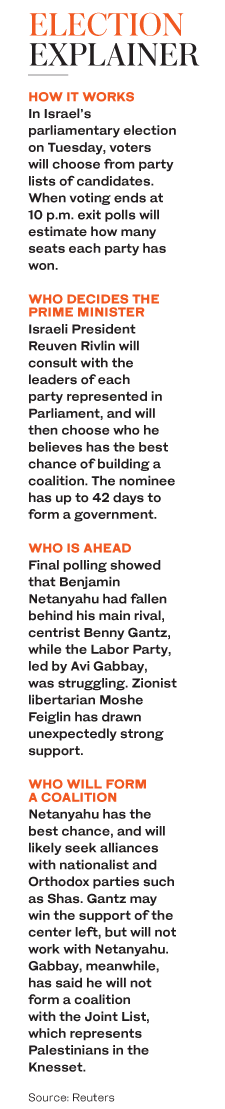
The problem for Netanyahu is that if enough far right Israelis shift their votes to him and his Likud Party, this could lead to the loss of parliamentary seats for smaller partners in his potential coalition, who then might not pass the threshold of 3.75 percent of the votes needed to enter the Knesset.
Equally concerning for Netanyahu is his strained relationship with Rivlin, a political moderate who may turn to Gantz should the Blue and White win more votes.
Nevertheless, Netanyahu has commitments from the Union of Right-Wing Parties, the New Right, the two ultra-Orthodox parties United Torah Judaism and Shas, and the Yisrael Beiteinu and Kulanu parties. The libertarian Zehut, led by a former Likud member, will almost certainly follow suit.
Ofer Zalzberg, a senior researcher at the International Crisis Group, said that while Netanyahu’s chances remain good, Gantz could still form a center-left government. “The critical question is not who will receive the most votes, but which party can convince 60 members of the Knesset to recommend its leader to form the next government,” he said.
It is possible neither Netanyahu nor Gantz will be able to form a coalition. In that case, either they will establish a government of national unity with a rotating premiership, or Rivlin will call a new election. History suggests that in a national unity government, Gantz would seek control of certain areas rather than demand Netanyahu adopt specific policies towards the Israeli-Palestinian conflict, according to Zalzberg.
While Palestinian-Israelis will vote, they are not expected to make much of a difference unless they do so in large numbers. The Joint List, headed by Ayman Odeh and which won 13 seats in the last election, has been broken up into two lists, with the smaller group in danger of not passing the threshold.
Most observers believe that there is little reason to expect dramatic changes in Israeli policy on Palestine, no matter who leads the next coalition. However, Netanyahu’s statements about annexing Israeli settlements in the West Bank have raised tensions.
“The settlements themselves are a war crime according to international humanitarian law,” said Dr. Anis Kassim, the publisher of the Palestinian Yearbook of International Law.
Ghassan Khatib, a senior member of the Palestinian People’s Party and a lecturer at Bir Zeit University, told Arab News that the US had a legal responsibility to ensure that Netanyahu does not proceed. Khatib, who participated in peace talks in the 1990s, said that if permitted, the US “would have violated the 1993 declaration of principles, of which Washington was a witness and a guarantor in terms of the integrity of the Palestinian territories.”
Martin Indyk, a fellow at the Council on Foreign Relations and former US assistant secretary of state for Near Eastern affairs, noted in a study by the Carnegie Middle East Center that, in the past, Netanyahu had resisted talk of annexing settlements, knowing the US would oppose it. “But by recognizing Israeli sovereignty over the Golan, Trump has given them all a green light.”