
ISLAMABAD: Pakistan prioritised inviting international social media influencers to a major tourism summit this week because they had more followers and were better placed to promote the country internationally, the minister of tourism said on Saturday evening, in a decision that has sparked debate about a colonial hangover and the government’s need to seek validation from foreigners.
The Ministry of Tourism organised the Pakistan Tourism Summit on April 3 and 4, in the backdrop of Prime Minister Imran Khan announcing a new visa policy to boost tourism by allowing citizens of 175 countries to apply for online visas and offering visas on arrival to visitors from 50 countries.
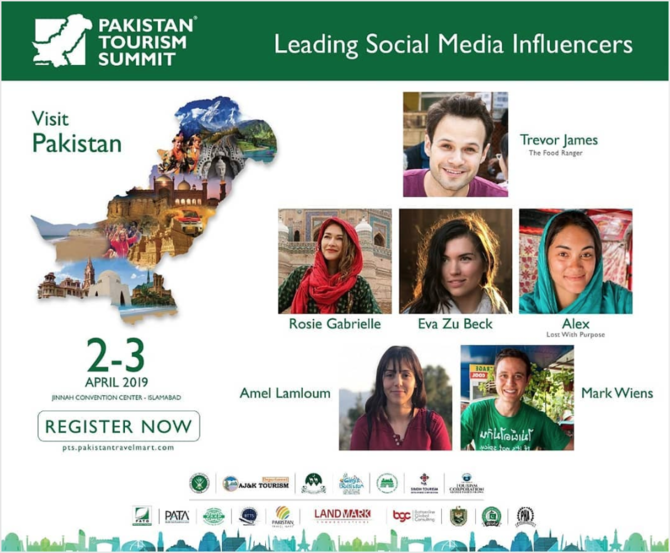
Speakers at the summit in Islamabad included international travel bloggers Trevor James, Mark Wiens, Eva zu Beck, Alex Reynolds and others. A poster calling for the public to register to attend the summit had pictures of six international social media influencers and no Pakistanis. Media showed footage of Prime Minister Khan meeting with the foreign social media personalities at his office. No Pakistani bloggers were present.
Atif Khan, minister of tourism for Khyber Pakhtunkhwa province which organised the summit, told Arab News that the aim behind inviting foreign social media influencers and content creators was to tap into their huge following and promote Pakistan outside the country.
He said two popular Pakistani social media personalities, Umar Khan and Taimoor Salahuddin aka Mooro, had been invited to the summit but could not attend.
Umar Khan and Mooro both told Arab News they never received an invitation to the summit.
“Obviously our first priority is to change the perception of Pakistan across the world and for that obviously, the foreigner bloggers who have more followers” are in a better position to promote Pakistan internationally, Khan said.
“For example Mark Wiens, he has already 4 million followers, Trevor James has 2.7 million followers,” Khan said. “I was looking at the numbers of likes or the number of views on Eva’s videos, I think the number of likes was 1.15 million in just one day, so obviously it matters.”
“International bloggers have more followers, have more international followers, obviously they are in a better position,” he added.
However, Khan said that he was in touch with several Pakistani social media influencers and would be collaborating with them on “future projects.”
Many Pakistani bloggers said the government had made a deliberate decision to exclude them from the summit.
Bilal Hasan, who catalogues his travels around the country on Instagram, said his excitement over the summit soured once he realised no local bloggers had been invited.
“Hosting a tourism summit where future travel/tourism policy for the country is being discussed without the input and presence of local content creators/influencers ... is quite problematic,” Hasan wrote on Instagram.
He said the government’s decision was the result of a hangover of colonialism in a region that was ruled by the British for almost a century and exposed the Pakistan government’s “gora complex,” a term mainly used in South Asia to refer to a tendency to give preferential treatment to white people.
“Millions of Pakistanis vehemently even to this day hold on to the view that whatever the white man/woman says holds more validation,” Hasan said. “These ideals are nailed deep into our subconsciousness. This traveler summit just further reiterates that point.”
“Out of 200 million plus population, [the summit’s] organisers weren't able to find even one Pakistani influencer?” another video blogger Danish Khan told Arab News. “Sorry to say but we Pakistanis seek validation from foreigners.”
Alex Reynolds, one of the foreign bloggers invited to the summit, also wrote on Instagram that “there is no one better suited to create content that communicates the wonders of Pakistan than its own photographers, vloggers, bloggers.”
Pakistan was last a prominent tourist destination in the 1970s but deteriorating security has since chipped away at the number of visitors. Law and order has improved dramatically in recent years, with militant attacks down sharply in the mainly Muslim country of 208 million people.
Culture and sports writer Ahmer Naqvi said the government’s approach stemmed from the fact that it was less interested in actually bolstering Pakistan’s potential as a true tourist destination and more in showing the world that the country was now safe to visit after years of militant attacks.
The government is “not looking at it as tourism first but as a way of showcasing that we have won the war against terror and that we’ve made the country safe,” Naqvi said.
However, he also said a three-year ban, now lifted, on accessing YouTube in Pakistan over an anti-Islam film meant the country’s video blogging scene was several years behind the rest of the world and it thus made some sense that the government reached out to international influences who had “much bigger audiences globally, perhaps even locally.”