

Myanmar ‘crazy drug’ tops agenda at border talks with Bangladesh

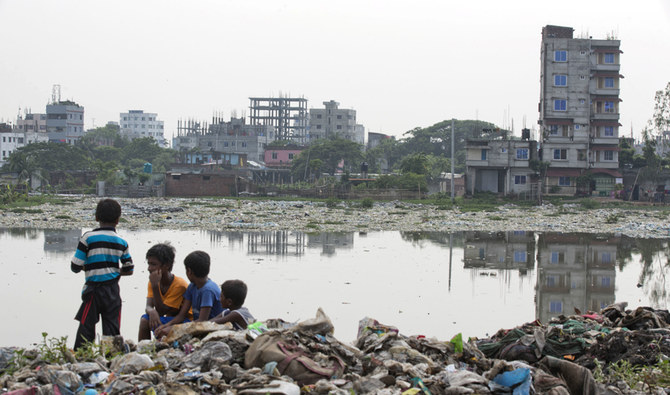
Bangladeshi children while the time away at a garbage dump along the river Buriganga in Hazaribagh area in Dhaka, at risk from colossal impacts of environmental disasters and drug trafficking. Bangladesh and Myanmar are holding a border conference to curb the smuggling of a highly addictive drug known as “crazy medicine”. ( AP file photo)
Updated 06 April 2019
Follow

Myanmar ‘crazy drug’ tops agenda at border talks with Bangladesh

  • Yaba, also known as “crazy medicine, usually comes in the form of colorful, candy-like tablets
  • The highly addictive stimulant is produced in border areas of Myanmar and smuggled into Bangladesh

DHAKA, Bangladesh: Moves to curb the smuggling of a highly addictive drug known as “crazy medicine” will top the agenda at a five-day border conference between Bangladesh and Myanmar.

The stimulant yaba — a mix of methamphetamine and caffeine that usually comes in the form of colorful, candy-like tablets — is produced in border areas of Myanmar and smuggled into Bangladesh.

The Dhaka government has “declared war” on the drug and stepped up measures to counter smuggling operations. In 2016, up to $29 million of yaba was seized by Bangladeshi authorities.

High-ranking border talks between the two countries began on Saturday in the Myanmar capital Nay Pyi Taw.

The 11-member Bangladesh delegation is led by Maj. Gen. Md Shafeenul Islam, the Border Guard director general, while the 17-strong Myanmar group is headed by Brig. Gen. Myo Than, the country’s police chief.

Bangladesh’s focus at the talks will be on the production of yaba in Myanmar and the smuggling of the banned drug across the 270 km border between the countries.

“It’s a very difficult situation,” a Bangladeshi security analyst, Maj. Gen. (rtd) Mohammed Ali Sikder, told Arab News. “The Myanmar army has a vested interest in this drug trading and that’s why they are not much interested in stopping its spread.

“Bangladesh needs to make Myanmar understand that the spread of yaba is a threat not only for Bangladesh but also for the security and stability of the region.”

Use of the drug is spreading rapidly across Asia and even as far as Australia and the west coast of the US.

The border talks will also examine joint security issues, attempts to stop Myanmar nationals trespassing on Bangladesh territory, and repatriation of jailed citizens of both countries.

Security experts hope the discussions will help “restore mutual trust” between the countries amid efforts to counter the activities of separatist groups from Myanmar, which are active in the border region and favor hideouts in neighboring Bangladesh.

“We need to develop some understanding with Myanmar to halt these separatist groups’ activities. We can introduce joint patrolling or joint surveillance on the border, which will help in the trust-building process,” Sikder said.

He said the strengthening of “mutual trust” between the countries will also help with the repatriation of millions of Rohingyas to their homeland Rakhine.

Bangladesh has tightened surveillance on the Myanmar border after declaring it will not accept any more Myanmar nationals.

More than 800,000 Rohingya Muslims have fled to Bangladesh from strife-torn Rakhine since August 2017, flowing a brutal military crackdown that the UN claims has “genocidal intent.”


8 in 10 British Muslims face ‘financial faith penalty’ when seeking home finance, survey finds

Updated 5 sec ago
Follow

8 in 10 British Muslims face ‘financial faith penalty’ when seeking home finance, survey finds

  • Restricted choices plague potential buyers

LONDON: Eight in 10 British Muslims say their home finance choices are restricted because of their faith, according to a new national survey that highlighted what researchers describe as a growing “financial faith penalty” in the UK housing market.

The report, published by Islamic home finance fintech firm Offa, found that 80 percent of Muslim respondents believe their religious beliefs limit their access to suitable home finance, while those who do use Islamic products often face slower decisions, heavier paperwork and poorer customer experiences than in the conventional mortgage market.

Based on surveys of 1,000 British Muslims conducted by Muslim Census, and 2,000 non-Muslims carried out by OnePoll, the research calls on providers, brokers and policymakers to modernize Islamic home finance and improve access to Sharia-compliant products.

Among the 24.3 percent of British Muslims who have used Islamic home finance, just 5 percent said they had received a same-day decision.

Some 62 percent waited up to two weeks, while 33 percent waited more than 15 days, including 16 percent who waited over a month.

Long decision times were cited as the biggest challenge by 28 percent of respondents, followed by excessive paperwork (22.6 percent) and poor customer service (18.9 percent).

Islamic home finance differs from conventional mortgages by avoiding interest and steering investment away from sectors considered harmful to society, including gambling, alcohol, tobacco, arms trading and animal testing.

Sagheer Malik, chief commercial officer and managing director of home finance at Offa, said the findings showed British Muslims were being underserved by outdated systems.

Malik said: “Property is the asset class of choice for many of the UK’s 3.87 million Muslims, both as a route to generational wealth and as a long-term financial foundation, yet our insightful research report reveals that British Muslims are being underserved and deterred by slow, outdated and opaque Islamic home finance provision.

“This is not a niche concern. It goes to the heart of financial fairness and inclusion in modern Britain.”

He added that Muslims deserved Sharia-compliant products that matched mainstream standards on “price, speed and simplicity.”

Despite strong demand, uptake remains low.

Only 12.8 percent of British Muslims surveyed said they currently use Islamic home finance, with a further 11.5 percent having done so in the past. More than three quarters (75.7 percent) have never used it.

Faith plays a central role in financial decisions, with 94.2 percent saying it is important that their financial products align with their ethical or religious beliefs. Yet more than half of those using conventional mortgages said they felt unhappy or uneasy about doing so because of their faith.

The study also found that British Muslims share similar home ownership aspirations to the wider population, with 79.1 percent citing the desire to provide a stable home for their family, while 18.6 percent said building generational wealth was their main motivation. Only 2.2 percent said they did not want to own a home.

The report suggests Islamic finance could appeal beyond Muslim communities. While 64 percent of non-Muslim respondents had never heard of Islamic home finance, 63 percent said they favored its ethical principles once explained.

Younger generations were the most receptive, with 43 percent of Generation Z and 37 percent of millennials saying they would consider using Islamic home finance, compared with just 7 percent of baby boomers. More than three quarters of Gen Z and 72 percent of millennials also said it was important that their finance provider avoided investing in ethically harmful sectors.

Offa said the findings pointed to an opportunity to expand ethical finance in the UK, provided the industry can deliver faster, simpler and more transparent services.
