

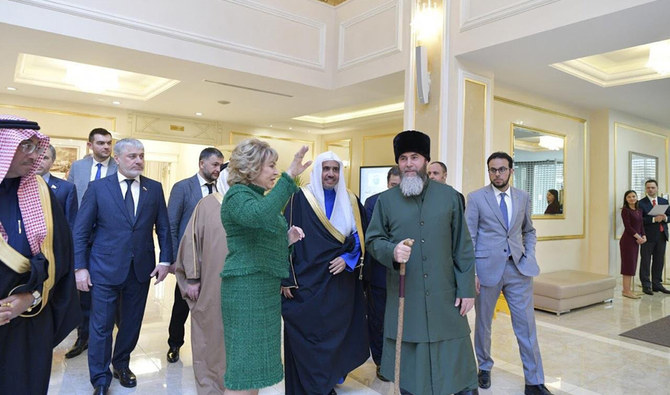
Russian official praises MWL chief’s humanitarian role

Valentina Matviyenko, chairwoman of Russia’s Federation Council, described the conference on Islam currently being organized by the MWL in Russia as historic. (SPA)
Updated 01 April 2019
Follow

Russian official praises MWL chief’s humanitarian role

  • Matviyenko described the conference on Islam currently being organized by the MWL in Russia as historic

MOSCOW: Valentina Matviyenko, chairwoman of Russia’s Federation Council, on Monday received Sheikh Dr. Mohammed bin Abdulkarim Al-Issa, secretary-general of the Muslim World League (MWL), in Moscow.

They discussed the importance of Islam in Russia, and the examples of coexistence and harmony set by the country’s Muslims.

They also discussed positive national integration in societies, and the characteristics that Russia possesses in this regard.

They discussed the importance of maintaining diversity in societies and employing it as a force for growth, while fighting and criminalizing hostile practices such as incitement to hatred and extremism.

Matviyenko described the conference on Islam currently being organized by the MWL in Russia as historic, and the first of its kind among international conferences hosted by the country.

Addressing Al-Issa, she said: “I’m sure that you’re playing an important humanitarian role, and acting as an international spiritual authority worthy of appreciation for its Islamic status.”

Matviyenko added that Islam is an important element of Russian culture, as Muslims have contributed throughout history to the country’s growth and rise.  

She said various religious groups in Russia are experiencing a remarkable revival, and this diversity has to be protected and turned into a force for growth.

“We offer you all the capabilities, services and assistance to promote the concepts of national integration, and we’ll make every effort to cooperate to eliminate extremism and hatred, which breed violence and terrorism,” she added.

“Russian law criminalizes these practices and punishes them, and we always seek to combat them.”

She said the conference’s participants will see in Russia the concepts of positive national integration by the country’s various religions and ethnicities.


Saudi Arabia’s KAUST named FIFA’s first research institute in MENA

The canal in the King Abdullah University of Science and Technology campus. (Shutterstock)
Updated 10 February 2026
Follow

Saudi Arabia’s KAUST named FIFA’s first research institute in MENA

  • KAUST President Prof. Sir Edward Byrne said that the university’s selection as the fifth FIFA Research Institute in the world — and the first in the region — marks a significant achievement, reflecting Kingdom’s growing presence in international football

RIYADH: FIFA has designated the King Abdullah University of Science and Technology as its first research institute in the Middle East and Asia to support the development of innovative football research, the Saudi Press Agency reported on Tuesday.

The recognition highlights KAUST’s commitment to integrating sports, academic research and industry through advanced, high-level initiatives grounded in rigorous scientific methodologies, contributing to the advancement of football studies.

KAUST President Prof. Sir Edward Byrne said that the university’s selection as the fifth FIFA Research Institute in the world — and the first in the region — marks a significant achievement, reflecting Saudi Arabia’s growing presence in international football.

The accreditation aligns with national efforts to invest in research and development and promote the knowledge economy, supporting Saudi Vision 2030’s goals of building an advanced sports system based on innovation and sustainability.

The collaboration’s first project focuses on developing advanced AI algorithms to analyze historical FIFA World Cup broadcast footage, transforming decades of match videos into structured, searchable data, according to the KAUST website.

This work opens new opportunities to apply state-of-the-art computer vision techniques and deepen understanding of how football has evolved over time.

The second project uses player and ball tracking data from the FIFA World Cup 2022 in Qatar and the FIFA Women’s World Cup 2023 in Australia and New Zealand to compile comprehensive datasets capturing in-game dynamics.

These datasets provide deeper insights into human movement, playing techniques and performance dynamics through AI-driven analysis.