

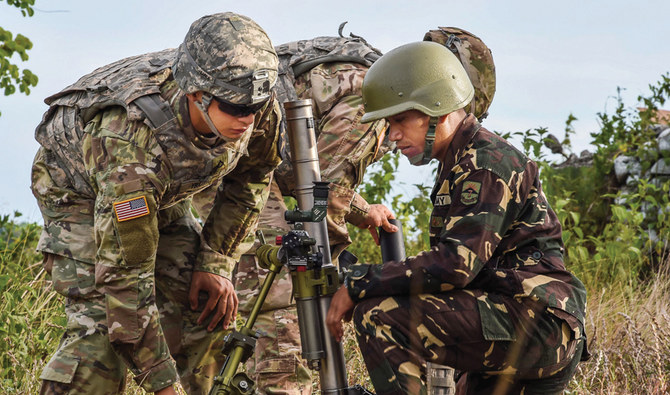
Philippine and US forces begin military exercises

The Balikatan military maneuvers uphold international norms. (Photo/Supplied)
Updated 01 April 2019
Follow

Philippine and US forces begin military exercises

  • Daesh-inspired groups pose a threat in southern Philippines

MANILA: More than 7,000 Filipino and American forces began their 35th joint military exercises on Monday as militants linked to Daesh continue to threaten the stability of the southern Mindanao islands.

Armed Forces of the Philippines (AFP) chief Gen. Benjamin Madrigal Jr. said the Balikatan (which translates as shoulder to shoulder) exercise this year will focus on territorial defense and counterterrorism.

The AFP, aided by US forces, crushed a Daesh-linked force that took over the city of Marawi in Mindanao in 2017.

Similar groups claimed the bombing of a church on the island of Jolo, south of Mindanao, which killed 23 worshippers in January.

Although 900 Daesh fighters, from the Philippines and elsewhere, were killed in Marawi, significant numbers are believed to be active in the Mindanao islands.

“Balikatan 2019 aims to enhance the interoperability of the Philippines and the United States forces in joint and combined operations, and to project a posture of readiness to combat any security threat,” Madrigal said during the inaugural ceremony held at Camp Gen. Emilio Aguinaldo.

Balikatan, the biggest war games involving US and Philippine troops, is a platform for the two countries to exchange best practices in military operations.

“(It’s) a venue where we could validate our defense plans, and an opportunity where we could amplify our alliances with other participating countries,” Madrigal said.

“All of us understand how threats on security constantly evolve, including the non-traditional security challenges at present. As we have this year’s Balikatan, we will shoulder the load together to prepare for these scenarios, and should a crisis or national disaster occur in the future, we’ll be ready.”

US Marine Corps Brig. Gen. Christopher McPhillips, the US exercise director for the annual military maneuvers, described Balikatan as one of the premier military training events in the Pacific, which has helped both militaries maintain regional stability, uphold international norms, combat violent extremism and alleviate human suffering.

He also said the US Marines are committed to standing shoulder to shoulder with their Filipino brothers and sisters “under any circumstances as true friends.”

US Ambassador Sung Kim said the importance of Balikatan extends far beyond the military interoperability of the two countries.

“It links us together on a personal level, fortifying friendships and better camaraderie from the lowest levels up to the leadership ranks,” Kim said. “The relationships, skills and cooperation that our nations build here will have significant implications for the safety and security of the Philippines and the whole Indo-Pacific region.”

The US envoy said he was shocked by the devastation of Marawi when he visited last year. “It was difficult to comprehend, but I was equally impressed to learn more about how our two militaries cooperated to defeat the insurgents and reclaim the city,” he said.

Marawi City was seized in 2017 by members of a local Islamist group that had pledged allegiance to and had been supported by Daesh in Iraq and Syria.

The group was defeated by government forces with US support after five months of heavy fighting that left the city destroyed.

“Our success in Marawi is an important reminder of how the training, relationships and shared experiences forged during exercises like Balikatan enabled us to defeat security threats and save lives,” said Kim.

More than 4,000 Filipino and 3,500 American troops will participate in this year’s Balikatan, which will include live-fire training, urban operations training, aviation operations, bilateral planning, and humanitarian and civic assistance projects.

Fifty members of the Australian Defense Force will participate in the special operations segment of the exercise.

This will also be the first Balikatan exercise to incorporate the US Navy’s amphibious assault ship USS Wasp and the US Marine Corps’ F-35B Lightning II aircraft.

“Participating in Balikatan demonstrates their ability to quickly forward deploy in support of an ally should a crisis or natural disaster occur,” said the US Navy.

Balikatan 2019 will also bring together representatives from Japan, Canada, New Zealand, South Korea, Thailand, Vietnam and the UK for an International Observers Program.

The program aims to promote greater defense cooperation with the Association of Southeast Asian Nations (ASEAN) and other key allies and partners, show multinational coordination where the observers can exchange ideas and best practices, and showcase the joint air, sea and ground operation of the Philippine-US armed forces.

Security expert Resty Aguilar said interoperability, as used in the exercise, is from the viewpoint of the armed forces of two different countries.

“It means they understand a common language, and at least a common interpretation of a certain tactic or strategy,” he told Arab News, adding that the exercises are important in preparation for natural catastrophes as well as combat.

In 2013, the US was one of the first countries to respond to the Philippines after super typhoon Yolanda wrought widespread destruction across the Visayas archipelago, killing more than 6,000 people.

“On the part of the Americans, their biggest take away is they learn a lot from their Filipino counterparts’ combat and non-combat experiences that are obtained in our own situation,” said Aguilar.

“Many of these are experiences that aren’t yet written in their reference materials or manuals, like the insurgency problems in the Philippines; they don’t have that in the US,” he added.

“They (the Americans) saw similarities in the insurgency in Iraq and Afghanistan. They only started reviewing our experiences when they were already fighting the insurgencies in Afghanistan and Iraq. It’s safe to say also that what they learned from us through these exercises somehow helped them in their operations in the Middle East.”


In Lahore’s historic Walled City, Ramadan fills the rows at Mughal-era Sunehri Mosque

Updated 46 sec ago
Follow

In Lahore’s historic Walled City, Ramadan fills the rows at Mughal-era Sunehri Mosque

  • Experts call for restoration of the 18th-century mosque amid encroachments and structural strain
  • Generations of traders shift their work schedules in Ramadan to gather for iftar and nightly prayers

LAHORE, Pakistan: In Old Lahore’s Kashmiri Bazaar, Ramadan changes the rhythm of trade.

By late afternoon, shop shutters begin to drop halfway and traders step away from their counters. Within minutes, the courtyard of Sunehri Mosque begins to fill.

On most days, the 18th-century mosque holds just a few rows of worshippers. In Ramadan, that number more than doubles.

“It has been 27 years since I have been leading the prayers here,” Qari Mohammed Hanif, the 47-year-old imam at the mosque, told Arab News. “On normal days, there are four to five rows. But in Ramadan, the mosque fills completely. People stand till the lower end.”

The congregation is largely drawn from the surrounding market — shopkeepers, traders and workers who close their businesses and walk directly into prayer.

The congregation at Sunehri Masjid is largely drawn from shopkeepers, traders and workers who close their businesses and walk directly into prayer. (Supplied)

For many, the mosque is inseparable from livelihood.

“I have a shop at Sunehri Masjid,” said Nasir Mehmood, 46, who runs a yarn business steps away. “This is our third generation running the shop. First it was my grandfather, then my father and now us. The shop is 50 years old.”

He said that at the beginning of Ramadan, he breaks his fast at home with his family. As the month progresses, the routine shifts.

“We start breaking our fast here at the shop, together with our friends and fellow shopkeepers. We also offer Taraweeh prayers here,” he continued, referring to the special Ramadan prayer performed after the obligatory Isha prayer at night.

Working hours extend as well.

“For the first three to four fasts, we come at 12 p.m. and leave after Asar prayers,” said Sheikh Mohammed Saleem, 50, who runs a clothing shop nearby. “After that, our routine changes. We open at 11 a.m. and stay until 12 a.m. at night, continuing this schedule until the last fast of Ramadan.

“Some food is brought from home, and some we buy from the market,” he added. “All of us gather together to break our fast.”

For many, the mosque is inseparable from livelihood. (Supplied)

Others return year after year for spiritual reasons.

“I have been coming here for 11 years,” said Mohammed Rafique, 45. “Whenever I am in this area, I always come to this mosque. I find peace here, peace in my heart. There is something from Allah. I cannot explain it. Whenever I come here, I try to break my fast here.”

Even younger traders feel a strong attachment to the space. Abdullah, 25, who gave only one name, said the mosque has become part of his working life.

“I have a shop in Lahore’s Rang Mehal, in Kasera Bazaar, under Sunehri Masjid,” he said. “I have been here for three years. The environment here is very good, the people are good.”

GILDED DOMES

The building that fills so quickly during Ramadan was constructed in 1753 during the later Mughal period by Nawab Bhikari Khan, a deputy governor of Lahore. Its three gilded domes gave it the name “Sunehri,” meaning golden.

Unlike imperial Mughal mosques built in expansive courtyards, Sunehri Mosque was embedded within a functioning marketplace. It rose not in isolation but among shops, a structure woven into commercial life rather than set apart from it.

“The Sunehri Mosque is small in scale because it was built during the decline of the Mughal Empire, a time when political power had weakened and resources were limited,” cultural heritage expert Saad Zahid told Arab News. “Its modest size and comparatively simple detailing reflect this period of reduced imperial strength.

Sunehri Mosque was embedded within a functioning marketplace. It rose not in isolation but among shops, a structure woven into commercial life rather than set apart from it. (Supplied)

“Unlike earlier Mughal monuments, it does not display the same richness or refinement, making it an important example of late Mughal architecture in Lahore,” he added.

Lahore, once a major administrative and cultural center of the Mughal Empire, saw numerous mosques constructed at the height of imperial power. Like most of them, Sunehri Mosque’s courtyard also featured a central pond, a hallmark of Mughal mosque design, though visitors usually find it dry these days.

Sunehri Masjid

While the mosque remains active and crowded during Ramadan, aspects of its physical condition raise concern.

The historic shops built beneath the mosque are now heavily encroached upon, obscuring parts of the mosque’s facade. Piles of wooden ladders and used boxes are stacked along sections of the structure. Tangled electricity wires hang across and above the building, cutting through the visual line of its domes. In some areas, residents hang washed clothes along its outer walls to dry.

B

angled electricity wires hang across and above the building, cutting through the visual line of its domes.  (Supplied)

Behind the mosque lies Baoli Bagh, once associated with an important Sikh-era gurdwara site, which Zahid said also deserves conservation.

He also argued that, like the Badshahi and Wazir Khan mosques, Sunehri Mosque should remain open to visitors beyond prayer times and be more actively promoted as part of Lahore’s historic landscape.

“The frescoes inside the mosque today appear overly bright and artificial. The original Mughal paintings were likely more subtle in tone, suggesting that later interventions have altered its authentic appearance,” he said, emphasizing the urgency of the building’s careful restoration to protect original design, materials and architectural identity rather than replace them with new construction.