PARIS: Big cities beset with gridlocked traffic, major regions producing coal, pockets of heavy industry encased by mountains — Europe’s air pollution hotspots are clearly visible from space on most sunny weekdays.
All across the continent, tens of millions of people live and work in areas where average air pollution levels are well above the maximum limits recommended by the World Health Organization (WHO).
But the density and type of pollutants can vary from town to town, and sometimes from block to block, depending on whether one is next to an expressway or inside an urban island of leafy green.
That variability makes it nearly impossible to say with accuracy which of Europe’s cities have the most befouled air.
But it is possible to pick out hotspot regions, and rank urban areas by type of pollutant.
On maps prepared by the European Environment Agency (EEA), Italy’s Po Valley is covered with a wide, stain-like blotch of air pollution from the Ligurian Sea in the west to the Adriatic, held in place by the towering Alps to the north.
Many cities in the valley have among Europe’s highest concentrations of dangerous microscopic particles less than 2.5 microns in diameter, known as PM2.5.
The WHO says these should not exceed, on average, 10 micrograms per cubic meter of air (10 mcg/m3) per year.
European Union standards are more lenient at 25 mcg/m3, and still several countries regularly overstep this red line.
PM2.5 is a top cause of premature deaths in the EU, some 391,000 in 2016 — 60,000 in Italy alone.
Turin and Milan, meanwhile, are also plagued by high levels of ozone and nitrogen oxides, produced mainly by petrol- and diesel-burning engines.
According to the Air Quality Life Index, maintained by researchers at the University of Chicago’s Energy Policy Institute, living in the Po Valley shaves half-a-year off one’s life expectancy.
Another dark spot on Europe’s pollution map is southern Poland, dense with coal-fired power plants and wood-burning.
For PM2.5, Krakow was the second most congested city on the continent in 2016, with an average annual concentration of 38 mcg/m3, just ahead of Katowice.
By comparison, some areas of northern India and China are plagued with concentrations three times higher.
EAA figures for 2016 also show that Krakow and Katowice exceed the recommended annual limits of nitrogen dioxide (NO2) and ozone.
Meeting WHO standards for small particle air pollution would add up to 1.5 years to people’s lives in this region, the Air Quality Life Index shows.
Virtually all major cities in Europe face seasonal pollution peaks or chronic air pollution due to non-electric road traffic.
According to Greenpeace, Sofia in Bulgaria boasted the highest levels of PM2.5 particulates in Europe in 2018, and placed 21st among all large cities in the world.
Close behind in the Greenpeace ranking — confirmed by EAA figures for 2016 — were Warsaw, Bucharest, Nicosia, Prague, Bratislava, Budapest, Paris and Vienna.
The high number of polluted cities in central Europe is directly linked to the continuing use of coal to generate electricity, experts say.
In western Europe, many cities have NO2 levels well in excess of EU-wide standards.
London tops the list, with an average annual concentration of 89 mcg/m3, followed by Paris (83), Stuttgart (82), Munich (80), Marseille (79), Lyon (71), Athens (70) and Rome (65).
Even wind-swept southern Europe has not escaped high levels of air pollution, notably ozone, which is created by a chemical reaction — triggered by sunlight — between nitrogen oxides (NOx) and volatile organic compounds.
The highest levels are generally found along the Mediterranean in spring and summer, when hundreds of thousands of sun-seekers descend upon the region.


London, Paris and Rome among air pollution hotspots in Europe
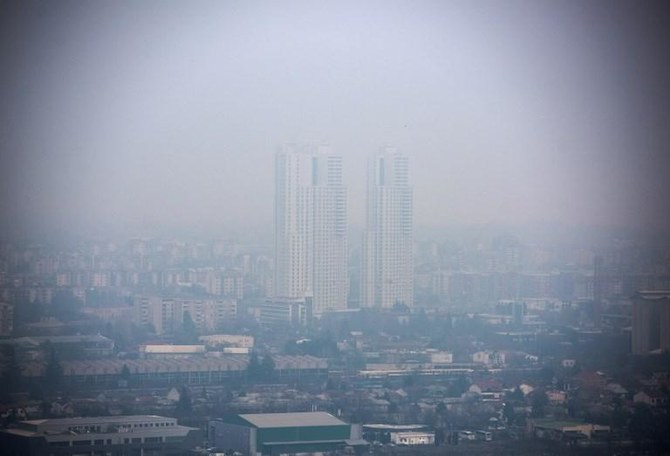
London, Paris and Rome among air pollution hotspots in Europe

- All across the continent, tens of millions of people live and work in areas where average air pollution levels are well above the maximum limits


Three-year heatwave bleached half the planet’s coral reefs: study
PARIS: A study published on Tuesday showed that more than half of the world’s coral reefs were bleached between 2014-2017 — a record-setting episode now being eclipsed by another series of devastating heatwaves.
The analysis concluded that 51 percent of the world’s reefs endured moderate or worse bleaching while 15 percent experienced significant mortality over the three-year period known as the “Third Global Bleaching Event.”
It was “by far the most severe and widespread coral bleaching event on record,” said Sean Connolly, one the study’s authors and a senior scientist at the Panama-based Smithsonian Tropical Research Institute.
“And yet, reefs are currently experiencing an even more severe Fourth Event, which started in early 2023,” Connolly said in a statement.
When the sea overheats, corals eject the microscopic algae that provides their distinct color and food source.
Unless ocean temperatures return to more tolerable levels, bleached corals are unable to recover and eventually die of starvation.
“Our findings demonstrate that the impacts of ocean warming on coral reefs are accelerating, with the near certainty that ongoing warming will cause large-scale, possibly irreversible, degradation of these essential ecosystems,” said the study in the journal Nature Communications.
An international team of scientists analyzed data from more than 15,000 in-water and aerial surveys of reefs around the world over the 2014-2017 period.
They combined the data with satellite-based heat stress measurements and used statistical models to estimate how much bleaching occurred around the world.
No time to recover
The two previous global bleaching events, in 1998 and 2010, had lasted one year.
“2014-17 was the first record of a global coral bleaching event lasting much beyond a single year,” the study said.
“Ocean warming is increasing the frequency, extent, and severity of tropical-coral bleaching and mortality.”
Australia’s Great Barrier Reef, for instance, saw peak heat stress increase each year between 2014 and 2017.
“We are seeing that reefs don’t have time to recover properly before the next bleaching event occurs,” said Scott Heron, professor of physics at James Cook University in Australia.
A major scientific report last year warned that the world’s tropical coral reefs have likely reached a “tipping point” — a shift that could trigger massive and often permanent changes in the natural world.
The global scientific consensus is that most coral reefs would perish at warming of 1.5C above preindustrial levels — the ambitious, long-term limit countries agreed to pursue under the 2015 Paris climate accord.
Global temperatures exceeded 1.5C on average between 2023-2025, the European Union’s climate monitoring service, Copernicus, said last month.
“We are only just beginning to analyze bleaching and mortality observations from the current bleaching event,” Connolly told AFP.
“However the overall level of heat stress was extraordinarily high, especially in 2023-2024, comparable to or higher than what was observed in 2014-2017, at least in some regions,” he said.
He said the Pacific coastline of Panama experienced “dramatically worse heat stress than they had ever experienced before, and we observed considerable coral mortality.”


