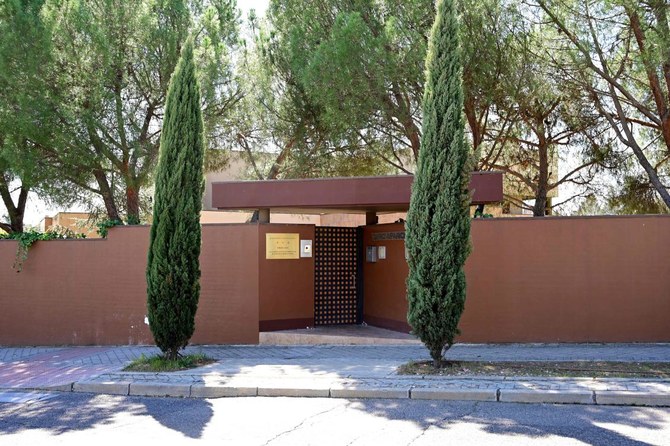
North Korea calls Madrid embassy raid a ‘grave terrorist attack’

The mystery over a commando-style assault on North Korea’s embassy in Madrid deepened after a shadowy group committed to overthrowing North Korean leader Kim Jong Un claimed responsibility. (AFP)
Updated 31 March 2019
Follow

North Korea calls Madrid embassy raid a ‘grave terrorist attack’

  • A group of armed men burst into Pyongyang’s Spanish embassy last month and roughed up employees before fleeing with documents and computers
  • The incident came just days before a high-stakes nuclear summit in Hanoi between North Korean leader Kim Jong Un and US President Donald Trump

SEOUL: North Korea on Sunday described the February raid on its embassy in Madrid by a dissident group as a “grave terrorist attack” and urged an investigation into the perpetrators.
A group of armed men burst into Pyongyang’s Spanish embassy last month and roughed up employees before fleeing with documents and computers.
The incident came just days before a high-stakes nuclear summit in Hanoi between North Korean leader Kim Jong Un and US President Donald Trump that ultimately failed to reach an accord.
In its first official comment on the raid, North Korea suggested Washington’s possible involvement and called on Spanish authorities to bring the “terrorists and their wire-pullers to justice.”
“A grave terrorist attack occurred on February 22, where an armed group assaulted the DPRK Embassy in Spain,” a spokesman for the foreign ministry said in a statement carried by the official KCNA news agency, using the acronym for the North’s official name.
“We expect that the authorities concerned in Spain... carry out an investigation into the incident to the last in a responsible manner.”
An investigation into the raid is already underway in Madrid.
On Wednesday, a Spanish court named Mexican national Adrian Hong Chang as leader of the group who contacted “the FBI in New York five days after the assault” with information related to the incident in the embassy.
Hours after the court statement, the Cheollima Civil Defense (CCD) — a dissident group believed to include high-profile North Korean defectors — claimed responsibility for the raid.


North Korea’s Kim positioning daughter as successor, Seoul spy agency briefing says

Updated 4 sec ago
Follow

North Korea’s Kim positioning daughter as successor, Seoul spy agency briefing says

  • Daughter Kim Ju Ae seen as de ‌facto second-highest leader
  • Briefing suggests Ju Ae provides input on policy matters
SEOUL: North Korean leader Kim Jong Un appears to be taking steps to consolidate his daughter’s position as successor, and there are signs she is providing input on policy matters, South Korean lawmakers said on Thursday, citing a spy agency briefing.
South Korea’s National Intelligence ‌Agency (NIS) will be closely ‌watching whether the daughter, believed to ‌be ⁠named Kim Ju Ae, ⁠attends an upcoming meeting of the ruling Workers’ Party and how she is presented, including whether she takes on any official title, the lawmakers said.
“In the past, the NIS described Kim Ju Ae as being ‘in study as successor’ but today the expression used was that she ‘was in the stage of being internally appointed ⁠successor’,” lawmaker Lee Seong-kweun told reporters following a closed-door briefing ‌from the NIS.
Ju Ae, who ‌is believed to be in her early teens, has been increasingly prominently ‌featured in North Korea’s state media accompanying her father on ‌field guidance including inspections of weapons projects amid speculation by analysts that she is being groomed as the country’s fourth-generation leader.
The NIS believes the role she has taken on during public events indicates she has started to ‌provide policy input and that she is being treated as the de facto second-highest leader, Lee and ⁠another lawmaker ⁠Park Sun-won said.
North Korea has announced the Workers’ Party will convene the inauguration meeting of the ninth Congress in late February, an event that analysts believe will unveil major policy goals for coming years on the economy, external affairs and defense.
Leader Kim Jong Un is directing the development of a large submarine that is likely capable of carrying up to 10 submarine-launched ballistic missiles (SLBM) and which, considering the vessel’s displacement of 8,700 tons, may be designed to be powered by a nuclear reactor, Park and Lee said.
It remains unclear, however, whether it will be nuclear powered or operationally functional as designed, the lawmakers said, citing the spy agency’s analysis.