

At Arab Media Forum in Dubai, social media told to ‘man up’ to counter hate rhetoric

1 / 3
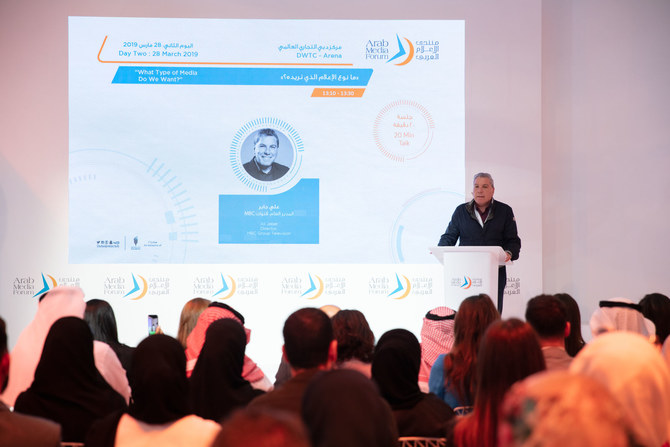
At a session titled “What Type of Media Do We Want?” Jaber told a fully-packed hall at the Dubai World Trade Center that “social media helped countries in the region gain some freedoms, but they had devastating effects for spreading terrorism and hard-line ideology. (DMO)
2 / 3
Daniel Funke, a journalist working with Poynter, a US school for journalists, gave a talk on “The Age of Fabrications,” in which he explained different types of misinformation and how it spreads. (DMO)
3 / 3
Phil Chetwynd, the global news editor at Agence France-Presse gave a session titled “Standing Together Against Fake News.”
Updated 02 April 2019
Follow

At Arab Media Forum in Dubai, social media told to ‘man up’ to counter hate rhetoric

  • MBC Group TV director Ali Jaber challenges big tech companies like Facebook and Google to become a ‘force of positive change’
  • Others talk about how to tackle the spread of fake news and misinformation in the digital age

DUBAI: Big tech companies such as Facebook and Google are not doing enough to counter hate rhetoric and terrorism and need to “man up,” MBC Group TV director Ali Jaber said on the second day of Dubai’s Arab Media Forum on Thursday.

“Digital platforms have become platforms that spread bigotry and hatred. They have to man up and organize and be more transparent,” Jaber told Arab News, adding that “they need to be a force of positive change, and not the negative force they have been for the past few years.”

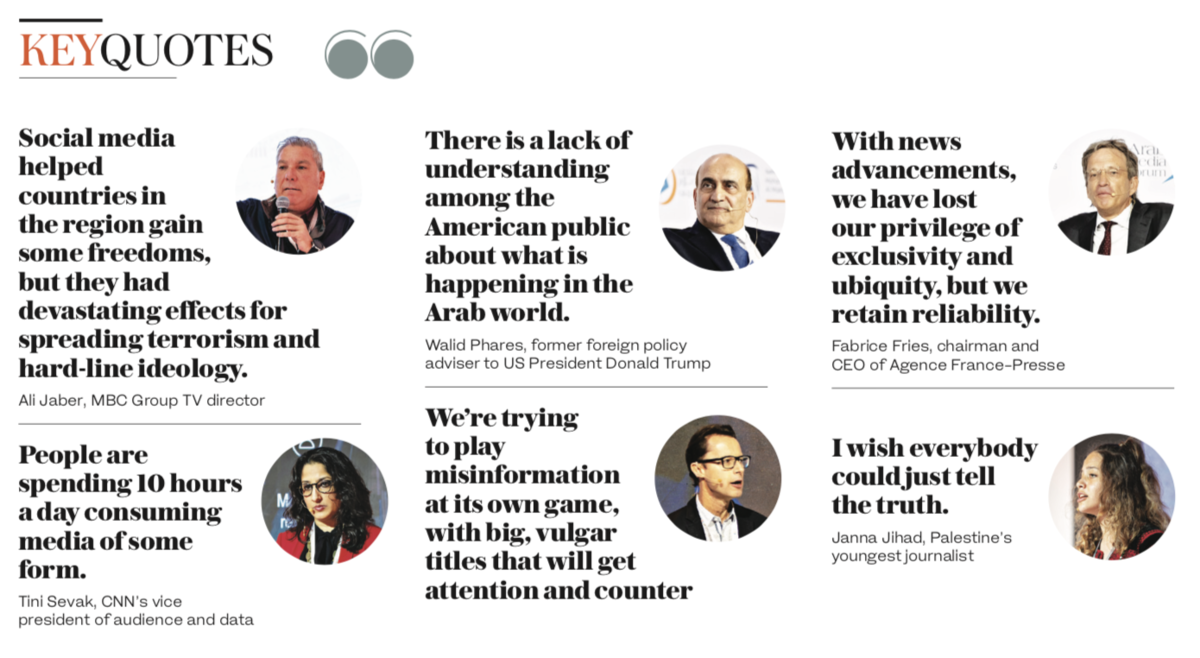
At a session titled “What Type of Media Do We Want?” Jaber told a fully-packed hall at the Dubai World Trade Center that “social media helped countries in the region gain some freedoms, but they had devastating effects for spreading terrorism and hard-line ideology.

“I have invested in the forum for the first time to launch a global anti-extremist initiative in the region,” he said, adding that “it is the responsibility of every journalist and media entity to counter and tackle these rhetorics. Whoever spreads them is not a journalist, but an instigator.”

Jaber also spoke of social media and big tech companies’ presence in everyone’s lives, for example,  how Google knows “when and what we eat, where we go, what we watch and what we do.”

“Google has an effect on us that we cannot even imagine, we don’t live in the world … we live in the Google world,” he said.

Countering terrorism and hate rhetoric in the region’s media has been a prevalent theme throughout the two-day forum, with several sessions highlighting the need to act swiftly and vigilantly.

Media agencies have been stepping up in terms of countering the spread of such deceit through the news mediums. Arab News recently launched a new series called Preachers of Hate, in which the words of the instigators are being documented and analyzed in an effort to inform the public of their ubiquity in all religions, and to create a dialogue to act against their destructive influence.

“The media possesses the power of the word and utilizes this power to make a positive impact on the community. Good words will grow and prosper. The media must maintain high levels of integrity and professionalism,” Dubai Ruler Sheikh Mohammed bin Rashid Al-Maktoum said at the forum on Wednesday.

Alongside countering terrorism and hate, delegates spoke about the continuing battle against fake news and misinformation. “We’re trying to play misinformation at its own game, with big, vulgar titles that will get attention and counter false news, as well as show and explain our craft of true reporting and fact-checking in Arabic and English,” Phil Chetwynd, the global news editor at Agence France-Presse, told the audience in a session titled “Standing Together Against Fake News.”

“We are in a position at the moment where we must justify everything that we are doing,” Chetwynd said. 

He showed examples of groups on Facebook getting more readers of stories than news entities do, which is troubling given the amount of misinformation that could be spread via these mediums when left unchecked.

Much is being done in countering fake news dissemination online. Several workshops and software programs were presented to journalists to help verify and fact-check certain news articles and images that are found online.
Daniel Funke, a journalist working with Poynter, a US school for journalists, gave a talk on “The Age of Fabrications,” in which he explained different types of misinformation and how it spreads.

“It’s not that hard to find fake news, but it’s really hard to tell when you want to intervene because you don’t want to amplify false narratives,” he told Arab News.

“Misinformation is trying to get a reaction out of you, so the headline could be all caps, big red letters, salacious claims, exclamation points, heavy punctuation … any of those things immediately should be a sign that things are probably not true,” he said.

But fake news could still appear in less obvious ways as it continuously adapts to draw in more viewers. “You see a lot of misinformation in your news feeds, and fact-checking journalists have become a primary defense against fakery. Anyone can become a fact-checker,” he said, adding that “if your mother tells you she loves you, check that out … check everything.”

Other sessions in the forum tackled the industry’s relationship with the political sphere. “There is a crisis between media and politics in the modern world,” said political analyst and author Abdel Monem Said. “Many media figures have become politicians and vice versa, and this is similar to the impersonation of roles between the political and media fields.”

He was speaking alongside Abdulrahman Al-Rashed, head of the editorial board at Al Arabiya, and Walid Phares, US President Donald Trump’s former foreign policy adviser.

“For us in the media, we try to give all parties space for self-expression, and this is the job of newsroom workers,” Al-Rashed said, adding that media should be unbiased and give a chance for all to voice their opinions and concerns.

Phares, however, gave the audience an insight into the West’s views of the Arab world, specifically those of US citizens. “There is a lack of understanding among the American public about what’s happening in the Arab world,’ he said.

The forum’s other sessions included one on the future of print journalism. “Print is not dead,” said Nayla Tueni, the editor-in-chief of Annahar newspaper in Lebanon.

Tueni referred to the day that Annahar printed blank pages in protest at the recent political stalemate in Lebanon, in which it took six months to form a government.

“Everyone went and bought the paper, which was only white (pages),” she said. “Print is still relevant.”


How media reshapes the rules of diplomacy

Updated 03 February 2026
Follow

How media reshapes the rules of diplomacy

  • International envoys discuss influence diplomacy, misinformation, and the growing need for credible storytelling
  • Dya-Eddine Said Bamakhrama: The Saudi Media Forum itself is a tool of influence diplomacy, projecting the Kingdom’s image and soft power to the world

RIYADH: As dialogue surrounding the media’s influence across all sectors continues at the fifth edition of the Saudi Media Forum, some of the Kingdom’s ambassadors took to the stage to discuss diplomacy in an age of greater transparency.

A major topic on the panelists’ minds was “influence diplomacy,” an evolution of traditional diplomacy shaped by modern realities, said Ambassador of Djibouti to the Kingdom and Dean of the Diplomatic Corps Dya-Eddine Said Bamakhrama.

Influence diplomacy draws on soft power, he said. It uses tools such as arts and culture, sports, education, and humanitarian work to serve political interests and enhance credibility.

According to Bamakhrama, Saudi Arabia harnesses that influence through international forums, cultural initiatives, and a growing global sports presence.

“The Saudi Media Forum itself is a tool of influence diplomacy, projecting the Kingdom’s image and soft power to the world,” he said. “When a child in Africa or Latin America wears the jersey of a Saudi football club, that is influence diplomacy reaching far beyond borders.”

South African Ambassador to the Kingdom Mogobo David Magabe added that every country seeks to project an image that accurately reflects its culture, values, and identity to the world through food, music, cinema, civil society engagement, and cultural exchange.

However, Magabe warned that influence diplomacy must respect legal frameworks, avoid interfering in internal affairs, and operate transparently and ethically.

Spain’s Ambassador to the Kingdom Javier Carbajosa Sanchez echoed those remarks in saying that influence diplomacy can be a positive tool when it is ethical, disciplined, and grounded in facts.

Media has historically played a generally positive role in shaping public opinion, he said. But the rise of digital platforms requires a more responsible hand.

Diplomatic communication must follow rules, training, and ethical limits. “Propaganda may work temporarily, but credibility is what endures,” Sanchez said.

The ambassadors also highlighted that media today, particularly digital media, was a key actor in diplomacy, not just an observer.

While credibility depends on truthful and consistent narratives, digital platforms also enable the rapid spread — and exposure — of falsehoods.

“In today’s connected world, lies are exposed faster than ever,” Bamakhrama added.

Propaganda-based diplomacy no longer survives in the age of digital transparency. Instead, an effective diplomatic narrative relies on diplomats and policymakers’ understanding of the audience’s mindset, honest and clear communication of facts, and giving the necessary context for events.

Truth, he said, does not always require full disclosure, but it does not tolerate deception.

And the truth is especially paramount during times of crisis. The ambassadors agreed that false narratives collapse during conflict, and unchecked narratives can escalate crises beyond control.

“During conflict, responsibility must be shared between governments and media institutions,” Sanchez said.

Misinformation, the speed of news cycles, and the pressure to respond instantly were cited by the South African ambassador as the biggest challenges facing influence diplomacy today.

Accurate storytelling weighed heavily on speakers’ minds in the forum, especially in an era when messages can diverge between digital and traditional media.

Many of the same concerns surfaced in “Television and Streaming Platforms: Conflict or Opportunity?”, a panel focused on journalism and broadcasting, where media leaders examined how misinformation and competition are reshaping television.

Tareq Al-Ibrahim, director of MBC 1 and MBC Drama Channels and chief content officer at MBC Shahid platform, said that social media is both a bridge and competitor to television.

“It allows us to reach wider and more diverse audiences, but it also competes for people’s time,” he said.

In addition to audiences being larger, more fragmented, and more demanding, news organizations must now not only compete with other newsrooms, but with every other form of content on social platforms.

Despite this, professional journalism still holds great value and reaches wide audiences — if it adapts.

Al-Ibrahim added that competition was essential, not just for platforms, but for the entire value chain: “From writers to cameramen to directors, competition raises everyone’s standards.”

He also pointed to the evolution of Arabic content over the last decade as driven by competition from Netflix, Shahid, and other regional and global platforms.

Amjad Samhan, head of social media at Al Arabiya news network, described what the network’s transition was like from television to social media.

The challenge, he said, was figuring out how to deliver news to people who are not actively looking for news.

One solution was to transform long-form TV content into fast, digital formats. “We built a parallel digital newsroom with the same standards and principles,” Samhan shared.

When the question of social media influencers was brought up, Samhan argued: “The real competition is not with influencers. It’s with low-quality content. Credibility is what distinguishes news institutions from content creators.”

Journalism is built on trust, resources, and responsibility while influencers often lack verification and accountability, he said.

Reflecting on what the rise of digital platforms means for television, Al-Ibrahim said they are not alternatives, but complementary partners.

“Television creates shared moments; platforms create personalized experiences,” and the average consumer could greatly benefit from both.