Pope to broaden Muslim dialogue with Morocco visit

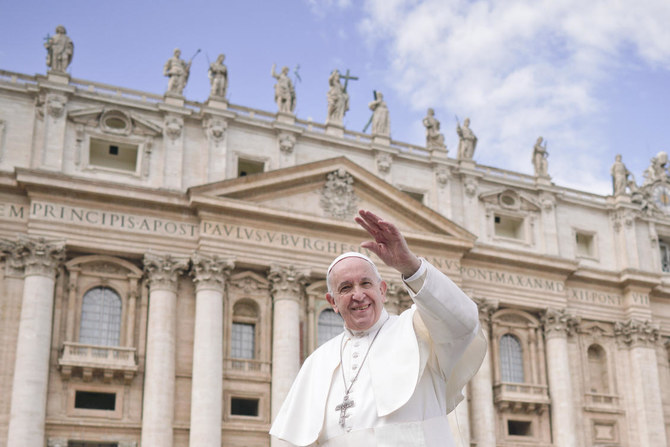
Pope Francis heads to Morocco on Saturday, the first pope to do so in 35 years, with interreligious dialogue and immigration on the agenda. (File/AP)
Updated 28 March 2019
Follow

Pope to broaden Muslim dialogue with Morocco visit

  • Up to 10,000 are expected to attend a mass in a Rabat stadium on Sunday, a first in the 99-percent Sunni Muslim country since Jean Paul II visited in 1985
  • The spiritual leader of the world's 1.3 billion Roman Catholics has repeatedly called for religious tolerance and dialogue and his visit is keenly awaited by the country's Christian minority

VATICAN CITY: Pope Francis heads to Morocco on Saturday, the first pope to do so in 35 years, with interreligious dialogue and immigration on the agenda.
The Argentine pontiff will be welcomed by the North African country's population of around 30,000 Roman Catholics, mostly sub-Saharan African students or migrants headed for Europe.
Up to 10,000 are expected to attend a mass in a Rabat stadium on Sunday, a first in the 99-percent Sunni Muslim country since Jean Paul II visited in 1985.
Following on from his visit to the United Arab Emirates in January, the papal mass will come the day after meeting the "Commander of the Faithful" King Mohammed VI and other senior religious leaders.
The spiritual leader of the world's 1.3 billion Roman Catholics has repeatedly called for religious tolerance and dialogue and his visit is keenly awaited by the country's Christian minority, including those who have converted from Islam.
Freedom of religion is inscribed in the Moroccan constitution, and during World War II King Mohammed V famously refused to cooperate with Nazi roundups of Jews.
"We dream of a free Morocco that takes responsibility for its religious diversity," the Christian Moroccan Coordination said ahead of the visit, hoping for a "historic occasion" for Morocco to "move forward in this direction".
According to the constitution, "Islam is the religion of State, which guarantees freedom to worship for all."
A religious official in Rabat who asked not to be named said that in Morocco "discretion is the name of the game".
Last June, Morocco's junior minister for human rights, Mustafa Ramid, said that freedom of belief was "a threat" to Morocco's cohesion.
Muslims can convert, but proselytising -- described as "shaking the faith of a Muslim or converting them to another religion" -- can be punished with up to three years in prison.
"Pope Francis's visit is important, for the fight against fanaticism, cultural blinkeredness, of intolerance but also... for positive interactions between religions, peoples and civilisations," said Morocco's ambassador to Paris, Chakib Benmoussa.
Pope Francis has said he would have liked to have gone to Marrakesh in December when over 150 countries signed the United Nations Global Compact for Migration. In the end he sent the Vatican's number two, Pietro Parolin.
The non-binding pact hoped to draw up a framework to deal with the global challenges of migration.
Francis will on Saturday meet migrants at the Caritas Diocesan Centre and give a speech.
Migrants are increasingly crossing the Mediterranean from North Africa to Spain since Italy all but closed its ports.
The Church has set up several such reception centres in different Moroccan cities, staffed by Christians and Muslims.
Morocco says that it has a "humanist" policy towards migrants but is regularly criticised by rights groups for mass arrests aimed at distancing would-be migrants from the Mediterranean.
"I hope that the pope's visit will help this matter progress," said Tangiers archbishop Santiago Angelo Martinez.
When Jean-Paul II visited in 1985 he an interreligious meeting for 80,000 youths in a stadium.
Then King Hassan II was the first Arab head of state to invite the pope to visit, and he himself visited the Vatican in 1991.


Secrecy, mines and Israeli strikes complicate removal of Assad-era chemical weapons, says Syrian envoy

Updated 7 sec ago
Follow

Secrecy, mines and Israeli strikes complicate removal of Assad-era chemical weapons, says Syrian envoy

  • Nevertheless, new authorities made significant progress in their work with Organization for the Prohibition of Chemical Weapons, he tells UN Security Council
  • Syrian authorities grant OPCW experts unrestricted access to 23 sites and since October have been hosting the organization’s longest continuous presence in the country

NEW YORK CITY: Syria’s envoy to the UN said on Thursday that secrecy surrounding the nation’s former chemical weapons program, security risks from land mines and other unexploded ordnance, and Israel’s targeting of suspected weapons sites continue to complicate his government’s efforts to eliminate Assad-era chemical weapons.
Speaking at a UN Security Council meeting about Syria’s chemical weapons, Ambassador Ibrahim Olabi said the nation’s new authorities had nevertheless made significant progress over the past year in their work with the Organization for the Prohibition of Chemical Weapons.
Despite what he described as “major challenges,” Syria had moved the issue “from a stage of suspicion and manipulation to one of partnership with the OPCW,” he said, adding: “Syria has achieved a qualitative leap in its cooperation with the OPCW.”
This shift is reflected in recent decisions by the watchdog’s executive council and changing positions among its member states, Olabi noted.
Syria’s chemical weapons program has been under international scrutiny since the early years of the country’s civil war, when repeated chemical attacks killed or injured large numbers of civilians. The deadliest incident occurred in 2013 in the Damascus suburb of Eastern Ghouta, when a sarin attack killed hundreds and triggered international efforts to dismantle the country’s chemical arsenal.
Olabi said the authorities that took over after President Bashar Assad and his regime were toppled in December 2024 were confronting what he called the “heavy legacy of the Assad era,” during which chemical weapons were widely used against civilians. He described the program as an inherited burden rather than a policy of the new government.
“The chemical file is a prime example of these inherited issues, issues of which we were victims,” he added.
Syrian authorities have granted OPCW experts unrestricted access during eight deployments that included visits to 23 sites, he said, and since October have been hosting what he described as the organization’s longest continuous presence in the country.
“This marks the beginning of a sustained presence of the OPCW in Syria,” Olabi added.
Adedeji Ebo, the UN’s deputy high representative for disarmament affairs, said OPCW teams visited 19 locations in Syria last year, four of them previously declared chemical weapons sites and 15 suspected locations, where they conducted interviews and collected samples in their attempts to determine the full scope of undeclared chemical weapons activity.
Some other sites are in dangerous areas, he added, which poses significant risks to both Syrian and international personnel.
“On-site destruction may be required where conditions prevent safe removal,” Ebo said, noting that a recent OPCW decision authorizing expedited on-site destruction of weapons marked a positive step forward.
He also highlighted the reestablishment of Syria’s National Authority for the OPCW and the watchdog’s current, continuous presence in Damascus.
Olabi said Syrian national teams had identified two sites containing empty cylinders previously used to store toxic chemicals and had immediately reported them to the OPCW. Syrian authorities also handed over about 6,000 documents relating to the former regime’s chemical weapons program, he added, and helped arrange interviews with 14 witnesses, including individuals who were involved with the program.
Syrian authorities were also cooperating with international investigators examining chemical attacks by Assad’s government, he said, and accountability and justice for the victims are priorities for the new authorities.
“Syria reiterates its determination to continue the efforts to close this chapter,” Olabi said, adding that there was “no place for chemical weapons in today’s world.”