

Morocco’s diverse Catholic community awaits Pope Francis

1 / 3
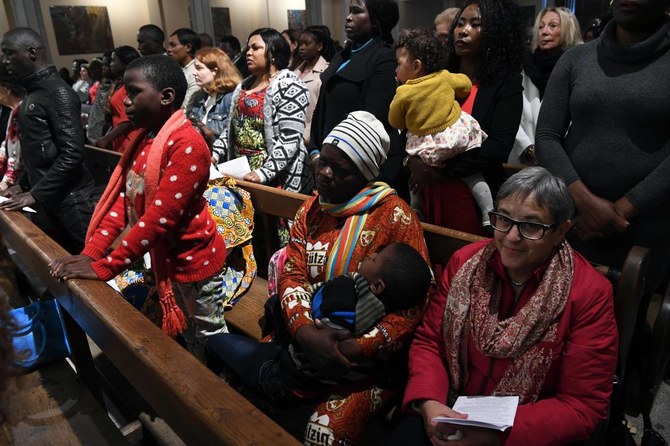
Around 30,000 to 35,000 Catholics live in Morocco. (AFP)
2 / 3
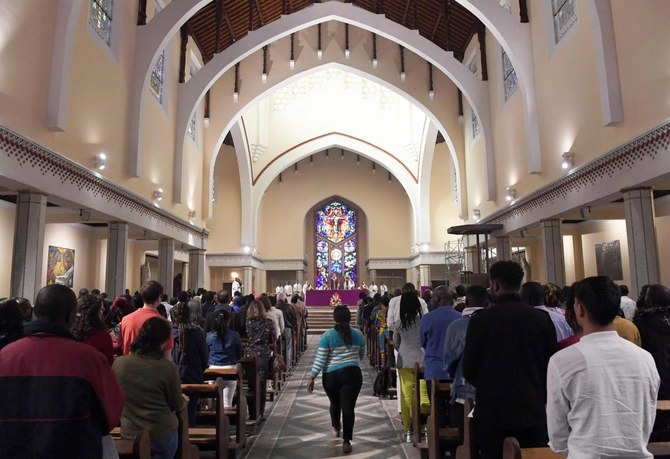
Back then there were more than 200 Catholic churches, while now just 44 remain. (AFP)
3 / 3
On the first Sunday of Lent, a tight crowd gathered around the cathedral nave including tourists, foreign retirees, and a majority of parishioners from sub-Saharan Africa. (File/AFP)
Updated 27 March 2019
Follow

Morocco’s diverse Catholic community awaits Pope Francis

  • The pope’s two-day visit follows an invitation by King Mohammed VI, as part of the “development of inter-religious dialogue”
  • The pope’s arrival on Saturday has been hailed as a “unique opportunity” by Rabat’s archbishop

RABAT: Ahead of Pope Francis arriving in Morocco, the country’s small and diverse Catholic community gathered excitedly at Rabat’s cathedral to get their hands on tickets to see the pontiff.
“We’re lucky! The pope is coming to Africa, it will bring together communities from all walks of life in a Muslim country. It’s extraordinary,” said Ernould Kumba, 27, originally from Congo-Brazzaville.
On the first Sunday of Lent, a tight crowd gathered around the cathedral nave including tourists, foreign retirees, and a majority of parishioners from sub-Saharan Africa.
The pope’s arrival on Saturday has been hailed as a “unique opportunity” by Rabat’s archbishop, Cristobal Lopez Romero, who said it demonstrates that “we value more that which unites us than that which divides us.”
“You come from all peoples and all countries,” the Spanish archbishop told churchgoers, rolling off a list of those who were due to be baptised.
Reflecting the diversity of the parish, there was a reading in Portuguese before the Lord’s Prayer in Arabic.
Around 30,000 to 35,000 Catholics live in Morocco, a tenth of the number before the North African country gained independence in 1956.
Back then there were more than 200 Catholic churches, while now just 44 remain, which are supported by Morocco’s migrant communities.
The first wave of arrivals from sub-Saharan Africa came in the 1990s, with students on university grants, followed by those over the past decade who are seeking to reach Europe.
“They breathe new life, I’ve never seen a church so young, with an average age of 30 to 35,” said Father Daniel Nourissat, who leads the Rabat parish.
Lizzie, a 20-year-old Ivorian, said she wasn’t previously a strong believer but “everything” changed when she came to study in Morocco.
“It’s not easy, here, and faith is a great support,” she said.
The sentiment was echoed by Jean-Baptiste, a fellow Ivorian, who said many parishioners attend church to “create a fraternity.”

The pope’s two-day visit follows an invitation by King Mohammed VI, as part of the “development of inter-religious dialogue” according to Moroccan authorities.
The king describes himself as the “commander of the faithful” and Islam is the state religion, although the constitution guarantees “to all the freedom to practice their faith.”
It is, however, a criminal offense to try to proselytise or “rock the faith of a Muslim or to convert him to another religion,” punishable with from six months to three years in prison.
“It’s true that compared to other Arab countries we have a degree of freedom,” said Mohamed, a Moroccan who converted to Catholicism in 2016.
The 70-year-old said he was “convinced by the preachings of Father Rachid,” a Christian convert and presenter on Egyptian satellite channel Al Hayat TV.
“It’s not always easy, but I don’t hide” visits to the cathedral, Mohamed said proudly.
With Christianity a sensitive subject, the Rabat parish avoids putting its flock in the spotlight.
“Some Muslims pretend that we don’t have the same God and that we will end up in hell,” said Cyrvine, a 24-year-old Congolese student who sings in the choir.
“But the pope’s visit will be an opportunity to unite communities and religions,” she added, impatient for the pontiff’s arrival.


UN rights chief Shocked by ‘unbearable’ Darfur atrocities

Updated 18 January 2026
Follow

UN rights chief Shocked by ‘unbearable’ Darfur atrocities

  • Mediation efforts have failed to produce a ceasefire, even after international outrage intensified last year with reports of mass killings, rape, and abductions during the RSF’s takeover of El-Fasher in Darfur

PORT SUDAN: Nearly three years of war have put the Sudanese people through “hell,” the UN’s rights chief said on Sunday, blasting the vast sums spent on advanced weaponry at the expense of humanitarian aid and the recruitment of child soldiers.
Since April 2023, Sudan has been gripped by a conflict between the army and the paramilitary Rapid Support Forces that has left tens of thousands of people dead and around 11 million displaced.
Speaking in Port Sudan during his first wartime visit, UN Human Rights commissioner Volker Turk said the population had endured “horror and hell,” calling it “despicable” that funds that “should be used to alleviate the suffering of the population” are instead spent on advanced weapons, particularly drones.
More than 21 million people are facing acute food insecurity, and two-thirds of Sudan’s population is in urgent need of humanitarian aid, according to the UN.
In addition to the world’s largest hunger and displacement crisis, Sudan is also facing “the increasing militarization of society by all parties to the conflict, including through the arming of civilians and recruitment and use of children,” Turk added.
He said he had heard testimony of “unbearable” atrocities from survivors of attacks in Darfur, and warned of similar crimes unfolding in the Kordofan region — the current epicenter of the fighting.
Testimony of these atrocities must be heard by “the commanders of this conflict and those who are arming, funding and profiting from this war,” he said.
Mediation efforts have failed to produce a ceasefire, even after international outrage intensified last year with reports of mass killings, rape, and abductions during the RSF’s takeover of El-Fasher in Darfur.
“We must ensure that the perpetrators of these horrific violations face justice regardless of the affiliation,” Turk said on Sunday, adding that repeated attacks on civilian infrastructure could constitute “war crimes.”
He called on both sides to “cease intolerable attacks against civilian objects that are indispensable to the civilian population, including markets, health facilities, schools and shelters.”
Turk again warned on Sunday that crimes similar to those seen in El-Fasher could recur in volatile Kordofan, where the RSF has advanced, besieging and attacking several key cities.
Hundreds of thousands face starvation across the region, where more than 65,000 people have been displaced since October, according to the latest UN figures.