

Iraqi, Jordanian leaders join Egypt at Cairo summit

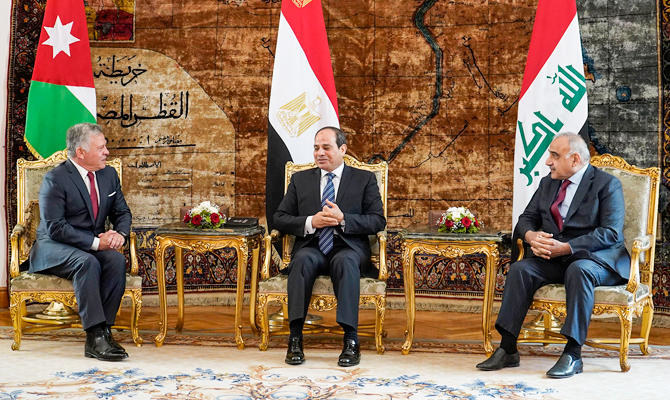
A handout photo released by the Jordanian Royal Palace on March 24, 2019 shows Jordan's King Abdullah II (L) and Iraq's Prime Minister Adel Abdel Mahdi (R) meeting with Egypt's President Abdel Fattah al-Sisi (C) at the presidential palace in the Egyptian capital Cairo. (AFP)
Updated 25 March 2019
Follow

Iraqi, Jordanian leaders join Egypt at Cairo summit

  • The statement stressed the importance of combating terrorism in all its forms and confronting those who support it by funding

CAIRO: President Abdel Fattah El-Sisi, King Abdullah II of Jordan and Adel Abdul Mahdi, the prime minister of Iraq, held a trilateral summit at the Federal Palace in Cairo at the weekend to discuss cooperation on a number of pressing regional issues.
While discussing energy, industrial development and infrastructure, the three leaders issued a joint statement stressing the importance of working with the rest of the Arab world to restore stability in, and find solutions to, ongoing crises in Palestine, Syria, Libya, and Yemen.
They expressed hope that the upcoming Arab League summit in Tunisia could provide a springboard for action on these conflicts, and that the assembled nations might agree a framework around which to share the burden of reconstructing the countries in question.
The statement also stressed the importance of combating terrorism in all its forms and confronting those who support it by funding, arming or providing safe havens and media platforms to political and religious extremists.
This came in the wake of the tragic attack on two mosques in Christchurch, New Zealand by a white supremacist gunman, and the declaration that the extremist group Daesh had relinquished control of its final territorial stronghold, the Syrian village of Baghouz, on Saturday.

Security issues
Amr Hashim Rabie, of Cairo’s Al-Ahram Center for Political and Strategic Studies, said: “The summit came at an important time, especially as it dealt with a number of developmental, economic, political and security issues, most notably in combating terrorism.”
El-Sisi and Mahdi also agreed to restart bilateral committees between Cairo and Baghdad which had not been held since 2002, shortly before the invasion of Iraq by a US-led coalition.
Hossam Al-Omda, a member of Egypt’s Foreign Affairs Committee, agreed with Rabie that the timing of the trilateral summit was significant. He cited the escalating events currently underway in the region, especially in neighboring Syria, with the defeat of Daesh and US government recognition of Israeli sovereignty over the Golan Heights, and increasing tensions in Gaza.


Trump warns Iran of ‘very traumatic’ outcome if no nuclear deal

Updated 12 February 2026
Follow

Trump warns Iran of ‘very traumatic’ outcome if no nuclear deal

  • Speaking a day after he hosted Netanyahu at the White House, Trump said he hoped for a result “over the next month”

WASHINGTON: US President Donald Trump threatened Iran Thursday with “very traumatic” consequences if it fails to make a nuclear deal — but Israeli Prime Minister Benjamin Netanyahu said he was skeptical about the quality of any such agreement.
Speaking a day after he hosted Netanyahu at the White House, Trump said he hoped for a result “over the next month” from Washington’s negotiations with Tehran over its nuclear program.
“We have to make a deal, otherwise it’s going to be very traumatic, very traumatic. I don’t want that to happen, but we have to make a deal,” Trump told reporters.
“This will be very traumatic for Iran if they don’t make a deal.”
Trump — who is considering sending a second aircraft carrier to the Middle East to pressure Iran — recalled the US military strikes he ordered on Tehran’s nuclear facilities during Israel’s 12-day war with Iran in July last year.
“We’ll see if we can get a deal with them, and if we can’t, we’ll have to go to phase two. Phase two will be very tough for them,” Trump said.
Netanyahu had traveled to Washington to push Trump to take a harder line in the Iran nuclear talks, particularly on including the Islamic Republic’s arsenal of ballistic missiles.
But the Israeli and US leaders apparently remained at odds, with Trump saying after their meeting at the White House on Wednesday that he had insisted the negotiations should continue.

- ‘General skepticism’ -

Netanyahu said in Washington on Thursday before departing for Israel that Trump believed he was laying the ground for a deal.
“He believes that the conditions he is creating, combined with the fact that they surely understand they made a mistake last time when they didn’t reach an agreement, may create the conditions for achieving a good deal,” Netanyahu said, according to a video statement from his office.
But the Israeli premier added: “I will not hide from you that I expressed general skepticism regarding the quality of any agreement with Iran.”
Any deal “must include the elements that are very important from our perspective,” Netanyahu continued, listing Iran’s ballistic missile program and its support for armed groups such as the Palestinian movement Hamas, Yemen’s Houthi rebels and Hezbollah in Lebanon.
“It’s not just the nuclear issue,” he said.
Despite their differences on Iran, Trump signaled his strong personal support for Netanyahu as he criticized Israeli President Isaac Herzog for rejecting his request to pardon the prime minister on corruption charges.
“You have a president that refuses to give him a pardon. I think that man should be ashamed of himself,” Trump said on Thursday.
Trump has repeatedly hinted at potential US military action against Iran following its deadly crackdown on protests last month, even as Washington and Tehran restarted talks last week with a meeting in Oman.
The last round of talks between the two foes was cut short by Israel’s war with Iran and the US strikes.
So far, Iran has rejected expanding the new talks beyond the issue of its nuclear program. Tehran denies seeking a nuclear weapon, and has said it will not give in to “excessive demands” on the subject.