
DUBAI: Thirty-five-year-old Mushtaq Ahmed prepares a sweet rice dish called kheer in his camp on March 23 every year.
He then goes around his compound distributing it to his coworkers. That is how he has been celebrating Pakistan Day in Jeddah for more than eight years now.
“I live and work in Jeddah as an electrician. Every year on March 23 I used to miss Pakistan Day festivities in my home town,” said Ahmed, who asked not to use his real name.
When the feeling became acute, he called up his mother and asked her for the recipe of this dish.
“I decided to treat all my friends and colleagues regardless of their nationality. This is my way of celebrating my home country in an adopted country,” said Ahmed who comes from a village near Islamabad, the capital of Pakistan.
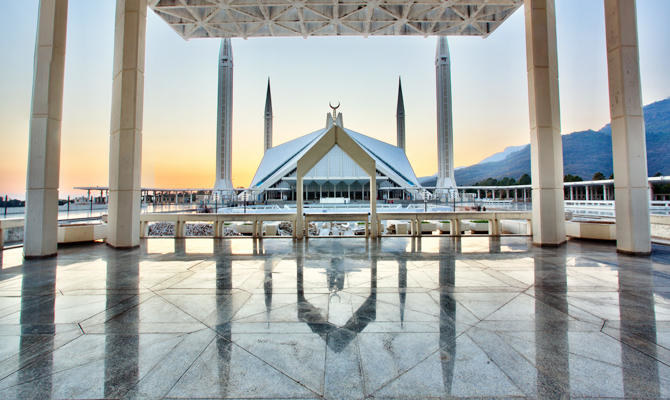
What he misses most, however, is going for Friday prayers at the Shah Faisal Mosque in Islamabad.
“That mosque is the pride of Pakistan. It was named after the late Saudi King Faisal, who loved our country,” he explained.
“I have been visiting this mosque since I was a teenager. I often prayed to Allah to get me a job in Saudi Arabia so that I can take care of my family members financially,” said Ahmed.
Working in Saudi Arabia has been a dream come true for him. “Earning a living for your family is the ultimate objective for any Pakistani here, whether it is an illiterate worker like me or a Western-educated CEO,” he said.
Ahmed is one of the 2.7 million Pakistanis who live in Saudi Arabia. In his own way, Ahmed maintains the relationship between the two countries.
He is not alone — Pakistan and Saudi Arabia are indeed connected in many ways. So to mark Pakistan Day, Arab News gathered views of experts in both the countries and asked them what the two countries mean to each other.
“Some of Pakistan’s celebrities — model-actor Fawad Khan, politician Marvi Memon and former prime minister Shaukat Aziz — have connections with Saudi Arabia, ” said Ahmed Quraishi, an Islamabad-based journalist and senior research fellow at Project for Pakistan in the 21st Century. Fawad Khan spent his childhood in Riyadh, while Marvi Memon’s father and Shaukat Aziz both worked in KSA.
Success stories of Pakistanis and Saudis connected through marriage could itself be the subject of a book as millions in Pakistan are linked to life in the Kingdom.
For Quraishi, Faisalabad (the Pakistani city named after King Faisal) is a permanent reminder of the connection, as is the Faisal Mosque.
He said that for Pakistan, Riyadh represents a force for positive change, the market economy, and peace in the Middle East.
“Riyadh is bringing in a lot of positivity to the region by promoting religious moderation, region-wide conflict resolution, and encouraging younger generations in the region to become active participants in the global economy.”
Senator Lt. Gen. Abdul Qayum was based in Saudi Arabia alongside 20,000 Pakistani army troops in 1985-87.
“I was a senior officer and as a lieutenant colonel in Khamees Mashaaikh I headed a 1,000-strong force that included pilots, engineers, artillery and defense units,” he said.
Lt. Gen. Qayum remembered those two years as among the best of his career and his personal life. “Since then, like millions of other Pakistanis, Saudi Arabia has been my second home.”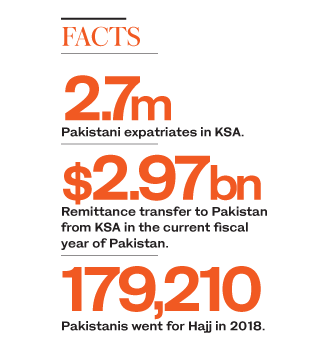
Qayum, who now heads Pakistan’s Senate Standing Committee on Defense Production, quoted Pew research to say that the most positive perception in the world of Saudi Arabia is in Pakistan. He said that faith is the main reason that connects both the countries very strongly.
“Millions of Pakistanis visit Makkah and Madinah for Hajj and Umrah. Our Hajj quota is the second largest in the world,” he said.
Qayum noted that millions of Pakistanis living in the Kingdom further the strong connection that exists between the two countries.
“These expatriates, whether blue-collar or white-collar, send millions worth of remittances to our country, which gives strength to our economy. And it is not just about the nation’s economy, this money also tremendously improves their personal financial conditions,” said Qayum.
It is because of income earned in Saudi Arabia that they have been able to provide quality living to their families.
Pakistan recorded a 12.2 percent increase in the inflow of remittances in the first seven months of the current fiscal year, according to official data released by the State Bank of Pakistan (SBP).
Saudi Arabia continues to be the largest source of remittances to Pakistan, the SBP report released on Monday said, with $2.97 billion recorded during the seven months of the current fiscal year.
Quraishi chooses to look at it from the prism of peace and security, and it works both ways.
“For Riyadh, Pakistan is an anchor for peace and stability in a region extending from West Asia to South Asia and Afghanistan,” Quraishi said.
On the other hand, according to Quraishi, the largest Pakistani diaspora resides in Saudi Arabia and the Gulf region, and Islamabad has important political, economic and strategic interests tied up to this region.
“The stability and security of the Arabian Sea and Arabian Gulf and the GCC states is an intrinsic Pakistani interest,” he noted.
Omar Farooqui, a Jeddah-based Saudi educator and entrepreneur, believes that Saudi Arabia and Pakistan are two forever-intertwined countries. He has his own reasons to draw that analogy.
“Saudi Arabia sees Pakistan as a country with major geographical advantages, and by investing heavily in Pakistan it has further entrenched itself strategically,” said Farooqui.
“For Saudi Arabia, having a strong, prosperous and thriving Pakistan is good for business and stability in the Muslim world and beyond,” said Farooqui, whose father migrated from Pakistan to Jeddah during the 1960s.
“From the oil boom of the 1960s, during the leadership of King Faisal, up to today under the leadership of King Salman and HRH Mohammed bin Salman, Saudi Arabia has always come to the aid of Pakistan during difficult economic times,” he said.
On the other hand, Pakistan has always provided Saudi Arabia with both tactical military services and a huge labor force for the Kingdom’s real estate and construction projects.
Omar also has numerous Pakistani friends in Saudi Arabia who have been living in the country for decades.
“They live a fabulous lifestyle and would never want to change it for any place on earth. For them, Saudi Arabia is a second home due to the fact that the treatment they get from their gracious hosts is incredibly generous,” he added.
Quraishi said that beyond people and economy the relationship is also about strategic partnership, and Riyadh and Islamabad have key roles to play to end the spread of extremism and extremist violence.
“Riyadh enjoys a spiritual power as the home to Islam’s two holiest places, and Pakistan is one of the largest Muslim nations, a military power, and a country with a long experience in countering the destructive role of groups that espouse extremism and militancy,” he said.
This is why both countries are cooperating with 38 other nations from the Muslim world in a joint effort under the banner of the Islamic Military Counter Terrorism Coalition (IMCTC).
“The objective is to curb and to end the malign influence of extremist, sectarian and violent groups that hurt the interests of Muslim peoples everywhere, and unite all Muslims in all of their schools of thought in a spirit of tolerance and acceptance,” said Quraishi.
He explained that both Pakistan and Saudi Arabia are forward-looking progressive nations that draw support and inspiration from each other and have the best interests of Muslim countries, the region, and the global community at heart.
“This is a significantly important relationship and one that many are watching closely.”