Trump fan to plead guilty to 2018 package bombs

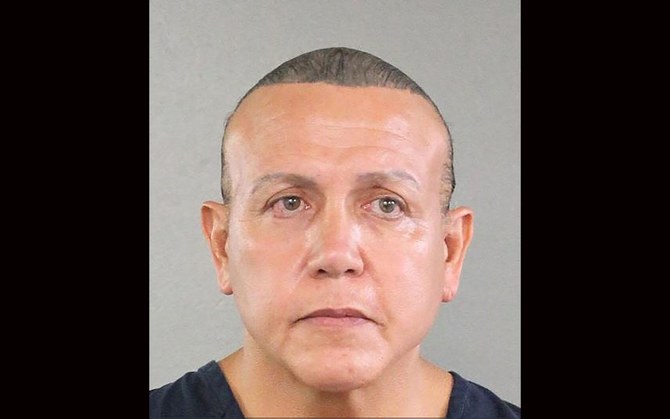
Above, an August 2015 mugshot of Cesar Sayoc released by Broward County Sheriff’s Office. Sayoc is expected to plead guilty to some of the 30 charges against him, all related to the 16 package bombs he sent to prominent personalities. (Broward County Sheriff’s Office/AFP)
Updated 21 March 2019
Follow

Trump fan to plead guilty to 2018 package bombs

  • The package bombs’ intended recipients included billionaire philanthropist George Soros, former secretary of state Hillary Clinton, former president Barack Obama
  • Cesar Sayoc’s criminal record dates back to 1991

NEW YORK: A fan of US President Donald Trump who mailed parcel bombs to prominent Democratic figures last October was set to appear in court Thursday, where he was expected to plead guilty to some of the 30 charges against him.
Cesar Sayoc, 57, who was arrested in Florida on October 26 following a massive manhunt, was due in federal court in New York at 4:00 p.m.
Although it was not known which charges he would plead guilty to, all relate to the 16 package bombs he is accused of mailing from a Florida post office to several well-known people who oppose Trump, as well as the Manhattan offices of CNN. He previously pleaded not guilty to all counts.
The packages’ intended recipients included billionaire philanthropist George Soros, former secretary of state Hillary Clinton, former president Barack Obama, former vice president Joe Biden, actor Robert De Niro and several Democratic lawmakers, including 2020 presidential hopefuls Cory Booker and Kamala Harris.
None of the packages exploded or even reached their targets and authorities questioned the actual danger they posed.
But by targeting Democrats, Sayoc — who also goes by the alias Cesar Altieri and was identified by DNA recovered from the packages — helped contribute to heightened tensions during the US midterm election campaign season.
Sayoc’s partial guilty plea Thursday could help mitigate the severity of a sentence if he is convicted on all counts.
As his trial loomed, information from Sayoc’s past began to filter into the public sphere, fueling the debate about extremism in the age of Trump and social media — a debate that grew more urgent as 11 people were shot dead at a Pittsburgh synagogue later in October.
Estranged from his family and in financial distress, Sayoc lived in a white van plastered in stickers proclaiming his admiration for the US president.
His criminal record dates back to 1991, peppered with convictions for theft, fraud, violence and a threat to bomb his electric utility company.
A former strip club manager and an adept bodybuilder and martial arts practitioner, Sayoc discovered a passion for Trump just as his political star was rising.
His social media posts took a politically radical turn: he’s seen wearing a “Make America Great Again” hat, sharing pro-Trump images and posting articles from ultra-conservative and conspiracy-driven websites such as Infowars and Breitbart.
“He was very angry and angry at the world, at blacks, Jews, gays,” recalled Debra Gureghian, the general manager of a Florida pizzeria where Sayoc worked as a delivery driver for several months.
Lawyer Ron Lowy, who defended Sayoc in 2002 and remained close to his family, described him on NPR in October as someone whose “intellect is limited, and who is “like a little boy in a man’s body.”


Bangladesh readies for polls, worry among Hasina supporters

Updated 6 sec ago
Follow

Bangladesh readies for polls, worry among Hasina supporters

  • The Muslim-majority nation of 170 million people will hold elections on February 12, its first since the uprising
  • Hasina was sentenced to death for crimes against humanity in Nov. and her former ruling party has been outlawed

Gopalganj: Bangladesh is preparing for the first election since the overthrow of Sheikh Hasina, but supporters of her banned Awami League (AL) are struggling to decide whether to shift their allegiance.

In Gopalganj, south of the capital Dhaka and a strong bastion of Hasina’s iron-grip rule, residents are grappling with an election without the party that shaped their political lives for decades.

“Sheikh Hasina may have done wrong — she and her friends and allies — but what did the millions of Awami League supporters do?” said tricycle delivery driver Mohammad Shahjahan Fakir, 68, adding that he would not vote.

“Why won’t the ‘boat’ symbol be there on the ballot paper?” he said, referring to AL’s former election icon.

The Muslim-majority nation of 170 million people will hold elections on February 12, its first since the uprising.

Hasina, who crushed opposition parties during her rule, won landslide victories in Gopalganj in every election since 1991.

After a failed attempt to cling to power and a brutal crackdown on protesters, she was ousted as prime minister in August 2024 and fled to India.

She was sentenced to death in absentia for crimes against humanity by a court in Dhaka in November, and her former ruling party, once the country’s most popular, has been outlawed.

Human Rights Watch has condemned the AL ban as “draconian.”

“There’s so much confusion right now,” said Mohammad Shafayet Biswas, 46, a banana and betel leaf seller in Gopalganj.

“A couple of candidates are running from this constituency — I don’t even know who they are.”

As a crowd gathered in the district, one man shouted: “Who is going to the polling centers? We don’t even have our candidates this time.”

‘DEHUMANISE’

Hasina’s father, Sheikh Mujibur Rahman, the founding president of Bangladesh, hailed from Gopalganj and is buried in the town.

Statues of Rahman have been torn down nationwide, but in Gopalganj, murals and statues are well-maintained.

Since Hasina’s downfall, clashes have broken out during campaigning by other parties, including one between police and AL supporters in July 2025, after which authorities filed more than 8,000 cases against residents.

Sazzad Siddiqui, a professor at Dhaka University, believes voter turnout in Gopalganj could be the lowest in the country.

“Many people here are still in denial that Sheikh Hasina did something very wrong,” said Siddiqui, who sat on a government commission formed after the 2025 unrest.

“At the same time, the government has constantly tried to dehumanize them.”

This time, frontrunners include candidates from the Bangladesh Nationalist Party (BNP) and Jamaat-e-Islami, the country’s largest religious party.

Both are from Hasina’s arch-rivals, now eyeing power.

“I am going door to door,” BNP candidate S.M Zilany, 57, told AFP, saying many would-be voters had never had a candidate canvass for their backing.

“I promise them I will stand by them.”

Zilany said he had run twice against Hasina — and was struck down by 34 legal cases he claimed had been politically motivated.

This time, he said that there was “a campaign to discourage voters from turning up.”

Jamaat candidate M.M Rezaul Karim, 53, said that under Hasina, the party had been driven underground.

“People want a change in leadership,” Karim told AFP, saying he was open to all voters, whatever their previous loyalties.

“We believe in coexistence; those involved in crimes should be punished; others must be spared,” Karim said.

Those once loyal to Hasina appear disillusioned. Some say they had abandoned the AL, but remain unsure whom to support.

“I am not going to vote,” said one woman, who asked not to be named.

“Who should I vote for except Hasina? She is like a sister.”