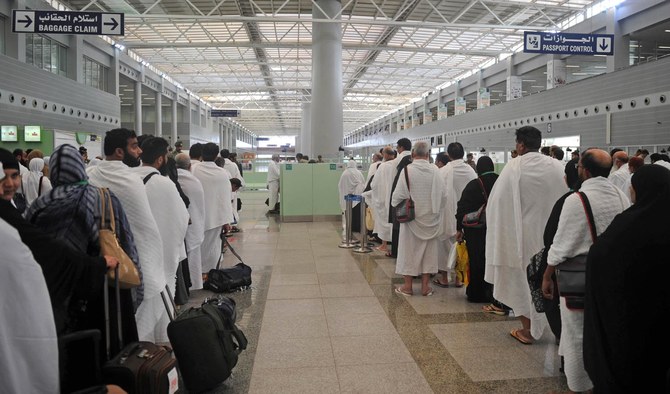
Saudi officials’ visit to check Pakistan’s Hajj immigration facilities

In this file photo, Pakistani Muslims wait to pass security as the first pilgrims for the annual Hajj pilgrimage arrive in Jeddah on July 24, 2017. (AFP)
Updated 20 March 2019
Follow

Saudi officials’ visit to check Pakistan’s Hajj immigration facilities

  • Kingdom to deploy staff at airports in the country to facilitate pilgrims
  • More than 180,000 to perform Hajj this year

ISLAMABAD: A 14-member delegation from Saudi Arabia is expected to visit Pakistan on March 31 in order to examine immigration facilities at various airports in the country, officials said on Wednesday.
The move is part of measures to facilitate more than 184,000 Hajj pilgrims as part of the Kingdom’s Road to Makkah project.
Saudi Crown Prince Mohammed bin Salman had formally granted permission to include Pakistan in the “Road to Makkah Project” – an initiative to facilitate pilgrims from across the Muslim world – during his visit to Islamabad in February.
“Pakistan’s inclusion in this project is nothing less than a blessing,” Imran Siddique, spokesman for Ministry of Religious Affairs, told Arab News on Wednesday.
He said that the Saudi delegation, comprising top government officials, would be checking arrangements for a seamless immigration process at the airports.
“They will assess the need of the staff to be deployed at our four major airports including Islamabad, Karachi, Lahore and Peshawar to get the immigration of all the pilgrims done here,” he said.
Terming it as a “great achievement” for Pakistani pilgrims, the spokesman also thanked the Saudi crown prince for extending the facility. Hajj flights from Pakistan to Saudi Arabia will begin from the first week of July.
A total of 184,210 pilgrims from Pakistan will perform Hajj this year, out of which 107,526 Pakistanis will perform Hajj on the government’s quota, while more than 76,000 will be using services offered by private tour and Hajj operators.
Siddique clarified that local immigration facilities will also be extended to those individuals who are not part of the government’s program and are planning their pilgrimage with private tour operators.
During his visit, the Saudi crown prince had signed agreements worth $20 billion in different fields including petrochemicals and renewable energy. “We believe Pakistan is going to be a very very important country in the future and we want to be sure we are part of that,” he said in his address at the inaugural session of the Supreme Coordination Council, co-chaired by Prime Minister Imran Khan and the crown prince.
Abuzar Butt, a private tour and Hajj operator, said that the completion of all immigration-related formalities at Pakistani airports will help Pakistani pilgrims, especially the elders, to save a lot of time and hassle.
“The local immigration means our pilgrims will go through the immigration process in Pakistan, saving them the hassle of going to the immigration counters once they reach Saudi Arabia,” he told Arab News.


Pakistan transporters call off five-day strike after successful talks with Punjab government

Updated 5 sec ago
Follow

Pakistan transporters call off five-day strike after successful talks with Punjab government

  • Transporters went on strike against heavy fines, penalties imposed by Punjab over traffic violations
  • Punjab government sets up committee to resolve transporters issues, confirms provincial minister

ISLAMABAD: Pakistani goods transporters called off their five-day-long nationwide strike on Friday after successful talks with the Punjab government, officials and transporters confirmed, as the business community warned of an impending economic crisis if the dispute stayed unresolved. 

Transporters went on a nationwide strike on Dec. 8 against stringent traffic rules and heavy fines imposed by the Punjab government over traffic violations. These penalties were included in the Motor Vehicle Ordinance 2025 last month. 

The ordinance details hefty fines ranging from Rs2000 [$7] to Rs50,000 [$178] and mentions prison sentences going up to six months for various offenses committed by drivers, such as driving on the wrong side of the road or driving in vehicles with tinted windows. 

“Yes, the strike has been called off after our meeting with Senior Minister of Punjab Marriyum Aurangzeb,” Nabeel Tariq, president of the All Pakistan Goods Transport Association (APGTA), told Arab News. 

Tariq said fines ranging from Rs1000 ($3.6) to Rs1500 ($5.4) for traffic violations have been increased to around Rs20,000 ($71.3) as per the new rules. 

He said the APGTA has agreed to accept a 100 percent or even 200 percent hike in fines. However, he said an increase of 2000 percent was not “logical.”

“Our urgent demands have been accepted and a committee has been formed to review the ordinance and come up with recommendations,” Tariq said. 

Speaking to Arab News, Aurangzeb confirmed the strike had been called off after talks with the Punjab government and that a committee has been formed to resolve the transporters’ issues. 

The committee will be headed by Aurangzeb and will include representatives of goods transporters, a statement issued by her office said. 

“The government wants to protect human lives and make things better for all citizens,” the statement said. “We will resolve the issues (with transporters) amicably.” 

‘UNPRECEDENTED CRISIS’

Pakistan’s business and industrial community, meanwhile, warned of an impending crisis if the disputed was not resolved. 

The All Pakistan Textile Mills Association (APTMA) and the Karachi Chamber of Commerce and Industry (KCCI) have both appealed for immediate government intervention.

Imdad Hussain Naqvi, president of the Grand Transport Alliance Pakistan (GTAP), told Arab News that over 400,000 goods carriers had been stranded across Pakistan due to the strike, affecting supplies to millions of consumers.

Earlier, in a letter to Punjab Chief Minister Maryam Nawaz, APTMA Chairman Kamran Arshad said the strike has “critically impacted import and export operations which are backbone of the country’s economy.”

He said hundreds of cargo vehicles remain stranded across Punjab, creating “abnormal delays” in goods movement and triggering heavy demurrage, detention charges, missed vessels and production shutdowns due to the non-availability of raw materials.

Arshad warned the disruption poses “a serious risk of order cancelation of export orders by international buyers, which would have far-reaching consequences for Pakistan’s foreign exchange earnings.”

Meanwhile in Pakistan’s commercial hub Karachi, KCCI President Rehan Hanif issued an even stronger warning, saying the nationwide strike threatens to paralyze Pakistan’s economic lifeline. 

“The complete suspension of cargo movement is pushing Pakistan toward an unprecedented trade and industrial crisis,” Hanif said in a statement. 

He added that import and export consignments are now stranded at the city’s ports, highways and industrial zones.