

Facebook under pressure to improve livestream moderation after New Zealand mosque attacks

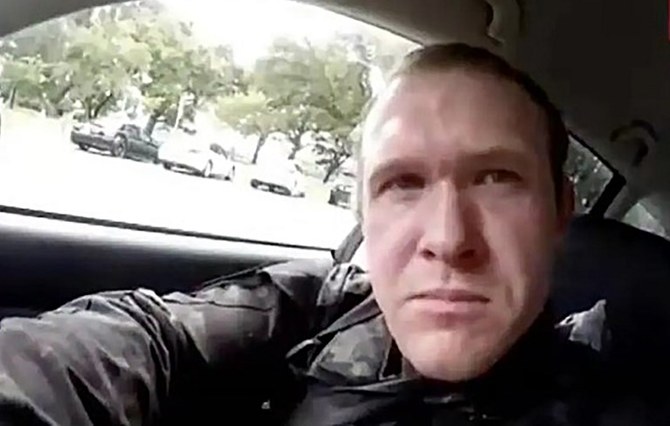
Facebook has removed 1.5 million videos globally of the New Zealand mosque attack, livestreamed by gunman Brenton Tarrant, above, in the first 24 hours after the attack. (Handout/AFP)
Updated 19 March 2019
Follow

Facebook under pressure to improve livestream moderation after New Zealand mosque attacks

CHRISTCHURCH, New Zealand: Facebook is facing pressure from New Zealand’s advertising industry and the country’s Privacy Commissioner for its role in distributing footage of the Christchurch mosque attacks.

The attacks, which killed 50 people, were live-streamed for almost 17 minutes on Facebook. the attack on two Christchurch mosques.

“Our concern as an industry is that live-streaming of these events becomes the new normal,” said Paul Head, chief executive of New Zealand’s Commercial Communications Council, which represents the country’s advertising agencies.

“We’re asking all of the platforms… to take immediate steps to either put in place systems, processes, algorithms or artificial intelligence that stops this kind of event,” he said.

Lindsay Mouat, chief executive of the Association of New Zealand Advertisers, confirmed some of New Zealand’s “very largest companies” were making changes to their advertising plans in light of the mosque shootings.

Both Head and Mouat agreed social media companies must consider temporarily removing live-streaming capabilities if they were unable to moderate the content.

“This simply cannot be allowed to happen again,” Head said.

New Zealand’s Privacy Commissioner John Edwards said it was appalling that Facebook allowed the gunman to live-stream the attack for 17 minutes.

“There’s no guarantee the same thing won’t happen tomorrow,” Edwards said.

“It is simply incomprehensible and unacceptable that Facebook cannot prevent that kind of content being streamed to the world,” he said.

University of Auckland Computer Science lecturer Dr Paul Ralph said it was extremely difficult for Facebook to implement an automated system to identify a live video showing a violent crime.

“Facebook should never have launched a live-streaming service if they didn’t have a method of stopping a video ... of a terrorist act,” Dr Ralph said.

He penned an open letter, published on noted.co.nz, calling on Facebook and YouTube to confront their role in terrorism.

Live-streaming was “a feature that should have never been launched”, Dr Ralph said.

In a statement, Facebook said it was working around the clock to prevent the shooting video showing up on the platform.

They confirmed the video was uploaded to Facebook 1.5 million times, but 1.2 million of those were stopped at upload, meaning they were never published.


Paris exhibition marks 200 years of Le Figaro and the enduring power of the press

Updated 17 January 2026
Follow

Paris exhibition marks 200 years of Le Figaro and the enduring power of the press

  • The exhibition celebrated the bicentennial of Le Figaro, offering visitors a rare opportunity to step inside the newspaper’s vast historical archive

PARIS: One of France’s most influential newspapers marked a major milestone this month with a landmark exhibition beneath the soaring glass nave of the Grand Palais, tracing two centuries of journalism, literature and political debate.
Titled 1826–2026: 200 years of freedom, the exhibition celebrated the bicentennial of Le Figaro, offering visitors a rare opportunity to step inside the newspaper’s vast historical archive. Held over three days in mid-January, the free exhibition drew large crowds eager to explore how the title has both chronicled and shaped modern French history.
More than 300 original items were displayed, including historic front pages, photographs, illustrations and handwritten manuscripts. Together, they charted Le Figaro’s evolution from a 19th-century satirical publication into a leading national daily, reflecting eras of revolution, war, cultural change and technological disruption.
The exhibition unfolded across a series of thematic spaces, guiding visitors through defining moments in the paper’s past — from its literary golden age to its role in political debate and its transition into the digital era. Particular attention was paid to the newspaper’s long association with prominent writers and intellectuals, underscoring the close relationship between journalism and cultural life in France.
Beyond the displays, the program extended into live journalism. Public editorial meetings, panel discussions and film screenings invited audiences to engage directly with editors, writers and media figures, turning the exhibition into a forum for debate about the future of the press and freedom of expression.
Hosted at the Grand Palais, the setting itself reinforced the exhibition’s ambition: to place journalism firmly within the country’s cultural heritage. While the exhibition has now concluded, the bicentennial celebrations continue through special publications and broadcasts, reaffirming Le Figaro’s place in France’s public life — and the enduring relevance of a free and questioning press in an age of rapid change.