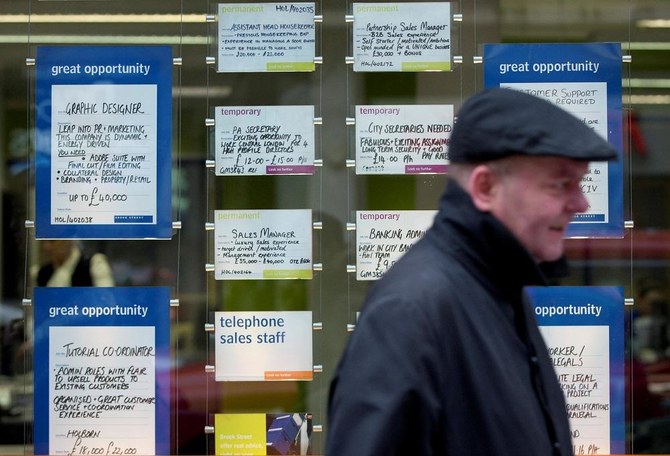
LONDON: British employers ramped up their hiring at the fastest pace in more than three years in the three months to January as the country’s labor market defied the broader weakness in the overall economy as Brexit approached.
The number of people in work surged by 222,000, helping to push down the unemployment rate to 3.9 percent, its lowest since the start of 1975, official data showed.
A Reuters poll of economists had pointed to a rise in employment of 120,000.
With the terms of Britain’s exit from the European Union still unclear, many businesses have cut long-term investment in equipment, potentially making them more likely to hire workers who can be sacked if the economy sours.
The strength of the labor market is pushing up wages more quickly.
Total earnings, including bonuses, rose by an annual 3.4 percent in the three months to January, the Office for National Statistics said, stronger than a median forecast of 3.2 percent in the Reuters poll.
Wage growth for the three months to December was revised up slightly to 3.5 percent, its highest since mid-2008.
Average weekly earnings, excluding bonuses, also rose by 3.4 percent on the year, in line with the Reuters poll.

UK jobs growth surges as labor market defies Brexit nerves
- With the terms of Britain’s exit from the EU still unclear, many businesses have cut long-term investment in equipment
- The strength of the labor market is pushing up wages more quickly
BYD Americas CEO hails Middle East as ‘homeland for innovation’
- In an interview on the sidelines of Davos, Stella Li highlighted the region’s openness to new technologies and opportunities for growth
DAVOS: BYD Americas CEO Stella Li described the Middle East as a “homeland for innovation” during an interview with Arab News on the sidelines of the World Economic Forum.
The executive of the Chinese electric vehicle giant highlighted the region’s openness to new technologies and opportunities for growth.
“The people (are) very open. And then from the government, from everybody there, they are open to enjoy the technology,” she said.
BYD has accelerated its expansion of battery electric vehicles and plug-in hybrids across the Middle East and North Africa region, with a strong focus on Gulf Cooperation Council countries like the UAE and Saudi Arabia.
GCC EV markets, led by the UAE and Saudi Arabia, rank among the world’s fastest-growing. Saudi Arabia’s Public Investment Fund has been aggressively investing in the EV sector, backing Lucid Motors, launching its brand Ceer, and supporting charging infrastructure development.
However, EVs still account for just over 1 percent of total car sales, as high costs, limited charging infrastructure, and extreme weather remain challenges.
In summer 2025, BYD announced it was aiming to triple its Saudi footprint following Tesla’s entry, targeting 5,000 EV sales and 10 showrooms by late 2026.
“We commit a lot of investment there (in the region),” Li noted, adding that the company is building a robust dealer network and introducing cutting-edge technology.
Discussing growth plans, she envisioned Saudi Arabia and the wider Middle East as a potential “dreamland” for innovation — what she described as a regional “Silicon Valley.”
Talking about the EV ambitions of the Saudi government, she said: “If they set up (a) target, they will make (it) happen. Then they need a technology company like us to support their … 2030 Vision.”