

Families of Christchurch dead in agonizing wait for burials

1 / 2
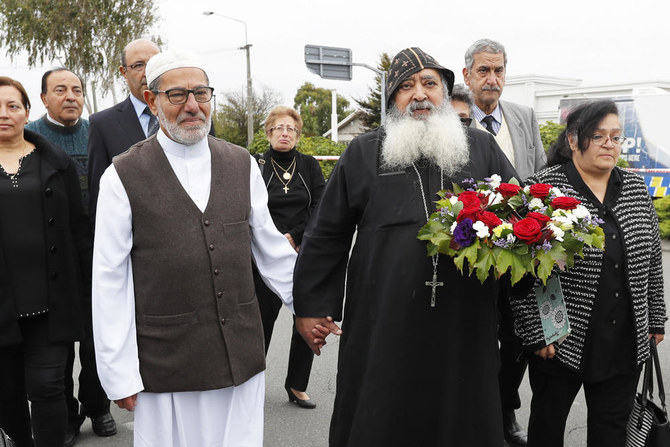
Imam Ibrahim Abdul Halim, left, of the Linwood mosque holds the hand of Father Felimoun El-Baramoussy from the Dunedin Coptic Church as they walk to the site of Friday's shooting outside the Linwood mosque in Christchurch, New Zealand, on March 18, 2019. (AP Photo/Vincent Thian)
2 / 2
Imam Ibrahim Abdul Halim of the Linwood mosque, center left, is embraced by Father Felimoun El-Baramoussy, center right, from the Coptic Church at the site of Friday's shooting outside the Linwood mosque in Christchurch, New Zealand, on Monday. (AP Photo/Vincent Thian)
Updated 18 March 2019
Follow

Families of Christchurch dead in agonizing wait for burials

  • Islamic custom dictates that the dead should be buried within 24 hours
  • Dozens of graves were being dug in a Christchurch cemetery on Monday for some of the dead victims

CHRISTCHURCH, New Zealand: Families of the people killed in the Christchurch mosque shootings are enduring an increasingly agonizing wait for the bodies of victims to be released as New Zealand reels from the unprecedented tragedy.
Three days after Friday’s attack, New Zealand’s deadliest shooting in modern history, relatives were anxiously waiting for word on when they can bury their loved ones. Islamic tradition calls for bodies to be cleansed and buried as soon as possible after death.
Aya Al-Umari, whose older brother Hussien Al-Umari died at the Al Noor mosque, said “It’s very unsettling not knowing what’s going on, if you just let me know — is he still in the mosque? Is he in a fridge? Where is he?“
Authorities say they hope to release all the bodies by Wednesday.
Meanwhile, dozens of graves were being dug in a Christchurch cemetery on Monday for some of the dead victims.
Coroners said they hoped to let grieving relatives fulfill Islamic burial customs soon, but insisted they had to move carefully through their investigation into the horrific multiple murder.
Islamic custom dictates that the dead should be buried within 24 hours, but strained authorities — desperate to make sure no mistakes are made or the complex investigation harmed — said a quick process was difficult.
“All of the deceased have had a CT scan, their fingerprints are taken, the property they were wearing or had with them is removed,” said Chief Coroner Deborah Marshall, adding that dental impressions were taken and post-mortems performed.
Ardern said she expected all the dead would have been returned to their families by Wednesday.
An AFP reporter early Monday saw workers and excavators preparing dozens of graves in Christchurch cemetery, though it was unclear when the funerals might start.
“It’s a massacre, what else do they need to know?,” said school principal Sheikh Amjad Ali, expressing frustration over the wait for loved ones’ remains.
The dead from Friday’s attack span generations, aged between three and 77, according to a list circulated among relatives.
Some victims came from the neighborhood, others from as far afield as Egypt. At least two of the dead came from the same family — a father and son.
Delhi said Sunday that five of its nationals were killed, while Pakistan said nine of its citizens were among the dead, including one man who died trying to rush gunman Brenton Tarrant.

Terrorist's manifesto
As New Zealand grappled to come to terms with the slaughter — the worst attack on Muslims in a Western country in modern times — Prime Minister Jacinda Ardern was holding a cabinet meeting Monday to address gun laws and intelligence failures.
Ardern was among about 30 officials who received the lengthy, meandering and conspiracy-filled far-right “manifesto” prepared by Tarrant, an Australia-born, self-avowed white nationalist who has been arrested in the March 15 terrorist attack on worshippers at the Al-Noor and Linden mosques in Christchurch.
“It did not include a location, it did not include specific details,” said Ardern, adding that it was sent nine minutes before the rampage and handed to security services within two minutes.
Around Christchurch, New Zealand and the world there have been vigils, prayers, memorials and messages of solidarity.
An emotion-filled haka — the Maori war dance — was performed by a New Zealand biker gang to honor the Christchurch dead.
The country remained on high alert, with police on Sunday briefly closing an airport in the southern city of Dunedin — where Tarrant had lived — after an unidentified package was spotted on the airfield. The airport re-opened a few hours later.
In Australia, counter-terrorism police searched two homes early Monday, both near the town of Grafton where Tarrant grew up.
“The primary aim of the activity is to formally obtain material that may assist New Zealand police in their ongoing investigation,” a police statement said.

Fighting for life
Authorities said 34 people remained in hospital.
Among those fighting for their lives is four-year-old Alin Alsati. The pre-schooler was praying alongside her father Wasseim at the Al Noor mosque when she was shot at least three times.
Her father, who was also shot, recently emigrated to New Zealand from Jordan.
The number of dead and injured could have been higher, were it not for people such as Afghan refugee Abdul Aziz.
Aziz was at the Linwood mosque with his four sons when he rushed the attacker armed with the only weapon he could find — a hand-held credit card machine.
He then picked up an empty shotgun discarded by the gunman and shouted “come on here” in an effort to draw him away from his sons and the other worshippers.
“I just wanted to save as much lives as I could, even if I lose my life,” he told AFP.
The mosque attacks have shaken this usually peaceful country, which prides itself on welcoming refugees fleeing violence or persecution.
Ardern has said she would use the cabinet meeting to press for a ban on semi-automatic weapons of the type used by Tarrant. A series of reform attempts in recent years have failed.
Ardern also wants answers from social media giants over the livestreaming of the carnage.
Facebook said it had removed 1.5 million videos of the attack around the world in the first 24 hours.


Immigration raids in Minnesota fuel grassroots Somali activism

Updated 5 sec ago
Follow

Immigration raids in Minnesota fuel grassroots Somali activism

  • “You would never fathom that people would just pluck you off the streets ... and say, ‘Prove to me that you’re a citizen,’” Mohamed said
  • Trump, who ‌has described Somalis as “garbage” who should be thrown out of the country, has said the operations are necessary to combat crime

MINNEAPOLIS: When immigration agents began aggressive operations in Minneapolis last month, Kowsar Mohamed started knocking on doors, fielding late-night calls and mobilizing other Somali Americans into an ad-hoc response team.
Many feared they were being singled out, a worry that revived memories of the state surveillance and arbitrary authority they thought they had left behind when they resettled in the United States.
More than 100 volunteers now patrol south Minneapolis, distribute “Know Your Rights” guides and escort frightened elders — part of a sweeping grassroots effort to counter what many describe as constitutionally suspect raids that are destabilizing Minnesota’s roughly 80,000-strong Somali community, one of the country’s largest refugee populations.
“You would never fathom that people would just pluck you off the streets ... and say, ‘Prove to me that you’re a citizen,’” Mohamed said, referring to reports of aggressive tactics by the agents. “It’s not that we never thought it was impossible. We just believed the Constitution was going to protect us from this level of interrogation.”

TRUMP’S 3,000-AGENT PUSH SPARKS VOTER-INTIMIDATION FEARS
The deployment of 3,000 federal agents — ordered by Republican President Donald Trump — has intensified accusations from Democrats and local leaders that he is targeting ‌a politically influential community ‌ahead of the 2026 midterm elections, deepening fears that the operations amount to intimidation aimed at suppressing ‌Somali ⁠voter turnout.
Trump, who ‌has described Somalis as “garbage” who should be thrown out of the country, has said the operations are necessary to combat crime, though many of those arrested have no criminal charges or convictions. He has also cited a fraud scandal around the theft of federal funds for social-welfare programs in Minnesota to justify sending agents into the state, many of them from US Immigration and Customs Enforcement.
Democrats and community leaders accuse the agents of harassing peaceful protesters, racial profiling and searching houses without warrants. Minneapolis has been on edge since the fatal shooting of 37-year-old Renee Good by an immigration agent on January 7.
“A lot of community members escaped war and this administration is triggering another war zone,” said Abdulahi Farah, co-chair of the Somali American Leadership Table, an advocacy group formed in response ⁠to hate crimes and political attacks on Somalis. He said Trump’s history of racist rhetoric against Black and other immigrants of color has emboldened far-right activists and had a destabilizing effect on ‌small businesses and citizens’ general sense of safety.
Department of Homeland Security spokesperson Tricia McLaughlin said in ‍a statement to Reuters that immigrants who are served administrative warrants or ‍I-205 removal orders “have had full due process and a final order of removal from an immigration judge.”

PUSHING BACK AGAINST IMMIGRATION RAIDS
In Cedar-Riverside, a ‍normally bustling Somali neighborhood lined with restaurants, boutique shops and convenience stores, business owners say activity is noticeably quieter since immigration agents arrived there last month.
“It’s been really slow,” said Rashid Jama, a grocery store manager in the neighborhood, also known as the West Bank. “A lot of our suppliers are Latino and they’re scared to come to work.”
The efforts of Mohamed, a third-year doctoral student at the University of Minnesota, are part of a broader wave of grassroots initiatives to push back by filming arrests, planning peaceful protests and accelerating voter outreach.
Some Somali Americans fear the raids are a bid to suppress voter turnout before midterm elections in November, according to over a dozen grassroots organizers, local officials and residents interviewed by ⁠Reuters.
“It’s signaling that if we get rid of them, if we scare them, they’re not going to come out to vote in the 2026 midterm election. We know that’s the target,” said Farah, whose group is partnering with other grassroots organizations to train people on priorities like opposing ICE raids as well as broader issues like affordability.
Mosques and neighboring community centers are now turning into political education hubs in Minnesota, local leaders said.
Civil rights advocates and scholars say the Minneapolis immigration operations echo past crackdowns in Black and Latino neighborhoods, fueling fears of political scapegoating, said political science professor Christina Greer at Fordham University.
Somali American voters have largely supported Democrats since refugees began resettling in the US in the 1990s, before becoming more politically active in the 2000s. US Representative Ilhan Omar is the community’s most high-profile member and a frequent target of racist attacks from Trump.
Asked about that and tactics of agents decried by residents, White House spokeswoman Abigail Jackson said in a statement to Reuters that immigrants “who fail to contribute to our economy, rip off Americans and refuse to assimilate into our society should not be here.”
Minnesota Republican Party Chairman Alex Plechash denied the raids were politically driven, calling the charge “categorically false” but said complaints about aggressive tactics ‌warrant review.
Some Somali community leaders say mobilizing voters will be a priority in the months ahead.
“The power we have is to vote,” said Abdullahi Kahiye, 37, who said he became a naturalized US citizen in 2024. “ICE and whoever is trying to terrorize the Somali community will not succeed.”