

Jordanian barber injured in Christchurch terror attack recovering, daughter, 3, battles for life

1 / 2
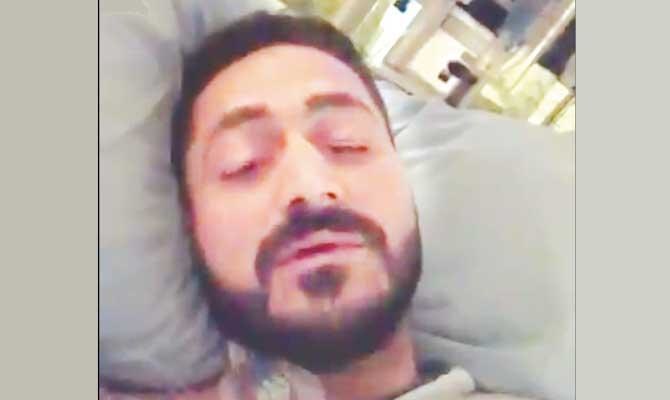
Wasseim Alsati in hospital bed. (Supplied)
2 / 2
Wasseim Alsati with his daughters. (Supplied)
Updated 17 March 2019
Follow

Jordanian barber injured in Christchurch terror attack recovering, daughter, 3, battles for life

  • One of those who died was engineer Ata Alyyan. His father, Dr. Mohammad Alyyan, founded Al-Noor Mosque, which was one of the mosques targeted by the gunman

AMMAN: “One of the reasons I decided to live in New Zealand is that they don’t pay attention to who you are, and they treat you as a human being. You can do what you want.” These are the words of 36-year-old Jordanian Wasseim Alsati, a barber who made Christchurch his home.
He is injured and his three-year old daughter Leen is fighting for her life after a massacre at two mosques killed 49 people and injured dozens on Friday.
Wasseim’s friends in Amman said he wanted to excel, but that Jordan was too small for him and his ambitions. Sati Abdel Razaq, Wasseim’s father, told Arab News that five years ago his son closed his shop in the capital and left for greener pastures.
“This person had Western attitudes and he was sure his future was not in Jordan. He would always tell me his rosy dreams about becoming a great hairdresser,” Usama Jeetawi told Arab News. “Every time I would come for a haircut, he would show me his latest innovations and he would say, ‘I wish I could get to a place where I could show off my talent.’ I tried to help find him a place with Amman’s leading hair stylists, but without much success.”
Razaq told Arab News his son was getting better “but three-year-old Leen is still in critical condition after receiving three bullets to the body.”
Friends of Wasseim launched an appeal on Facebook, hoping to raise $25,000 to help the family. By Saturday $13,000 had been raised.
Wasseim is one of eight Jordanians who were injured in the terrorist attack. The Associated Press reported Saturday that four Jordanians had been killed.
One of those who died was engineer Ata Alyyan. His father, Dr. Mohammad Alyyan, founded Al-Noor Mosque, which was one of the mosques targeted by the gunman.
Family member Saed Azzam told Arab News that the father left for New Zealand 25 years ago and that the son studied computer engineering.
Father and son set up a firm, A & B Educational Consultancy, in 2007 to help Arab students wishing to study in New Zealand.
Khaled Haj Mustafa was a Syrian who lived in Jordan. He fled the brutal war in Syria and was involved in equestrianism, a profession many in Jordan remembered him for, only to be killed in a Christchurch mosque while praying.
A Jordanian ministry spokesman, Sufian Qudah, earlier announced the death of three Jordanians and said a team was working round the clock to communicate with families in Jordan and New Zealand. A Foreign Ministry envoy, Ahed Sweidat, was also dispatched to liaise with local authorities on the investigation and to arrange the repatriation of the bodies.
Tareq Khoury, a Jordanian MP, said the attack was proof that “Daesh is alive and well in the minds of the leaders of the US ... as well as other Western leaders.”
Sami Awad, executive director of the Holy Land Trust, said that the person who carried out the attack was not alone in his belief system or crazy.
“He is an extreme version of millions if not billions who believe the color of their skin, their religion, or ‘way of life’ is better than other people’s and commit violence in their hearts and minds. Let us not kid ourselves. This is a global phenomenon and epidemic,” he told Arab News.

• With input from Mohammad Ersan


Iraq says it will prosecute Daesh detainees sent from Syria

Updated 8 sec ago
Follow

Iraq says it will prosecute Daesh detainees sent from Syria

  • Iraq government says transfer was pre-emptive step to protect national security
  • Prosoners have been held for years in prisons and camps guarded by the Kurdish-led SDF
BAGHDAD: Iraq’s Supreme Judicial Council said on Thursday it would begin ​legal proceedings against Daesh detainees transferred from Syria, after the rapid collapse of Kurdish-led forces in northeast Syria triggered concerns over prison security.
More than 10,000 members of the ultra-hard-line militant group have been held for years in about a dozen prisons and detention camps guarded by the Kurdish-led Syrian Democratic Forces (SDF) in Syria’s northeast.
The US military said on Tuesday its forces had transferred 150 Daesh detainees from Syria to Iraq and that the operation could eventually see up to 7,000 detainees moved out of Syria.
It cited concerns over security at the prisons, which also hold thousands more women and children with ties to the militant group, after military setbacks ‌suffered by the ‌SDF.
A US official told Reuters on Tuesday that about 200 low-level ‌Daesh ⁠fighters ​escaped from ‌Syria’s Shaddadi prison, although Syrian government forces had recaptured many of them.
Iraqi officials said Prime Minister Mohammed Shia Al-Sudani mentioned the transfer of Daesh prisoners to Iraq in a phone call with Syrian President Ahmad Al-Sharaa on Tuesday, adding that the transfers went ahead following a formal request by the Iraqi government to Syrian authorities.
Iraqi government spokesperson Basim Al-Awadi said the transfer was “a pre-emptive step to protect Iraq’s national security,” adding that Baghdad could not delay action given the rapid pace of security and political developments in Syria.
Daesh emerged in Iraq and Syria, and at the ⁠height of its power from 2014-2017 held swathes of the two countries. The group was defeated after a military campaign by ‌a US-led coalition.
An Iraqi military spokesperson confirmed that Iraq had received ‍a first batch of 150 Daesh detainees, including ‍Iraqis and foreigners, and said the number of future transfers would depend on security and field assessments. The ‍spokesperson described the detainees as senior figures within the group.
In a statement, the Supreme Judicial Council said Iraqi courts would take “due legal measures” against the detainees once they are handed over and placed in specialized correctional facilities, citing the Iraqi constitution and criminal laws.
“All suspects, regardless of their nationalities or positions within the terrorist ​organization, are subject exclusively to the authority of the Iraqi judiciary,” the statement said.
Iraqi officials say under the legal measures, Daesh detainees will be separated, with senior figures including foreign nationals to ⁠be held at a high-security detention facility near Baghdad airport that was previously used by US forces.
Two Iraqi legal sources said the Daesh detainees sent from Syria include a mix of nationalities, with Iraqis making up the largest group, alongside Arab fighters from other countries as well as European and other ‌Western nationals.
The sources said the detainees include nationals of Britain, Germany, France, Belgium and Sweden, and other European Union countries, and will be prosecuted under Iraqi jurisdiction.