

Pain grips family of Saudi man killed in Christchurch terror attack

1 / 2
Feras Al-Harbi said his father Mohsin Al-Harbi died eight hours after sustaining injuries in the massacre. (Supplied photo)
2 / 2
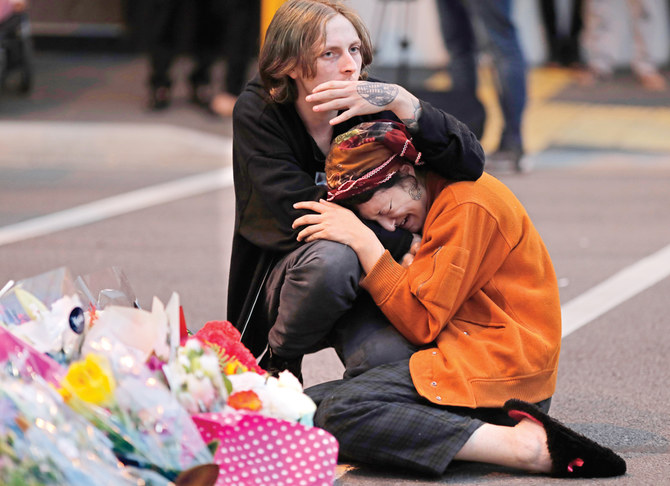
Christchurch residents are struggling to deal with the aftermath of what is thought to be the worst act of terror against Muslims in the West. (AP)
Updated 17 March 2019
Follow

Pain grips family of Saudi man killed in Christchurch terror attack

  • Mohsin Al-Harbi, from Madinah, worked in water desalination and had lived in New Zealand for 25 years
  • “My father lived a full life. It was a good life,” Mohsin’s son Feras Al-Harbi tells Arab News

RIYADH: “My father lived a full life. It was a good life,” Feras Al-Harbi told Arab News.

Saudi national Mohsin Al-Harbi lived in New Zealand for 25 years. He worked in water desalination.

Feras said his father was a good man - a devout Muslim and a part-time imam, who sometimes gave the Friday sermon at one of the mosques where Friday’s terror attacks took place.

New Zealand’s Prime Minister Jacinda Ardern has called the massacre an unprecedented act of violence, a terrorist attack and “one of New Zealand’s darkest days.”

Moshin was not giving the sermon on Friday – but he was in one of the mosques as the attack began which left 49 dead and dozens injured – including Moshin.

A photo circulated on social media that captured the moment Mohsin was carried out of the mosque on a stretcher. He was being loaded into an ambulance, his finger pointing to the sky.
At first Feras was told his father had been injured in the massacre.

“Eight hours later he passed away,” Feras said.

“We accept his destiny and Allah’s will. I’m grateful and thankful to Allah in all situations and circumstances.”

Amid the chaos, Mohsin’s wife Manal had searched for her husband in the mosque where earlier worshippers had been praying.

Overwhelmed by the horror which lay before her - bodies strewn across the blood-soaked carpet - she collapsed having suffered a heart attack.

“The foreign ministry called me and informed me that I must come to the hospital to identify my brother-in-law’s remains,” Jordanian media reported Moshin’s brother-in-law Bader Dukhan as saying.

“I then found out what happened with my sister (Mohsin’s wife). She’s in a critical condition at the moment after her heart attack.”

Bader said New Zealand authorities contacted Jordan’s foreign ministry to help their mother and brother be by her side.

Now people have started paying tribute to Moshin – many of whom experienced his kindness, including student Moshari Sa’ad.

“Last January, I visited the mosque in southern New Zealand. It is considered one of the most important mosques there with the vast social activities it holds,” he wrote on social media.

“One day, at 10 a.m. in the middle of the week, I found Uncle Mohsin with his sleeves rolled up and in sweatpants sweeping the mosque himself. He smiled and welcomed me warmly.”

Moshin’s body has been taken to Saudi Arabia where he is buried in Al-Baqi cemetery in Madinah.

 “I want to thank King Salman for his support and Prince Faisal bin Salman, governor of Al-Madina, for his assistance and swiftness in helping us to return our father’s body and bury him,” Feras added

Najran’s camels are embedded in local culture and traditions

Camels are not only a vital livestock resource in Najran, but also a cornerstone of local identity and tradition. (SPA)
Updated 25 December 2025
Follow

Najran’s camels are embedded in local culture and traditions

  • Several distinct camel breeds are found in the region
  • Animals permeate Arab consciousness, says expert

RIYADH: In Najran, camels are not only a vital livestock resource but also a cornerstone of local identity and tradition.

According to Hadi Benyan Al-Amer, head of Najran’s Camel Association, the region has several distinct camel breeds.

Principal among them is the Awarik, an ancient Arabian lineage linked to territories where arak trees flourish, the Saudi Press Agency reported on Thursday.

These light-colored, sparsely-haired camels possess remarkable resilience, and are prevalent across southern Arabia.

The Majahim are characterized by dark hues spanning black to brown, and excel in both milk yield and endurance.

The Asayil are prized for their sleek, lean physiques, and dominate in speed-based competitions.

Al-Amer said traditional water sources known as Odood, or traditional water wells and artesian wells, have sustained herders navigating the Empty Quarter’s grazing lands for generations.

These permanent water points, equipped with dedicated drinking basins for camels, showcase the animals’ extraordinary environmental resilience.

Among the principal wells accessible from Najran are Al-Minkhali, Abu Shadid, Hamra Nathil, Tamani, Umm Al-Wahat, and Khujaima.

Countless additional wells dot the Empty Quarter and adjacent territories, forming the backbone of camel owners’ far-reaching pastoral networks.

Dr. Hind bint Dawood Al-Shuqair of Najran University’s Arabic Language Department explained how camels have permeated Arab consciousness through legends and stories spanning thousands of years.

Representing endurance, power, and grace, they have become inseparable from Arab cultural identity.

Archaeological evidence at Al-Ukhdood, Mount Al-Tharwa and Hima, preserves through carvings and ancient artwork the deep bond between people and camels, Al-Shuqair said.

She drew attention to Saudi Arabia’s substantial investment in camel heritage, exemplified by proclaiming 2024 as the Year of the Camel.

This designation emphasizes their importance to national prosperity and cultural heritage while backing global initiatives to promote awareness of camels as valuable economic and cultural assets.

The Kingdom further demonstrates its commitment to protecting the animals through the annual King Abdulaziz Festival, the SPA reported.