Saudi Arabia’s megaprojects in spotlight at Riyadh International Book Fair

The fair continues until March 23 at the Riyadh International Convention and Exhibition Center. (SPA)
Updated 19 March 2019
Follow

Saudi Arabia’s megaprojects in spotlight at Riyadh International Book Fair

  • UN-recognized Saudi cultural heritage showcased
  • The Red Sea gate shows a virtual image of the Kingdom’s coast in the future

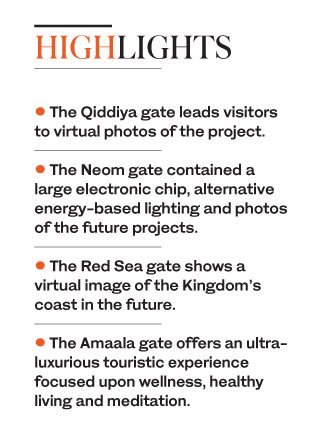
RIYADH: Visitors arriving at the Riyadh International Book Fair 2019, one of the region’s largest cultural events, enter through four main gates bearing the names of the Saudi Vision 2030’s megaprojects: Neom, Qiddiyah, Red Sea and Amaala. The aim is to introduce visitors to the Kingdom’s hopes, ambitions and future plans.

The first gate leads visitors to virtual photos of the Qiddiya project. This is a cultural, sports and recreational project in Al-Qidiyya city, southwest of Riyadh. The city was named after the Aba Al-Qid road (Camel Trail) that used to connect Al-Yamama to Hijaz.
The second gate, Neom, contained a large electronic chip, alternative energy-based lighting and photos of Neom future projects. Neom is based in three countries, Saudi Arabia, Jordan and Egypt, with a half-a-trillion-dollar investment and the support of the Public Investment Fund of Saudi Arabia.
Located in the northwest of the Kingdom, the project will stretch across the Egyptian and Jordanian borders. Neom aims to transform the Kingdom into an international pioneering example, through the introduction of value chains of industry and technology.
The origin of the name is a combination of the word “neo” — Latin for “new,” and the first letter “m” of the Arabic word “mustaqbal” which translates as “future.”
The Red Sea gate shows a virtual image of the Kingdom’s coast in the future. This is a touristic project that includes more than 50 islands located between the cities of Umluj and Al-Wajh. It covers a number of the Red Sea’s untouched islands, as well as the archaeological site of Madain Saleh and a nature reserve containing regional flora and fauna.
The Amaala project displayed at the fourth gate of the fair will offer an ultra-luxurious touristic experience focused upon wellness, healthy living and meditation, thanks to the site’s moderate climate. The project will be within the Mohammed bin Salman Natural Reserve in the northwest of the Kingdom, to the south of the Neom project.

Cultural heritage
Saudi cultural heritage, that has been officially recognized by the UN Educational, Scientific and Cultural Organization, is being celebrated with an exhibition at the fair. The display includes official UNESCO certificates awarded in recognition of the importance of Arab and Saudi culture and traditions such as the mizmar flute; Arabic coffee; the majlis; Al-Qatt Al-Asiri interior wall decorations; the Ardeh, the Saudi folkloric dance; and falconry.
Falconry has been on UNESCOS’s List of the Intangible Cultural Heritage of Humanity since 2012. The Ardeh, which was added in 2016, combines poetry, swordplay and drums, and is one of the most prominent performing arts in the Kingdom.
Arabic coffee, added in 2015, has been an important part of life in the region for hundreds of years and has its own deeply rooted customs and traditions. Majlis, a gathering place for social events, discussions of social issues and honoring guests, was also added in 2015.
The mizmar flute, registered by UNESCO in 2016, is one of the best-known musical arts in the Hijaz region. Al-Qatt Al-Asiri was the most recent Saudi addition to the list, in 2017. It is a traditional form of art that women use to decorate the interior walls of Asiri homes.


National program identifies 165 native plants for afforestation efforts in Asir

Updated 29 December 2025
Follow

National program identifies 165 native plants for afforestation efforts in Asir

  • The survey is part of broader plans focused on restoring degraded land, using native vegetation 

JEDDAH: Saudi Arabia’s National Afforestation Program has identified more than 165 species of native plants suitable for afforestation in the Asir region, highlighting the ecological diversity of one of the Kingdom’s most environmentally varied areas, the Saudi Press Agency reported.

The findings form part of broader national efforts to expand vegetation cover, address land degradation, and support sustainability goals linked to the Saudi Green Initiative and Vision 2030.

According to the program, the identified species are distributed across a wide range of natural environments in Asir, including mountainous terrain, highlands, slopes, valleys, plains, rocky landscapes, and coastal areas stretching from the Red Sea to Tihama.

The species belong to numerous plant families, including Fabaceae, Anacardiaceae, Burseraceae, Capparaceae, Ebenaceae, Euphorbiaceae, Malvaceae, Myrtaceae, Oleaceae, and Primulaceae, among others.

Plants suitable for afforestation range from large and small trees to perennial and annual shrubs, herbs, succulents, bulbs, and climbing plants. 

Among the most notable species identified are the grey mangrove, mastic tree, mooring or ben tree, juniper, sycamore fig, wild olive, henna, wild jasmine, hawthorn, and arak.

The Saudi Arabian Botanical Society described the announcement as an important step in protecting plant diversity and strengthening the ecosystem conservation in the Kingdom. 

Munirah bin Hamad Al-Hazani, founder and president of the society, said that prioritizing native species is central to sustainable afforestation.

“Focusing on the cultivation of native plants adapted to diverse environments forms the cornerstone of sustainable afforestation projects, as it plays a pivotal role in enhancing vegetation cover, combating land degradation, and conserving natural and financial resources,” she told Arab News.

Al-Hazani added that long-term success depends on cooperation between government bodies and the nonprofit sector, alongside community involvement and environmental awareness programs.

The National Afforestation Program has increasingly emphasized community participation, working with government agencies, private companies, and nonprofit organizations to support planting initiatives and environmental education. Its approach includes promoting volunteerism and discouraging harmful environmental practices, while focusing on the use of native plants adapted to local conditions.

Parallel efforts are underway in other regions of the Kingdom to support vegetation restoration through research and infrastructure development. In Jouf, often referred to as the Kingdom’s food basket, the King Salman bin Abdulaziz Royal Reserve Development Authority has established a Central Nursery and a Wild Seeds Research and Production Station to address the growing demand for reliable sources of native seeds and seedlings.

The project was launched in 2023 under the directive of Prince Abdulaziz bin Saud bin Naif, the minister of interior and chairman of the authority’s board of directors. 

Since then, the facilities has become a key component of vegetation restoration efforts within the reserve.

The authority has focused on building operational capacity by recruiting and training specialists to manage cultivation and research activities. The research and production station includes 14 mother-seed production fields containing over 400,000 trees and shrubs. 

Planting began in late 2024, with more than 30 native plant species represented, selected for their role in the reserve’s natural ecosystem. 

The facility also includes two seed storage units with a combined capacity of 3,000 kilograms. Seeds are collected annually from multiple sites within the reserve and used for seedling production habitat rehabilitation.

The Central Nursery spans 6,000 square meters and includes 30 greenhouses spanning 1,500 square meters, as well as two shade houses used during summer months. A plant hardening facility, designed to prepare seedlings for natural environmental conditions, covers 10,000 square meters and is divided into seven sections. The nursery’s annual production capacity reaches 1.5 million seedlings, representing more than 15 native plant species. 

Together, these initiatives underscore the growing role of native plant research and propagation in Saudi Arabia’s afforestation strategy, particularly as the Kingdom works to balance environmental restoration with long-term sustainability goals.