EU parliament calls for freeze on Turkey’s membership talks

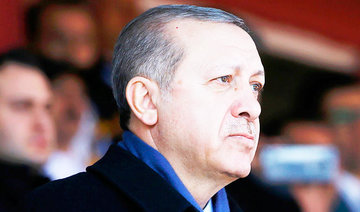
Turkish President Tayyip Erdogan addresses his supporters during a rally for upcoming local elections, in Istanbul. (Reuters)
Updated 13 March 2019
Follow

EU parliament calls for freeze on Turkey’s membership talks

  • Forging a common position on Turkey’s long-stalled EU bid, lawmakers voted 370 in favor and 109 against, with 143 abstentions, for an official freeze of the membership process
  • The parliament adopted its stance two days before EU foreign policy chief Federica Mogherini is set to meet Turkish Foreign Minister Mevlut Cavusoglu in Brussels to discuss bilateral relations

STRASBOURG: The European Union should formally suspend Turkey’s negotiations to join the bloc, EU lawmakers said on Wednesday in a symbolic rebuke of Turkish President Tayyip Erdogan, who Western governments accuse of widespread abuses of human rights.
Forging a common European Parliament position on Turkey’s long-stalled EU bid, lawmakers voted 370 in favor and 109 against, with 143 abstentions, for an official freeze of the membership process, which would jeopardize some EU funding.
EU governments have the final say in any suspension.
“Sitting in a cell for 17 months without knowing what you are being accused of, that is reality in today’s Turkey,” Kati Piri, a Dutch center-left EU lawmaker who sponsored the non-binding resolution, told the plenary in Strasbourg.
She accused Erdogan of a “witchhunt against his critics,” referring to what the EU says is a crackdown on dissidents, the collapse of an independent judiciary and a turn toward authoritarianism that are incompatible with the bloc’s values of democracy and freedom of speech.
Ankara dismissed the vote as meaningless. Turkish ruling AK Party spokesman Omer Celik called it “worthless, invalid and disreputable.”
Turkish foreign ministry said it expected the EP to take objective decisions and to adapt a constructive stance to contribute to Turkey’s EU accession process.
The parliament adopted its stance two days before EU foreign policy chief Federica Mogherini is set to meet Turkish Foreign Minister Mevlut Cavusoglu in Brussels to discuss bilateral relations.
The EU process is not formally frozen but was faltering even before Erdogan’s purge of suspected plotters of a failed coup attempt in 2016 and his broadsides against Europe in 2017, comparing the Dutch and German governments to Nazis.
The negotia1tions, launched in 2005 after decades of Turkey seeking a formal start to an EU membership bid, dovetailed with Erdogan’s first economic reforms in power as prime minister from 2003.
Today, EU officials say limits on press freedoms, mass jailing and shrinking civil rights make it almost impossible at the present time for Turkey to meet EU joining criteria.
Lawmakers acknowledged that the bloc relies on Turkey as a NATO ally on Europe’s southern flank, while an EU deal with Ankara has halted the influx of Syrian refugees into the bloc.
“Nobody denies the important role that Turkey plays, in particular in the migration crisis and the war in Syria. But that doesn’t mean Europe can be hostage to a system that criticizes everyone who thinks differently,” Portuguese center-left EU lawmaker Liliana Rodrigues said.
Two German journalists left Turkey on Sunday after authorities rejected their media accreditation, a step that drew condemnation from Germany’s foreign minister and stoked diplomatic tension.


India’s new budget bets on AI, data centers to sustain growth

Updated 42 min 32 sec ago
Follow

India’s new budget bets on AI, data centers to sustain growth

  • Budget features new Bharat‑VISTAAR AI‑powered platform for agriculture sector
  • It also includes tax holiday until 2047 for foreign companies using Indian data centers

NEW DELHI: India’s latest budget has emerged as one of its most technology-focused, with new measures to utilize artificial intelligence, semiconductor manufacturing, and expand digital infrastructure aimed at offsetting the impact of global tariff wars.

Finance Minister Nirmala Sitharaman presented the 2026-27 budget in parliament on Sunday, saying it would “accelerate and sustain economic growth by enhancing productivity and competitiveness” at a time when India was facing “an external environment in which trade and multilateralism are imperiled and access to resources and supply chains are disrupted.”

New Delhi has yet to secure a trade deal with its largest trading partner, the US, which last year hit it with punitive tariffs of up to 50 percent over India’s purchases of Russian oil. To mitigate their impact, India has been looking for alternative agreements, including last week’s agreement with the EU, cutting duty on 99.5 percent of Indian exports to the bloc.

The new budget prioritizes infrastructure and domestic manufacturing, with a total expenditure estimated at $583 billion.

It offers tariff concessions for products from the marine, leather, and textile industries — all of which have been affected by US tariffs — and provides duty exemptions on materials and goods used to process rare-earth minerals, make lithium ion batteries, solar glass, and components for electric vehicles.

The finance minister also announced doubled spending for semiconductor manufacturing to $4.8 billion and a tax holiday until 2047 for foreign companies providing cloud services using Indian data centers.

The budget also features Bharat‑VISTAAR (Virtually Integrated System to Access Agricultural Resources), a multilingual AI‑powered platform for the agriculture sector to give farmers customized, real‑time advisory on crop management, weather, soil conditions and government schemes in different Indian languages.

“There is a lot of focus on AI and technology. It is to achieve the ambitious target India has already declared — Viksit Bharat 2047. It is very clear that without technology, it would be difficult to achieve that target,” Prof. Pardeep S. Chauhan, Centre for Economic Studies and Planning, Jawaharlal Nehru University, told Arab News, referring to the government’s plan to transform the nation into a fully developed country by 2047 — the 100th anniversary of its independence.

“That was the need of the hour, and the government has taken care of it, focusing on semiconductors, AI, and rare-earth minerals.”

The technology focus also comes against the backdrop of China’s dominance in the global critical minerals supply chains, and last year’s restrictions imposed by Beijing in the wake of escalating trade tensions with the US.

“India lags far behind the US and China, particularly China,” Chauhan said. “India has taken this move to maybe after five, 10, 15 years ... compete up to some extent. Without technology, nobody can think of establishing (their) leadership — whether it’s in the economy, defense or financial infrastructure architecture. Everywhere you need technology.”