

Jamaat-ud-Dawa to take legal route to overturn ban

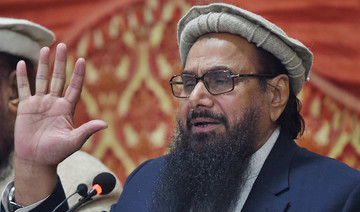
In this Feb. 5, 2019 file photo, Hafiz Saeed, chief of Pakistani religious group Jamaat-ud-Dawa, addresses a rally in Lahore, Pakistan. (AP)
Updated 06 March 2019
Follow

Jamaat-ud-Dawa to take legal route to overturn ban

  • Assets of Hafiz Saeed-linked outfits impounded
  • “We are a peaceful welfare organization,” JuD spokesman Yahya Mujahid said

LAHORE: A spokesman for the charity Jamaat-ud-Dawa (JuD), which has been linked to the Lashkar-e-Taiba (LeT) militant group behind the deadly 2008 Mumbai attacks, said it would go to court on Wednesday after a government crackdown closed several of its missions. 

On Tuesday, Pakistan’s National Counter Terrorism Authority (NACTA) added the JuD and the Falah-e-Insaniat Foundation (FIF) to its list of banned organizations. 

Both groups are linked to LeT founder Hafiz Saeed — one of South Asia’s most wanted men, with a $10 million bounty on his head. Saeed has always maintained the JuD and FIF are just charities, and not fronts for militant activity. 

“We are a peaceful welfare organization,” JuD spokesman Yahya Mujahid said. “Despite all the atrocities, we will stay peaceful and get justice from the courts.” He added the government had closed JuD offices, pharmacies, health units and schools, impounded ambulances and arrested dozens of activists across the country. “It is an injustice to a peaceful organization. Police are even harassing women during raids at our homes.”

At Al-Qadsia, the JuD’s Lahore headquarters, which Arab News visited on Wednesday, little seemed to have changed other than a few policemen standing outside the complex.

But a spokesman for the local government in Punjab, Shahbaz Gill, confirmed that police and other security agencies had launched crackdowns against groups including the JuD across the country. In Rawalpindi, a hospital, religious school and two JuD pharmacies were sealed, and several religious seminaries linked to the group were closed in Chakwal.

An intelligence official said police had also arrested dozens of members of Jaish-e-Mohammad (JeM) and the sectarian militant group Sipah-i-Sahaba in the cities of Jhang, Bahawalnagar and Bahawalpur in the south of Punjab. 

Last month, JeM claimed responsibility for a suicide bombing in Indian-administered Kashmir that killed at least 40 police and brought India and Pakistan to the brink of war. 

On Tuesday, Pakistan said it had detained two close relatives of JeM chief Masood Azhar. A day earlier, Islamabad announced it had taken fresh steps to seize and freeze the assets of people wanted by the UN and others.  

Last year, the global watchdog, the Financial Action Task Force (FATF), put Pakistan on a watch list of nations with inadequate controls to prevent terrorist financing and money laundering, handicapping chances of attracting Western investment.

Last week, New Delhi and Islamabad came to blows after the former said it attacked a JeM training camp in northern Pakistan, who retaliated by downing an Indian jet that entered its airspace last Wednesday, capturing its pilot.

“Pakistan is taking action against militant groups, under pressure from the FATF and the UN,” political analyst Dr. Hasan Askari Rizvi said. “The crackdown looks serious this time but let’s see how long the government sustains it.”

Islamabad has admitted to launching crackdowns against militant groups but denied it was due to international pressure.

India, Arab League target $500bn in trade by 2030

Updated 6 sec ago
Follow

India, Arab League target $500bn in trade by 2030

  • It was the first such gathering of India–Arab FMs since the forum’s inauguration in 2016
  • India and Arab states agree to link their startup ecosystems, cooperate in the space sector

NEW DELHI: India and the Arab League have committed to doubling bilateral trade to $500 billion by 2030, as their top diplomats met in New Delhi for the India–Arab Foreign Ministers’ Meeting. 

The foreign ministers’ forum is the highest mechanism guiding India’s partnership with the Arab world. It was established in March 2002, with an agreement to institutionalize dialogue between India and the League of Arab States, a regional bloc of 22 Arab countries from the Middle East and North Africa.

The New Delhi meeting on Saturday was the first gathering in a decade, following the inaugural forum in Bahrain in 2016.

India’s Foreign Minister S. Jaishankar said in his opening remarks that the forum was taking place amid a transformation in the global order.

“Nowhere is this more apparent than in West Asia or the Middle East, where the landscape itself has undergone a dramatic change in the last year,” he said. “This obviously impacts all of us, and India as a proximate region. To a considerable degree, its implications are relevant for India’s relationship with Arab nations as well.”

Jaishankar and his UAE counterpart co-chaired the talks, which aimed at producing a cooperation agenda for 2026-28.

“It currently covers energy, environment, agriculture, tourism, human resource development, culture and education, amongst others,” Jaishankar said.

“India looks forward to more contemporary dimensions of cooperation being included, such as digital, space, start-ups, innovation, etc.”

According to the “executive program” released by India’s Ministry of External Affairs, the roadmap agreed by India and the League outlined their planned collaboration, which included the target “to double trade between India and LAS to US$500 billion by 2030, from the current trade of US$240 billion.”

Under the roadmap, they also agreed to link their startup ecosystems by facilitating market access, joint projects, and investment opportunities — especially health tech, fintech, agritech, and green technologies — and strengthen cooperation in space with the establishment of an India–Arab Space Cooperation Working Group, of which the first meeting is scheduled for next year.

Over the past few years, there has been a growing momentum in Indo-Arab relations focused on economic, business, trade and investment ties between the regions that have some of the world’s youngest demographics, resulting in a “commonality of circumstances, visions and goals,” according to Muddassir Quamar, associate professor at the School of International Studies, Jawaharlal Nehru University.

“The focus of the summit meeting was on capitalizing on the economic opportunities … including in the field of energy security, sustainability, renewables, food and water security, environmental security, trade, investments, entrepreneurship, start-ups, technological innovations, educational cooperation, cultural cooperation, youth engagement, etc.,” Quamar told Arab News.

“A number of critical decisions have been taken for furthering future cooperation in this regard. In terms of opportunities, there is immense potential.”