

Crown prince of Abu Dhabi tweets in Hindi and Urdu to defuse India-Pakistan tension

In this file photo, Sheikh Mohammed bin Zayed Al-Nahyan, Crown Prince of Abu Dhabi inspects a guard of honor during his ceremonial reception at the forecourt of India’s Rashtrapati Bhavan presidential palace in New Delhi, India, Jan. 25, 2017. (REUTERS)
Updated 04 March 2019
Follow

Crown prince of Abu Dhabi tweets in Hindi and Urdu to defuse India-Pakistan tension

  • Mohamed bin Zayed also called premiers Khan and Modi on February 28 to discuss the problem
  • Urged both sides to “prioritize dialogue” to resolve the issue

ISLAMABAD: In a bid to defuse the ongoing crisis between India and Pakistan, Abu Dhabi Crown Prince Sheikh Mohamed bin Zayed Al Nahyan tweeted in both the countries’ local languages last week, urging the two to resolve their differences through dialogue.
The crown prince had called Pakistan’s Prime Minister Imran Khan and his Indian counterpart, Narendra Modi, on February 28 as part of the UAE’s efforts to de-escalate the worst standoff in decades between the two nuclear-armed neighbors.

In two separate tweets — one in Hindu and the other in Urdu — he urged both the countries to address the issues through dialogue.
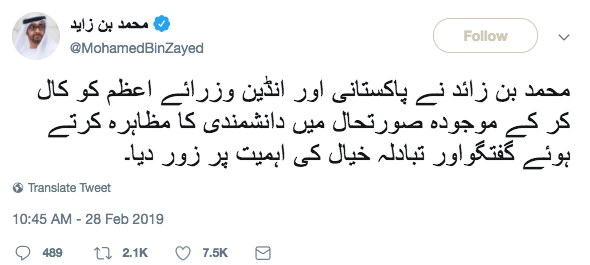
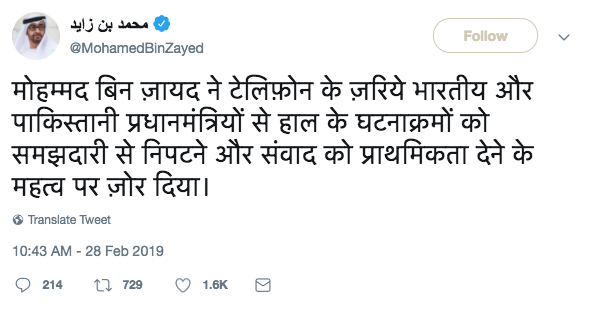
On Sunday, Pakistan’s Information Minister Fawad Chaudhry said both the crown princes of Saudi Arabia and the UAE had played a “commendable” role in trying to defuse the crisis which began on February 14 after more than 40 soldiers were killed in a suicide attack in Indian-administered Kashmir.
New Delhi blames Islamabad for the attack but the latter has denied any complicity. India responded by carrying out airstrikes in Pakistan last week and Pakistan quickly retaliated with its own strikes. It also struck down an Indian plane and captured an Indian pilot who was released two days later as part of PM Khan’s “peace gesture.”
“Saudi Arabia, the UAE and other Muslim countries have been a great help,” Chaudhry said in an interview to Arab News.
The two countries have fought three wars, two of them over the disputed Kashmir region which is divided by the Line of Control, the de facto international border that splits the region into two parts.


Pakistan, UK sign £35 million Green Compact to strengthen climate resilience

Updated 21 December 2025
Follow

Pakistan, UK sign £35 million Green Compact to strengthen climate resilience

  • Pakistan ranks among nations most vulnerable to climate change and has seen erratic changes in its weather patterns
  • UK will help Pakistan mobilize climate finance, strengthen regulatory frameworks and develop bankable climate projects

ISLAMABAD: Pakistan and the United Kingdom (UK) have formalized a comprehensive climate partnership with the launch of a Green Compact that aims to enhance climate resilience, accelerate clean energy transition and scale up nature-based solutions, including mangrove conservation, Pakistani state media reported on Sunday.

The agreement, signed in Islamabad by Federal Minister for Climate Change and Environmental Coordination Dr. Musadik Malik and UK Minister for International Development Jennifer Chapman, unlocks £35 million in targeted support for green development and long-term climate action, according to Radio Pakistan broadcaster.

Pakistan ranks among nations most vulnerable to climate change and has seen erratic changes in its weather patterns that have led to frequent heatwaves, untimely rains, storms, cyclones, floods and droughts in recent years. In 2022, monsoon floods killed over 1,700 people, displaced another 33 million and caused over $30 billion losses, while another 1,037 people were killed in floods this year.

Mohammad Saleem Shaikh, a spokesperson for Pakistan’s Ministry of Climate Change, described the compact as a “decisive move toward action-oriented climate cooperation,” noting that its implementation over the next decade will be critical for Pakistan which regularly faces floods, heatwaves and water stress.

“The Compact is structured around five core pillars: climate finance and investment, clean energy transition, nature-based solutions, innovation and youth empowerment, and adaptation and resilience,” the report read.

“Under the agreement, the UK will work with Pakistan to mobilize public and private climate finance, strengthen regulatory frameworks for green investment, and develop bankable climate projects.”

Clean energy forms a central component of Pakistan’s transition, with Islamabad planning to expand solar and wind generation to reduce fossil fuel dependence, improve energy security and stabilize power costs, according to Shaikh.

“Renewable energy is now economically competitive, making the transition both environmentally and financially viable,” he was quoted as saying.

“Nature-based solutions, particularly large-scale mangrove restoration, will protect coastal communities from storm surges and erosion while enhancing biodiversity and carbon sequestration.”

Under the Compact, technical support, mentoring and access to investors will be provided to climate-smart startups and young innovators, reflecting Pakistan’s recognition of youth-led initiatives as central to future climate solutions.

On the occasion, Chapman, on her first official visit to Pakistan, underscored the urgency of climate action, highlighting the UK’s support for renewable energy, mangrove and ecosystem restoration, early-warning systems, climate budgeting and international investment flows into Pakistan.

Shaikh described the Green Compact as “a strategic turning point” in Pakistan–UK relations on climate change, saying its effective implementation is essential for Pakistan to meet its national climate targets.