

After outcry, Hedi Slimane U-turns on the Celine catwalk

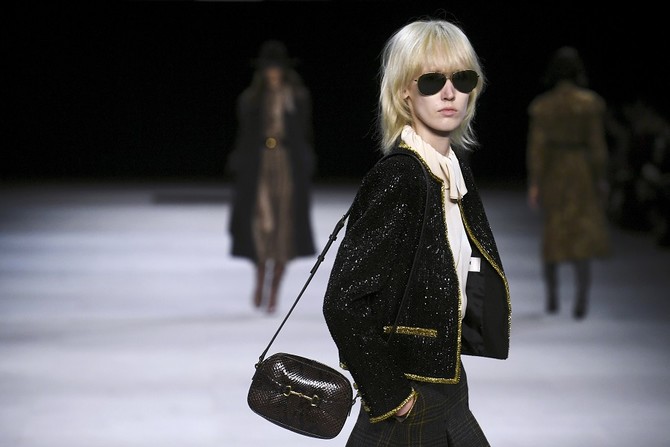
Hedi Slimane showed off his Fall/Winter 2019/2020 collection. AFP
Updated 02 March 2019
Follow

After outcry, Hedi Slimane U-turns on the Celine catwalk

PARIS: Head designer Hedi Slimane turned his back on black Friday in one of the biggest about-turns in years on the Paris catwalk, as French-Algerian actress Leila Bekhti enjoyed a coveted front row seat at the show.

The actress wore a suave menswear suit to the show, complete with a skinny black tie and loafers. 

The superstar French designer, who is of Tunisian descent and is famed for his love of black, was dubbed the “Trump of fashion” after trashing the legacy of his much-loved feminist predecessor at Celine, Phoebe Philo, in his first women’s show for the brand in Octobe, AFP reported.

Rather than the too-cool-for-school night owls of his “Paris at night” debut, Slimane went all bourgeois as he tried to double back toward Celine’s more romantic roots.

His new cool gang are a glammy 1980s horsey set, with pleated riding skirts in earthy browns, greens and taupes worn with long shiny boots.
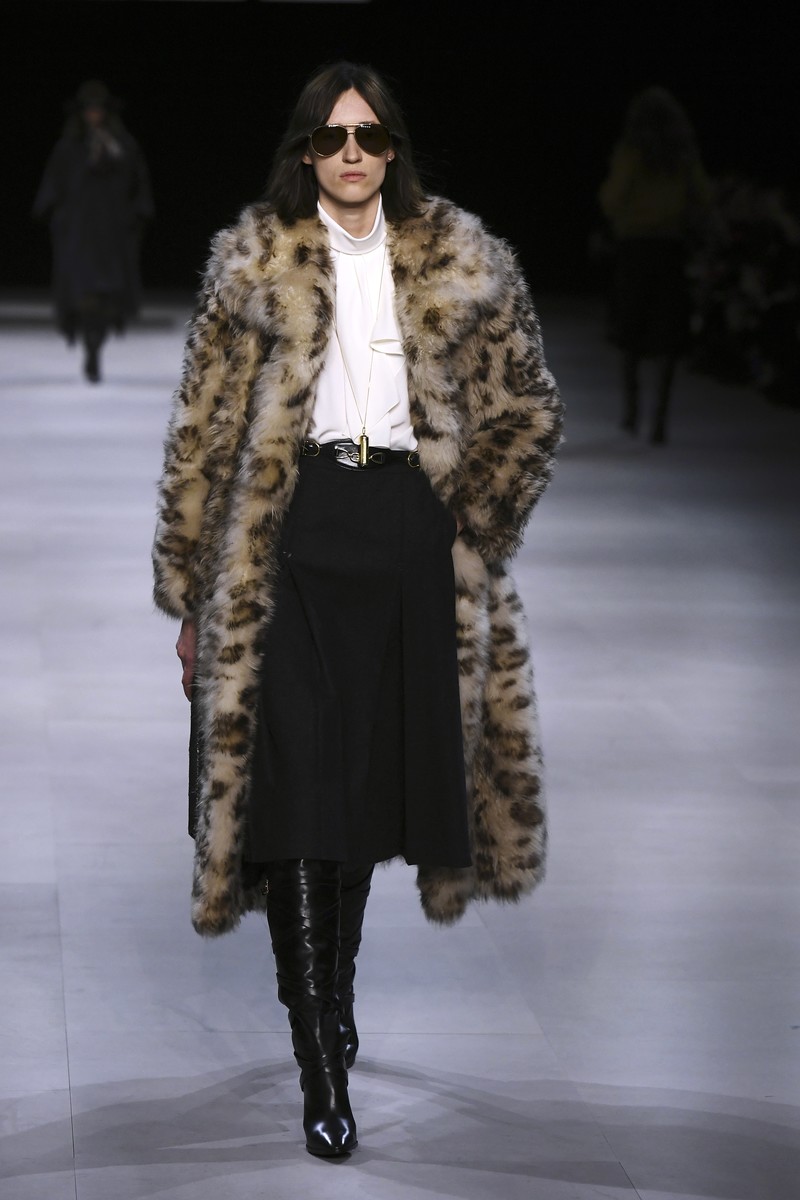
But the really big takeaway was the comeback of the culotte, with a whole cavalry charge of them galloping down the catwalk.

Surprising as that was, no one had predicted the return of silky pussy bow blouses worn under sensible coats and cardigans.

The man they once called the “Sultan of skinny” even got a few frilly blouses in too. All that was lacking was the pearls.

This embrace of romantic, comfortable country glamor, of the type that Hermes and others do rather well, left critics scratching their heads, with the New York Times’ Vanessa Friedman asking, “(The) joke’s on who?“

But for the fact that every model wore black sunglasses, it hardly looked like a Slimane show.

It also seemed strangely at odds with Slimane’s first media campaign for the house, which he released this week, featuring 17-year-old British model Hannah Motler.

Shot by Slimane itself, it was full of the dark rock ‘n’ roll glamor he is famous for.

Friedman, however, had no doubt that the oxblood shearling-edged thigh-high boots that Slimane teamed with jeans and camel coats and capes in the show were a winner.

“Betcha Celine is going to sell a lot of these boots,” she tweeted.
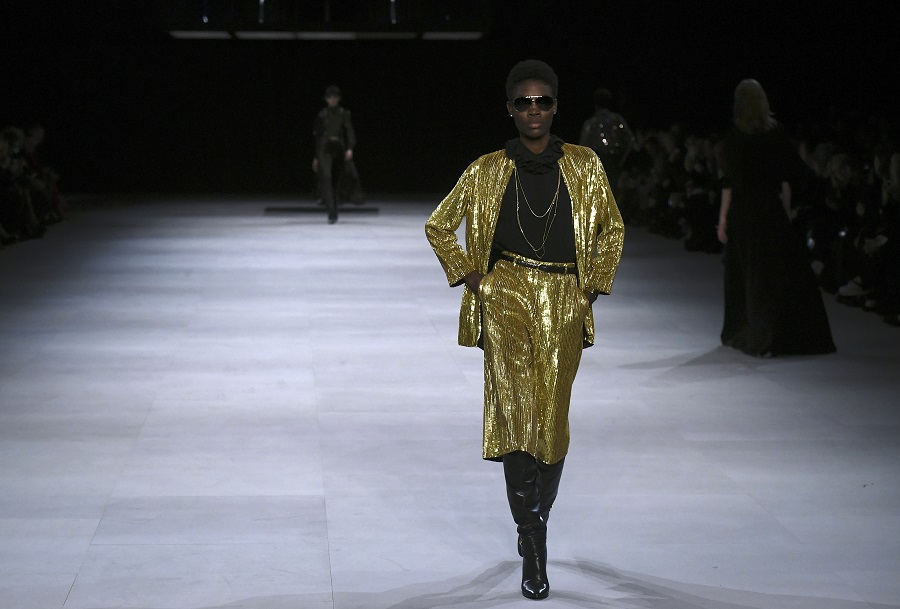
While there was some slight nods to the Philo’s legion of grieving followers — who have made her past Celine collections collector’s items — Slimane leapfrogged over her minimalism to go deep into the brand’s archives in search of inspiration.

His slash and burn attitude to the brand — getting rid of the French accent on its logo, calling his first show “Celine 01” as if the 70 years before his arrival at the label had not existed, and erasing Philo’s clothes from the label’s Instagram account, irritated many.

His first collection took an unprecedented kicking from English-speaking critics in particular, with social media spats between his defenders — the Slimaniacs — and Philo supporters, the Philophiles.

Slimane — who has a record of turning labels into cash cows — has form in ruffling feathers. He dropped the Yves from Saint Laurent when he took over at the iconic house in 2012.


Sotheby’s ‘Origins II’: Local heroes go under the hammer 

Updated 7 sec ago
Follow

Sotheby’s ‘Origins II’: Local heroes go under the hammer 

  • Regional highlights from Sotheby’s ‘Origins II’ auction, which takes place Jan. 31 in Diriyah 

DUBAI: Here are some of the regional highlights from Sotheby’s ‘Origins II’ auction, which takes place Jan. 31 in Diriyah.

Mohamed Siam 

‘Untitled (Camel Race)’ 

Siam is described by Sotheby’s as “one of the most significant voices of the Kingdom’s second generation of modern artists.” His “highly discernible visual aesthetic,” the auction catalogue states, references European cubists and Italian Futurism, using “multiple overlapping planes to create an endless sense of movement” — an approach that “fragments visual reality, enabling the viewer to experience multiple viewpoints simultaneously.” This work from the late 1980s “shrewdly captures through a fractured, shifting perspective two camel riders in an enthralling, head-to-head race.” It marks Siam’s auction debut and is expected to fetch between $70,000 and $90,000.  


Abdulhalim Radwi 

‘Untitled (Hajj Arafah)’ 

The Makkah-born artist is one of Saudi modernism’s most significant figures. His “multifaceted practice was shaped by a profound engagement with regional heritage and the evolving aesthetic currents of the 20th century,” the catalogue notes. This 1967 oil painting is hailed by Sotheby’s as “a vibrant example of Radwi’s practice (at the time), depicting a bustling arrangement of tented structures rendered in his characteristic Cubist-inflected idiom. The tightly interlocking forms, rhythmic repetitions, and cool, airy palette evoke the temporal architecture of the Hajj pilgrimage, distilled into a kaleidoscopic composition that celebrates the textures and visual poetry of life in Makkah.” 


Mohammed Al-Saleem 

‘Untitled’ 

Another of the Kingdom’s modern-art pioneers, Al-Saleem was born in 1939 in Al-Marat province. His work, Sotheby’s says, “is celebrated for its distinct visual language, a style which the artist coined ‘Horizonism.’ Drawing inspiration from the shifting sands and gradating skyline of Riyadh as seen from the desert, as well as the intensity of the Saudi sun, Al-Saleem reimagined his beloved landscape through the prism of abstraction.” In works such as this 1989 oil painting, he “replaced the traditional horizon line with stylized forms resembling organic forms and Arabic calligraphy … a fusion of modernist abstraction and cultural identity.” 


Taha Al-Sabban  

‘Untitled’ 

This mixed-media-on-canvas work from 2005 typifies the Makkah-born artist’s modernist approach, which, Sotheby’s states “has been described as both an act of conservation and a homage to the nature and culture of his homeland.” The artist “used expressive color and form to preserve local memory — palm groves, open waters, and traditional architecture — while transforming the traditional cityscape into ascending, abstracted rhythms.” His work is often described as “nostalgic,” but the Al-Sabban is quoted by the Al-Mansouria Foundation as saying: “Although I am acutely aware of the passage of time, my aim is not nostalgia; instead I seek to capture the moment and reveal the life in the world.” 


Zeinab Abd El-Hamid 


‘Untitled (Shisha Shop)’ 

This 1987 watercolor is the work of one of Egypt’s most significant female artists of the modern era who belonged, Sotheby’s says “to a generation of artists who came of age during the cultural reawakening that followed Egypt’s independence.” Abd El-Hamid, the catalogue states, “painted with a refined sensibility, grounded in her belief in humanity’s ability to transcend hardship. She did not seek to romanticize the past, but to distill its forms and emotions into something enduring. Her work carries a sense of nostalgia for a rhythm of life rooted in shared dignity and poetic structure … rooftops, cafés, and courtyards become vessels of memory, harmony, and inner light.” 


Samia Halaby 

‘Copper’ 

Central to the Palestinian artist’s practice was the belief that “abstraction, like any visual language, is shaped by social forces and reflects the movements of working people and revolutionary ideas,” Sotheby’s states. This 1976 oil painting combines Halaby’s exploration of the diagonal as “a dynamic formal element” and of the reflective properties of metals. The work “eschews traditional linear perspective in favor of a compositional strategy that flattens and destabilizes the viewer’s gaze. Halaby achieves a sense of spatial infinity — not through illusion, but through repetition and variation.” 


Mahmoud Sabri 

‘Demonstration’ 

The Iraqi painter’s career, Sotheby’s says, was unique among his peers in his homeland. “He simultaneously explored Arab and European cultures, studied the history of painting, and created his own unique art language and style.” That language arrived after this particular oil painting from the early Sixties, a time in which “Sabri often returned to the subject of revolutionary martyrdom and probably referring to the events of the 1963 coup d’état.” In the foreground, a group of women surround a bereaved mother, who is weeping for her murdered son.