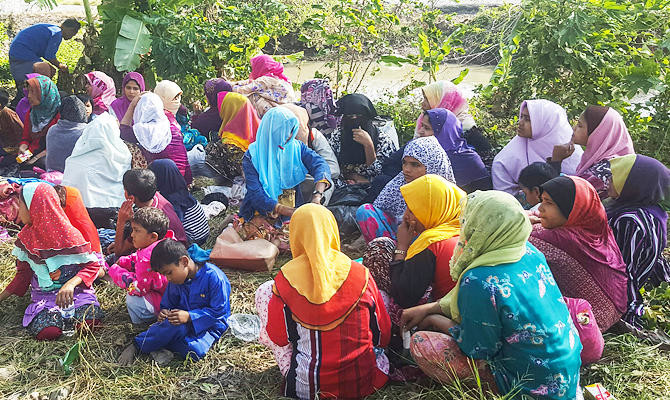
34 Rohingya women, children found stranded on Malaysia beach

1 / 2
Rohingya refugees, who landed on an isolated northern shore near the Malaysia-Thai border, huddle in a group in Kangar on March 1, 2019, following their detention by Malaysian immigration authorities. (AFP)
2 / 2
Rohingya refugees, who landed on an isolated northern shore near the Malaysia-Thai border, huddle in a group in Kangar on March 1, 2019, following their detention by Malaysian immigration authorities. (AFP)
Updated 02 March 2019
Follow

34 Rohingya women, children found stranded on Malaysia beach

  • The UN General Assembly approved a resolution in December condemning “gross human rights violations and abuses” against Myanmar’s Rohingya

KUALA LUMPUR, Malaysia: More than 30 Muslim Rohingya women and children were found stranded along a beach in Malaysia’s northernmost state, and are believed to have been dropped off by human traffickers, authorities said.
A police official in Kangar, the capital of northern Perlis state, said villagers early Friday found the 34 people, including nine children, weak, hungry and covered in mud as they made their way through the coast. A Myanmar welfare group said the group is believed to have been trafficked into Thailand from Bangladesh, before heading to Malaysia, whose dominant Malay Muslim population makes it a sympathetic destination.
More than 700,000 ethnic Rohingya have fled from Myanmar to Bangladesh since August 2017, when a group of militants attacked security forces, triggering a massive retaliation by Myanmar’s army. The exodus came after hundreds of thousands of other Rohingya escaped previous bouts of violence and persecution.
The police official, who declined to be identified due to the sensitivity of the issue, said they have been fed and handed over to immigration officials.
Nur Aziah Mohamad Shariff, an official with the National Security Council, said his office was aware of the illegal entry and is investigating.
Zafar Ahmad Ghani, who heads the Myanmar Ethnic Rohingya Human Rights Organization of Malaysia, said he obtained information that many more Rohingya are being tricked by traffickers into leaving Bangladesh after being warned they may face death if repatriated to Myanmar.
Pictures and videos obtained by members of the group showed a long rope placed across the shore at low tide to help the Rohingya walk through the mud.
Chris Lewa, founder of the Arakan Project, which works to improve conditions for Rohingya, said the women and children may be part of a large group that sailed from Bangladesh in two boats in mid-February. She said the total number of passengers was unclear, with estimates of about 150, and that it was unclear what happened to the others.
She said the Arakan Project spoke to a Rohingya man who landed in northern Malaysia in late February on a boat that had arrived undetected with 85 aboard.
Lewa said it was unclear why the women and children were stranded, and that the two boats were the only ones they knew had sailed from Bangladesh this year.
Most people in Buddhist-majority Myanmar don’t accept Rohingya Muslims as a native ethnic group. They are, instead, viewed as having migrated illegally from Bangladesh, though generations of Rohingya have lived in Myanmar.
Nearly all have been denied citizenship since 1982 and lack access to education and hospitals.
The UN General Assembly approved a resolution in December condemning “gross human rights violations and abuses” against Myanmar’s Rohingya.
Myanmar’s government denies claims of genocide and ethnic cleansing. The country rejects the UN investigators’ work and the General Assembly resolution as biased.


Only 4% women on ballot as Bangladesh prepares for post-Hasina vote

Updated 26 January 2026
Follow

Only 4% women on ballot as Bangladesh prepares for post-Hasina vote

  • Women PMs have ruled Bangladesh for over half of its independent history
  • For 2026 vote, only 20 out of 51 political parties nominated female candidates

DHAKA: As Bangladesh prepares for the first election since the ouster of its long-serving ex-prime minister Sheikh Hasina, only 4 percent of the registered candidates are women, as more than half of the political parties did not field female candidates.

The vote on Feb. 12 will bring in new leadership after an 18-month rule of the caretaker administration that took control following the student-led uprising that ended 15 years in power of Hasina’s Awami League party.

Nearly 128 million Bangladeshis will head to the polls, but while more than 62 million of them are women, the percentage of female candidates in the race is incomparably lower, despite last year’s consensus reached by political parties to have at least 5 percent women on their lists.

According to the Election Commission, among 1,981 candidates only 81 are women, in a country that in its 54 years of independence had for 32 years been led by women prime ministers — Hasina and her late rival Khaleda Zia.

According to Dr. Rasheda Rawnak Khan from the Department of Anthropology at Dhaka University, women’s political participation was neither reflected by the rule of Hasina nor Zia.

“Bangladesh has had women rulers, not women’s rule,” Khan told Arab News. “The structure of party politics in Bangladesh is deeply patriarchal.”

Only 20 out of 51 political parties nominated female candidates for the 2026 vote. Percentage-wise, the Bangladesh Socialist Party was leading with nine women, or 34 percent of its candidates.

The election’s main contender, the Bangladesh Nationalist Party, whose former leader Zia in 1991 became the second woman prime minister of a predominantly Muslim nation — after Pakistan’s Benazir Bhutto — was the party that last year put forward the 5 percent quota for women.

For the upcoming vote, however, it ended up nominating only 10 women, or 3.5 percent of its 288 candidates.

The second-largest party, Jamaat-e-Islami, has not nominated a single woman.

The 4 percent participation is lower than in the previous election in 2024, when it was slightly above 5 percent, but there was no decreasing trend. In 2019, the rate was 5.9 percent, and 4 percent in 2014.

“We have not seen any independent women’s political movement or institutional activities earlier, from where women could now participate in the election independently,” Khan said.

“Real political participation is different and difficult as well in this patriarchal society, where we need to establish internal party democracy, protection from political violence, ensure direct election, and cultural shifts around female leadership.”

While the 2024 student-led uprising featured a prominent presence of women activists, Election Commission data shows that this has not translated into their political participation, with very few women contesting the upcoming polls.

“In the student movement, women were recruited because they were useful, presentable for rallies and protests both on campus and in the field of political legitimacy. Women were kept at the forefront for exhibiting some sort of ‘inclusive’ images to the media and the people,” Khan said.

“To become a candidate in the general election, one needs to have a powerful mentor, money, muscle power, control over party people, activists, and locals. Within the male-dominated networks, it’s very difficult for women to get all these things.”