KARACHI: The 12th edition of the International Garments and Textile Machinery Exhibition and Conference (IGATEX) Pakistan, kicked off in Karachi on Tuesday, despite reports of India violating Pakistan’s airspace headlining major news topics across the country.
With 37 countries participating in the exhibition, Dr. Mirza Ikhtiar Beg, acting president of the Federation of Pakistan Chambers of Commerce and Industry (FPCCI), inaugurated the event at the Expo Center in Karachi, where he also condemned the incident.
“India has violated Pakistan’s airspace. They wanted to exhibit that their craziness has not yet subsided despite Pakistan’s measures. We sent Ramesh Kumar [a Pakistani lawmaker] with a clear message of Prime Minister Imran Khan and he met with the foreign minister of India and PM Modi. We have taken some measures on our own after a national security council meeting,” Dr. Beg said.
“Against any aggression Pakistan’s business community and people are on the same page. The violation shows the frustration of Indian Prime Minister Modi who is suffering from war hysteria,” he added.
The escalating tension between the two countries follows a suicide attack on February 14 --- in the Pulwama district of Indian-administered Kashmir --- which resulted in the deaths of more than 40 paramilitary troops. India blames Pakistan for the attack. Pakistan has denied the allegations.
Soon after the Pulwama incident, India had slapped restrictions on all imports and exports with Pakistan, which included a ban on vegetables too. “Our policy statement is that $2.3 billion bilateral trade betwen Pakistan and India takes place, out of which Pakistan’s exports are only $485 million while the rest $1.8 billion is of India. If business activities get hurt it would be India who will suffer more than Pakistan. They have bigger stakes,” Dr. Beg said
He added that following the restrictions, they would have to gauge whether “we can afford to trade with such an aggressive neighbor or we need to develop import substitutes especially cotton which we import from India.”
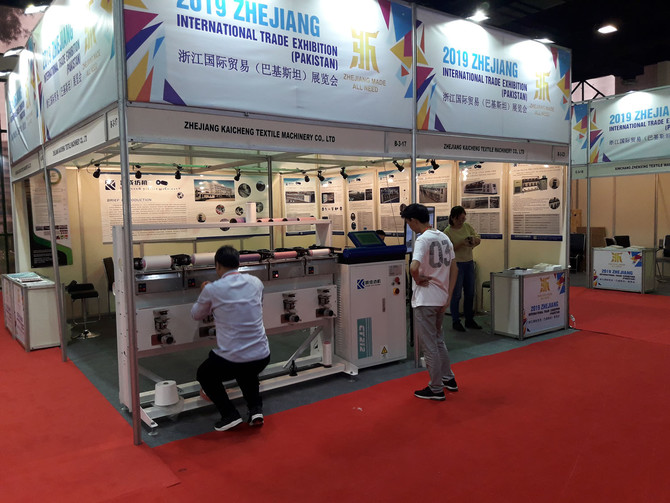
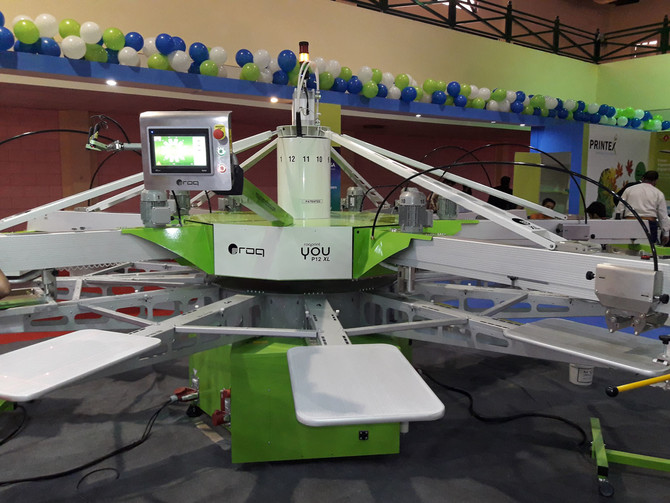
With the launch of the textile exhibition, organizers expect a footfall of more than 20,000 visitors during the three days of the event where nearly 500 companies are showcasing their products.
Turkey and China have a strong presence at the exhibition. Apart from Germany, Japan and Italy, organizers said “other countries are also taking Pakistan as an emerging market. All leading brands of textile products are participating in the exhibition.”
Meanwhile, foreign participants said that they hoped to incur better deals during the exhibition considering the fact that Pakistan was a growing textile market. “I feel safe while traveling to Pakistan. It has changed quite a lot in the last five years. The Pakistani industry is growing and it is changing, it is bringing in better technology and people are getting more educated,” Olivier Dessouslay, area sales manager of Schärer Schweiter Mettler (SSM) AG, Switzerland, told Arab News.
Turkish participants, for their part, were jubilant as they expected a further boost in trade ties during the upcoming visit of Turkish President Recep Tayyip Erdogan to the country. “We are participating in the exhibition for the last 10 years. [With the arrival of the president]...the two countries will be more familiar in the future and Pakistan’s textile market will grow as we will have good partnership in various sectors. We feel at home,” Emre Hasbay, a representative of the Turkish company Has Group Makina Endustri A.S., said.
China, too, has overwhelmingly participated in the exhibition with representatives saying that they hoped for the textile sector to grow in the backdrop of the ongoing China Pakistan Economic Corridor (CPEC) projects. “We always concentrate on the Pakistani market. It is our traditional market for the last 30 years as our company started exporting machines to Pakistan in the 1980s. The CPEC is a great initiative.... We hope that Pakistan’s textile sector will grow rapidly in the coming years,” Qu Zhenjie, chief representative of the China Texmatech Company in Thailand, told Arab New.
Other participants said that with the improved law and order situation in the country, major nations are considering Pakistan as a potential investment destination. Additionally, recent investment deals worth $21 billion signed by Saudi Arabia has created the impression that Pakistan is no longer an unsafe option for foreign investment.


![]()
![]()
![]()
![]()
![]()

Mega international textile exhibition begins in Karachi despite trade ban by India


Mega international textile exhibition begins in Karachi despite trade ban by India
- By imposing restrictions, New Delhi will suffer more than Islamabad, FPCCI official says
- Pakistan is emerging as a major market in the region, foreign participants say
Latest updates


© 2026 SAUDI RESEARCH & PUBLISHING COMPANY, All Rights Reserved And subject to Terms of Use Agreement.