

Japanese spacecraft touches down on asteroid to get samples

1 / 2
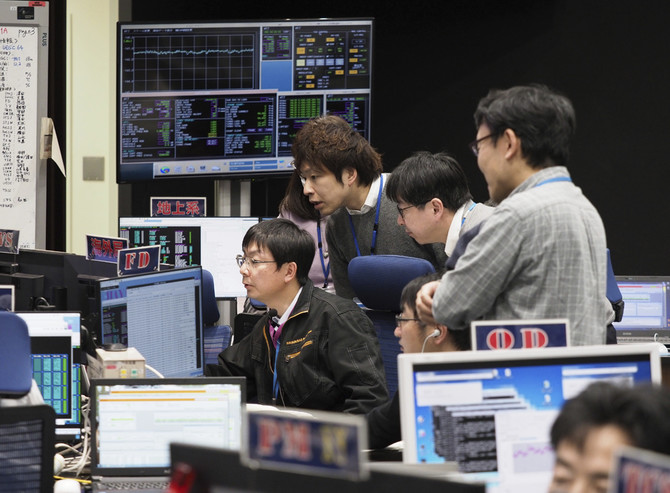
Staff of the Hayabusa2 Project watch monitors for a safety check at the control room of the JAXA Institute of Space and Astronautical Science in Sagamihara, near Tokyo, on Feb. 21, 2019. (ISAS/JAXA via AP)
2 / 2
This Oct. 25, 2018, image provided by the Japan Aerospace Exploration Agency (JAXA) shows asteroid Ryugu. (JAXA via AP)
Updated 22 February 2019
Follow

Japanese spacecraft touches down on asteroid to get samples

  • Probe to fire a “bullet” into the asteroid’s surface to stir up surface matter, which the probe will then collect for analysis back on Earth
  • Scientists hope the samples may provide answers to some fundamental questions about life and the universe

TOKYO: A Japanese spacecraft touched down on a distant asteroid Friday on a mission to collect material that could provide clues to the origin of the solar system and life on Earth.
Workers at the Japan Aerospace Exploration Agency (JAXA) control center applauded Friday as a signal sent from space indicated the Hayabusa2 spacecraft had touched down.
During the touchdown, Hayabusa2 is programmed to extend a pipe and shoot a pinball-like object into the asteroid to blow up material from beneath the surface. If that succeeds, the craft would then collect samples to eventually be sent back to Earth. Three such touchdowns are planned.
Japanese Education Minister Masahiko Shibayama said the space agency had concluded from its data after the first touchdown that the steps to collect samples were performed successfully.
JAXA, as the Japanese space agency is known, has likened the touchdown attempts to trying to land on a baseball mound from the spacecraft’s operating location of 20 kilometers (12 miles) above the asteroid.

Scientists hope the samples may provide answers to some fundamental questions about life and the universe, including whether elements from space helped give rise to life on Earth.

The asteroid, named Ryugu after an undersea palace in a Japanese folktale, is about 900 meters (3,000 feet) in diameter and 280 million kilometers (170 million miles) from Earth. It is thought to contain relatively large amounts of organic matter and water from some 4.6 billion years ago when the solar system was born.


UN’s top court opens Myanmar Rohingya genocide case

Updated 14 min 8 sec ago
Follow

UN’s top court opens Myanmar Rohingya genocide case

  • The Gambia filed a case against Myanmar at the UN’s top court in 2019
  • Verdict expected to impact Israel’s genocide case over war on Gaza

DHAKA: The International Court of Justice on Monday opened a landmark case accusing Myanmar of genocide against its mostly Muslim Rohingya minority.

The Gambia filed a case against Myanmar at the UN’s top court in 2019, two years after a military offensive forced hundreds of thousands of Rohingya from their homes into neighboring Bangladesh.

The hearings will last three weeks and conclude on Jan. 29.

“The ICJ must secure justice for the persecuted Rohingya. This process should not take much longer, as we all know that justice delayed is justice denied,” said Asma Begum, who has been living in the Kutupalong refugee camp in Bangladesh’s Cox’s Bazar district since 2017.

A mostly Muslim ethnic minority, the Rohingya have lived for centuries in Myanmar’s western Rakhine state but were stripped of their citizenship in the 1980s and have faced systemic persecution ever since.

In 2017 alone, some 750,000 of them fled military atrocities and crossed to Bangladesh, in what the UN has called a textbook case of ethnic cleansing by Myanmar.

Today, about 1.3 million Rohingya shelter in 33 camps in Cox’s Bazar, turning the coastal district into the world’s largest refugee settlement.

“We experienced horrific acts such as arson, killings and rape in 2017, and fled to Bangladesh,” Begum told Arab News.

“I believe the ICJ verdict will pave the way for our repatriation to our homeland. The world should not forget us.”

A UN fact-finding mission has concluded that the Myanmar 2017 offensive included “genocidal acts” — an accusation rejected by Myanmar, which said it was a “clearance operation” against militants.

Now, there is hope for justice and a new future for those who have been displaced for years.

“We also have the right to live with dignity. I want to return to my homeland and live the rest of my life in my ancestral land. My children will reconnect with their roots and be able to build their own future,” said Syed Ahmed, who fled Myanmar in 2017 and has since been raising his four children in the Kutupalong camp.

“Despite the delay, I am optimistic that the perpetrators will be held accountable through the ICJ verdict. It will set a strong precedent for the world.”

The Myanmar trial is the first genocide case in more than a decade to be taken up by the ICJ. The outcome will also impact the genocide case that Israel is facing over its war on Gaza.

“The momentum of this case at the ICJ will send a strong message to all those (places) around the world where crimes against humanity have been committed,” Nur Khan, a Bangladeshi lawyer and human rights activist, told Arab News.

“The ICJ will play a significant role in ensuring justice regarding accusations of genocide in other parts of the world, such as the genocide and crimes against humanity committed by Israel against the people of Gaza.”