


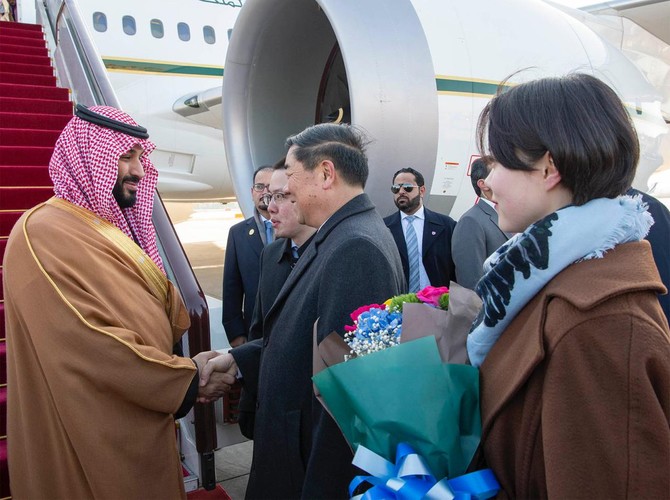
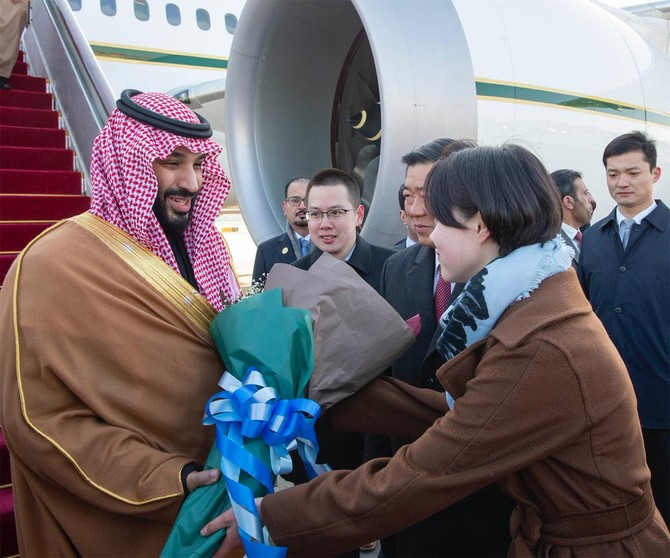

BEIJING: China and Saudi Arabia agreed on Thursday to further boost financial cooperation as Crown Prince Mohammed bin Salman arrived in Beijing on the final leg of his Asia tour.
The crown prince was due to meet President Xi Jinping in Beijing. Later he was expected to join Chinese Vice Premier Han Zheng to co-chair the third meeting of the China-Saudi Arabia High-Level Joint Committee.
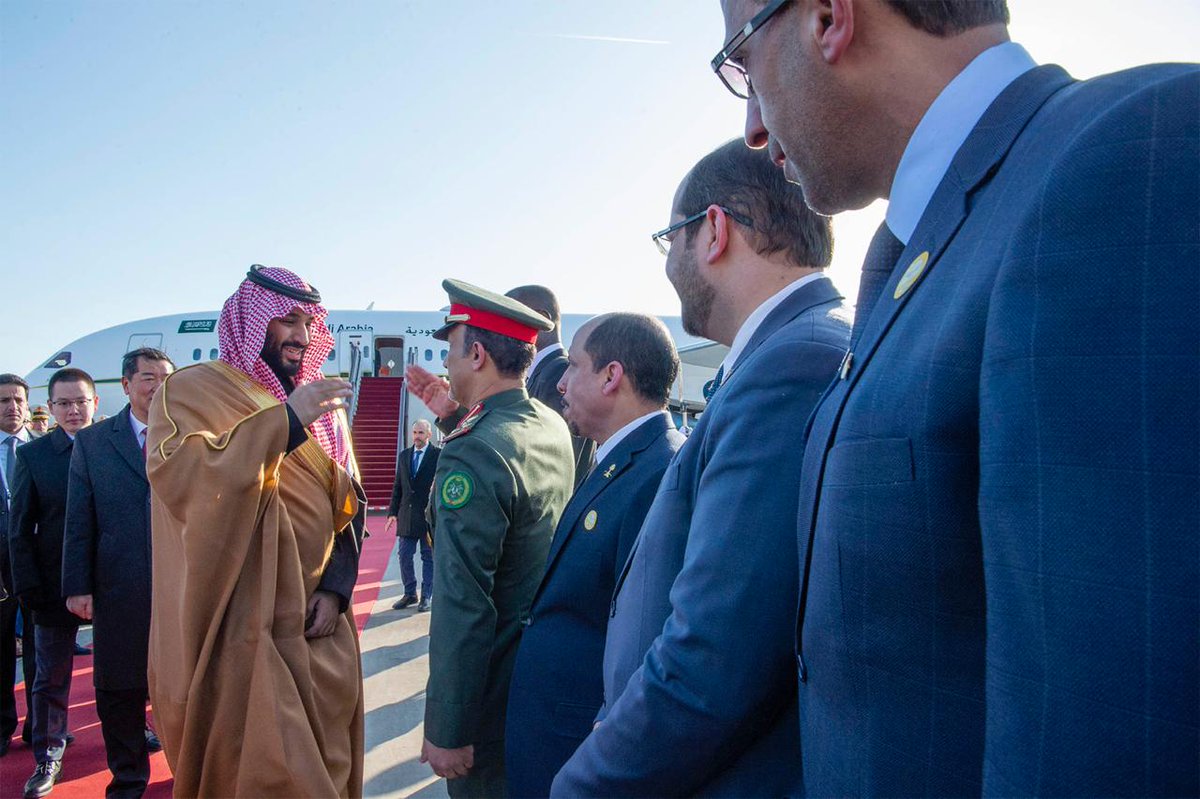
At the airport, the crown prince was greeted by a number of Chinese officials, including Khi Li Fung, Deputy Chairman of the Advisory and Political Council of the People's Republic of China, and Chinese Ambassador to the Kingdom Li Huaxin.
The crown prince visited the Great Wall of China on Thursday, where he posed for photos and took in the dramtic scenery.
Among the most striking initiatives agreed by the two countries is a plan to develop greater integration between China’s Belt and Road development strategy and the Saudi Vision 2030 reform program.
Support for a multilateral approach to development and greater policy communication were agreed at a meeting of a financial subcommittee, jointly chaired by Chinese Vice Finance Minister Zou Jiayi and her Saudi counterpart Hamad Al-Bazai.
Leading academics and literary talents from #SaudiArabia and #China will be honored under an award scheme sponsored by Crown Prince Mohammed bin Salman #CrownPrinceinChinahttps://t.co/YMmRcXz3Si pic.twitter.com/4vQPRCAFFc
— Arab News (@arabnews) February 21, 2019
Meanwhile, more than 25 Saudi government and private companies will launch their products and services at a major investment forum held in conjunction with the crown prince’s visit.
“Invest in Saudi Arabia,” organized by the Saudi Arabian General Investment Authority and the Saudi Center for International Strategic Partnerships, will take place at the Sino-Saudi Forum in Beijing on Friday.
The investment forum will promote closer economic ties in sectors including industry, energy, transport, finance, culture, heritage and agriculture.
More than 1,000 visitors, including leading investors, decision makers and investment companies, will focus on business links between the Kingdom and China, with partnerships and agreements likely to be agreed in several fields.
Other initiatives signed off by the Saudi and Chinese delegations include support for reform of the World Bank and the International Monetary Fund, and backing for new multilateral development institutions, such as the Asian Infrastructure Investment Bank.
In a separate meeting, Chinese Foreign Minister Wang Yi and Saudi Minister of State for Foreign Affairs Adel Al-Jubeir hailed the rapid growth of cooperation and mutual understanding between the two countries.
Saudi Energy Minister Khalid Al-Falih also said the crown prince’s visit will lift bilateral relations to a “new high.”
As the Kingdom’s largest trading partner, “China is climbing the ladder very quickly with its technology, capabilities and exports in the world,” Al-Falih said.
“This major investment is just starting,” Al-Falih said. “Saudi Arabia has a lot of capital that needs to find profitable places to be deployed. China is a great place to invest.”
The Saudi minister expressed confidence in planned integration between Vision 2030 and China’s Belt and Road Initiative (BRI).


